Facebook wants to get in on the currency business. They are creating a new form of digital payment called Libra and calling it a cryptocurrency. It isn’t really, but it relies on the same technology, the blockchain. A blockchain is a software product—a bunch of computer code that enables a task. In this case the creation and maintenance of a ledger, or record-keeping system.
Blockchains are appealing because they rely on a distributed network of nodes and users. They are decentralized and thus theoretically more secure and more robust than any one particular data location. At least that’s what the computer geniuses say, and I’m not here to argue with them.
The Libra blockchain will be run by a non-profit composed of a lot of fancy folks. Here’s a nice graphic about it:
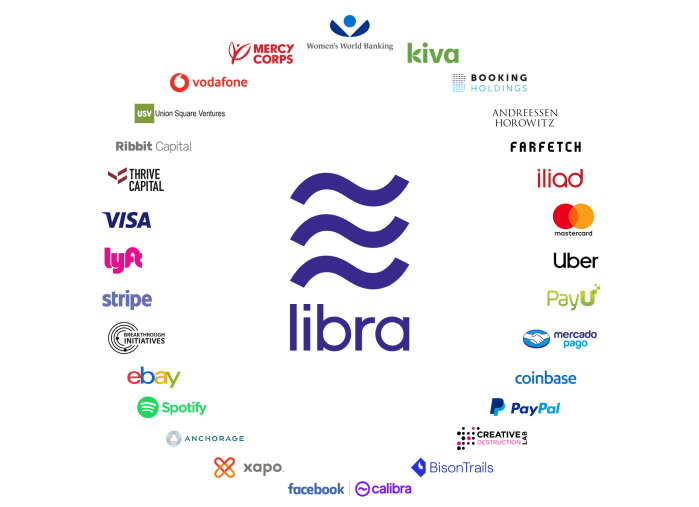
The wiggly-wavey thing is the symbol for Libra currency. Users of Libra will get a sort of PayPal on steroids. They will have a digital wallet and they can pay for things (and/or receive payment) wherever they have access to the wallet, be it on a computer or smartphone. If you have an internet connection you have a payment system. Libra’s goal is to be worldwide. You buy Libra with your local currency and get an equivalent amount of digital money, and since it is digital it can be moved around and transacted more readily than ordinary currency. And you avoid the payment of transaction fees like with credit cards (there are fees, just vanishingly small to the ordinary user).
You can’t make money with Libra. It is just a platform, and you can’t earn interest on your deposits in your digital wallet. But the whole thing is a money-making strategy for its investors. You got an extra ten million bucks? You can be one, too. People who invest ten million US dollars expect a return. And the Libra Investment Token will give them that. The more people who use Libra the more these investors will make, kind of like the old-fashioned pyramid schemes.
Libra is not a cryptocurrency like Bitcoin because Bitcoin derives its value from the underlying blockchain technology itself. People crunch numbers with computers to support the blockchain cryptography and they get paid in Bitcoin. Libra is more like a traditional investment. The Libra Association will invest in fiat currencies, government bonds, and other securities to guarantee a stable value for Libra. In that sense it is more like an ETF than a cryptocurrency. Due to the volatility of things like Bitcoin a market has emerged for what are known as stablecoins which are tied to real-world assets like commodities. Libra is closer to that.
Users of Libra coin gain access and convenience. For people who don’t use banks, this could be a real boon. Libra Investment Token holders will get rich, very rich, even if only a small percentage of Facebook’s user base of over two billion people participate.
And what does Facebook get out of all this? You won’t need a Facebook account to use Libra, and Facebook’s digital wallet, called Calibra, won’t require one either. Mark Zuckerberg will tell you it is about serving the under-served in the world financial marketplace, which is all very nice, but ultimately this is a for-profit company.
A digital platform is a digital platform. If people use it, you can use that platform to sell other products and services. I assume Facebook’s leap into new forms of currency is another version of their current business model.
Software is famous for bugs. And also for being marketed well before it is bug-free. Just look at the Boeing 737-MAX tragedies to see the consequences of that. I’m not going to put my money in a Libra coin/Calibra wallet just yet, but I won’t be surprised if we all have something like that in the very near future.



 Mark C. O'Connor