Choke point

The COVID-19 pandemic is making us aware of some serious problems with our supply chains. Toilet paper, hand sanitizers, and iso-propyl alcohol are still hard to find on store shelves. Personal protective equipment shortages have been felt by everyone. Potato farmers, losing their huge commercial market with restaurants, bars, and cafeterias shut down, have given away or dumped their crop. Dairy farms are pouring out milk they would normally have delivered to schools. The international market for crude oil collapsed and created a storage shortage, forcing producers to pay people to take the stuff off their hands.

And those are just a few examples.

I’m not informed enough about the global supply chain to make judgments. I’m not looking to point fingers, unless it is squarely back at me and you. We want all this stuff and we depend on a goofy global mess to make it work. I’m amazed it works at all! One factory in China, for example, could make a part needed by several industries all over the world and if that factory shut down all of those businesses would be impacted. Another example is the consolidation of the meat-packing business here in the States. It’s more efficient but the food supply is more vulnerable. When plants closed due to sick workers stores ran out of meat. Big chunks of our economy depend on systems that have real bottlenecks. If something plugs up that bottleneck everyone downstream gets hurt.

If you read naval history (like A.T. Mahan, for example) they always talk about choke points. A choke point is a narrow passage, like a strait, or an entrance to a bay, that could be defended by a relatively small force. Control of the choke point could thwart a superior enemy’s plans by closing off their access to your waters. The land equivalent would be the Spartans defending the pass at Thermopylae.

Our intertwined global economy is full of bottlenecks and choke points. Clearly we have to become more robust, with multiple sources for raw materials and other products. Industries have to plan better for disruptions and be more flexible.

You can get a great picture of the long and narrow threads that hold our world together at vesselfinder.com. You can zoom in on any part of the globe and pick out a ship. You can see Liberian oil tankers, Singaporean bulk carriers, and Maltese container ships plying the sea lanes in real time. Or check out flightradar24.com and find a plane. Did you know a large amount of cargo is delivered by passenger jet? When flights were cut it lead to delays and shortages. Look overhead and track down that contrail. For me it’s probably the Los Angeles (LAX) to Portland (PDX) run.

We are all knitted together by marine diesels and aircraft gas turbine engines! Not to mention the ribbons of asphalt and concrete that snake across our lands, and the motors of all sorts that power the rubber-tired beasts that prowl them. Like I said, I’m amazed it works as well as it does. People don’t seem to be that organized, but somehow they get this whole thing to hold together, even in a pandemic.

Thank goodness.


Thrash, Doom, or Death?

Here are some awesome lyrics for a heavy metal song called Oh I Fear! All I need now is some bad-ass double-kick bass drum lines, thermonuclear guitar riffs, and alien mutant screaming vocals. It will be a hit, I know it. Here it is:

Oh I Fear

Verse 1

Oh I fear

With the devil in my mind

My heart’s in flames I pray for nothing

My lungs filled with smoke

Oh oh oh my heart is aflame

Oh I fear

Chorus

With the Devil in my mind

I feel his arms around my neck

He caresses all my flesh

My veins full of blood

Verse 2

And I can feel no light

Oh oh oh my heart is aflame

Oh I fear

As my heart is burning

Oh oh oh I fear

With the devil in my mind

Chorus

With the Devil in my mind

I feel his arms around my neck

He caresses all my flesh

My veins full of blood


I didn’t actually write these lyrics. No one did. Or, everyone did. There’s a website called Bored Humans that uses AI (artificial intelligence) to create passable fakes of human creations like songs and stories. These programs pick out text from millions of web pages and use machine learning to figure out what to write. I’ve always wanted to write a heavy metal song. This will have to do.

Oh, you should really check out the computer-generated (by competing neural networks) paintings. Here’s one that will make a dandy heavy metal album cover:

hm album cover


I’m calling my band Dagon’s Minions and I’m titling the album The Abyss. I’ll use blood-red Olde English script stamped in an angry diagonal across the front of this bitchin’ art. On the back will be pictures of the band flipping off shocked school teachers.

Whaddya think?

Heapin’ piles o’shite

That’s what I’m reading about these days. Infrastructure fascinates me. How do we move all the stuff we move from place to place? How do we store all that stuff and process it? How do we get rid of it when it becomes a nuisance? How do we get more of it?

Stuff is the most important subject. I’ve long lamented the lack of good Stuff Management courses at the high school and college level. Living here in the States even those near the bottom of our economic pyramid can accumulate one hell of a lot of stuff.

And that’s the stuff we make outside of our bodies. What about all that stuff we make inside of our bodies? You know, shit. How do we deal with all the shit we generate each day? Seven billion people you have to figure seven billion turds per day and that’s not including the two-a-day types, the dogs and cats, the cows and chickens, you get the idea it’s a hell of a lot.

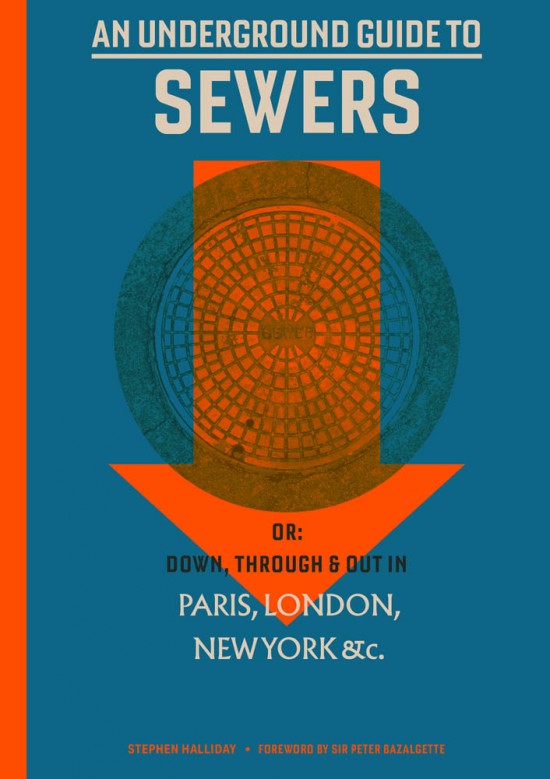
This book An Underground Guide to Sewers by Stephen Halliday plunges into the subject of shit removal. There’s a lot of pictures, and they are all really cool, but other than the occasional fatberg there are no pictures of shit. Instead you get pictures of the remarkable and beautiful structures people created to deal with their shit over the centuries. The subtitle of the book is Down, Through & Out In Paris, London, New York &c. so you get a lot about those cities in particular. (Note the very British ampersand-c. instead of our preference in the States for etc.)

book cover


My dad was a plumber and pipe fitter so I have an appreciation for things like drains, sewers, pipelines, pumps, valves, and whatnot. Toilets, too. How can you not appreciate the toilet? Think about what a remarkable societal advance that is! Now think about the fact that millions of people in the world still shit outside.

Proper disposal of urban sewage is an enormous engineering task. But it is largely hidden from us. In fact the only time we think about it is if the toilet backs up and we have to call the plumber. After that it is out of sight, out of mind. That’s OK, of course. But be glad we have folks who keep that vast network of underground things working so that our shit keeps flowing.