On to 2021

Several months ago we learned that SARS-CoV-2 is more infectious than the flu. Roughly twice as infectious, in fact.

That hasn’t changed.

Several months ago we learned that the disease caused by this novel coronavirus, called COVID-19, is at least ten times deadlier than the flu.

That hasn’t changed.

Several months ago we learned that your chance of getting infected with the coronavirus was directly proportional to the number of people you got within six feet of, particularly indoors, and particularly for any extended time. “Two meters, two minutes” was a good mantra.

That hasn’t changed.

2020 comes to an end this evening and we are all looking forward to 2021. In the meantime there have been about 20 million infections in this country. With roughly 340 million residents, that’s (20/340 = 0.059) just under six percent of the population.

Six percent is A LOT. Here in Siskiyou county there have been 1,000 infections in 44,000 people for a rate of (1/44 = 0.023) just over two percent. We are luckier here, but two percent is still A LOT.

The virus has killed over 340,000 Americans. That’s 1 in 1,000. That is not a happy number.

2021 brings hope with the emergence of several apparently quite effective vaccines. This is an exceptional achievement. Advances in virology, genetics, and molecular biology over the last two decades have paid off in spectacular fashion. I for one am eager to participate in this great experiment. All medical advances, no matter how well tested in advance, are experiments. This particular experiment has an excellent chance of stunning success, however. The evidence is good, and it should give us confidence in the process. The people creating these vaccines know what they are doing!

So, that’s a nice change. We know what hasn’t changed: SARS-CoV-2 is twice as infectious as the flu, COVID-19 is at least ten times deadlier than the flu, and your chances of getting the coronavirus depend on the number and intensity of your contacts with other people. The virus spreads by respiratory droplets from breathing, coughing, talking, sneezing, singing, etc. That’s why mask-wearing works to reduce the spread. That fact hasn’t changed, either, even though folks are still arguing about it.

I like to look ahead. Lots of things don’t change, but some do. I hope I can get the vaccine soon, but even more, I hope those folks who really need to be protected get it first. I’m 61 and in good health. I’m retired and have a comfortable and safe place to be. I can wait, even if I don’t want to. Too many other people have to be out there facing the public, and I mean literally face-to-face, and they should certainly be ahead of me in line. There are almost 50 million Americans who are over 65—they get to cut in front, too.

I think there will be many lasting changes from this pandemic. I know we like to focus on “getting back to normal” and I understand that desire. I’m more interested in the changes that will happen, and in the ones that might happen because we now have some opportunities that didn’t exist before. We hear tech entrepreneurs bragging all the time about being “disruptors” in the marketplace. Worse, they go around defending themselves with a twisted appeal to capitalist virtue, as if making a killing puts you on a moral high ground. Innovation is fine, I’m all for it, but just because something is new and different (and makes you rich) doesn’t mean it is necessarily good for society.

Mother Nature provided us all with a big disruptor in 2020. What shall we make of it? Good things, I hope.

In the meantime, take care and stay safe.

Have a happy and prosperous 2021!
Ski season!

The ski area on Mt Ashland was busy today, as one would expect on a Saturday after Christmas. It’s a violation of my retirement rules to go anywhere on a weekend or a holiday, but the lure of fresh powder was just too great. I’d rather ski mid-week and outside of the vacation calendar but sometimes you just have to strap it on and go.

My ski partner and I spent most of our time on the mountain waiting in the long, slow lift lines but when we did ski we found plenty of good snow. Mt Ashland on a powder day is something to behold—it is like a plague of locusts. The mountainside gets carved up pretty quickly! There are many powder-skiing enthusiasts in the Rogue Valley.

Mt Ashland is a funny place. The worst weather is usually on the road up the mountain and in the parking lot. We were lucky to have a reasonably easy drive. I hit a patch of ice about three-quarters of the way up and got a bit of fishtail action but I was able to steer on and stay in control. The wind was howling and the snow was blowing when we were gearing up but once we skied down to the lift line it got better. You don’t ski down the hill from the parking lot in many ski areas. Most of them require you to clamber up to a chairlift, but at Mt A you get a nice little run in before you load.

Skiing is something that ought to work in a pandemic. You spend most of your time outside and you try real hard to avoid other skiers! The lift lines are bit of a problem as people tend to crowd together when queuing up for things, but it can be done. Mt A’s employees did a good job encouraging people to keep their distance from each other. Almost everyone was masked and the lift operators, for the most part, kept after people to stay masked. Face coverings are pretty common at ski parks, as you can imagine, but I for one rarely cover my mouth when I’m skiing so I had to come up with a solution. It worked, mostly. I could stay covered but it took too much fussing so I’ll have to improve on that. Skiing is a gear-intensive activity so solving gear issues is part of the fun.

In March my ski buddy and I were in Tahoe hoping to catch some freshies at Alpine Meadows. Alas, things were shut down and we never got on the slopes. In fact, we had a bit of a harrowing road trip back home! That was the last time we tried to ski so being able to click it in this morning felt great.

We are at the mercy of the weather gods. Do your snow dances, people!

I’ll keep you posted on any further alpine outings.

Portable power

When you are far from the electricity grid and you need electric power what do you do? Typically, you use a generator. Those usually run on diesel, or gasoline, or even bottled gas like propane. These days you can get portable solar arrays that can be used in remote applications, but these depend not only on the weather but on good energy storage, by which I mean batteries. Solar and wind power both have the dreaded “intermittency” issue, that is, they can’t guarantee the lights will be on 24/7. This is why battery research is so big right now. With proper storage technology renewables can indeed replace fossil fuels in many applications. A good example is the electric car—the batteries are now robust enough that an EV can fulfill most driving needs.

The electric grid here in the West depends on big power plants. They burn natural gas, mostly, some still burn coal, and a bunch are hydroelectric. The big plants provide grid stability and make it possible for spikes in demand to be met at any time. This is good news for folks in cities and living and working in places that are close to transmission lines.

But imagine a remote mine. Or a community above the Arctic Circle. In the first case the energy needs might be quite large. In the second case the winter sun might not be sufficient for solar generation. Fossil fuels are noisy, messy, smelly, polluting, not all that efficient, and costly to transport. What might work instead?

How about a small nuclear reactor? Not the kind you might find in a generating station. Those things are huge and meant to stay in one place. What if the reactor could fit in a shipping container? Or better yet, the back of a pickup truck?

It sounds like sci-fi, but it is not. There is genuine interest in this idea, not to mention several companies and countries developing applications. Up in Oregon we have NuScale, which makes SMRs (small modular reactors) that can be deployed singly or in clusters depending on the power needs. The reactor designs are new, but the technology is not. My father-in-law spent a year at Oak Ridge National Lab in the 1950s learning how to build nuclear power plants. These things are older than I am!

Nuclear power is increasingly falling out of favor with the general public, mostly due to the infamous events at Chernobyl and Fukushima. The result, though, is not that nuclear power will fade away, but will instead become more dispersed.

Batteries used to be big, ugly things filled with nasty chemicals that were dangerous to work around. Later they got miniaturized and now we drive around with them in our automobiles. Tiny ones power our phones which we carry in our pockets. Even tinier ones power things inside of us like pacemakers. You can get wall-mounted picnic cooler-sized batteries from an outfit like Tesla that you stick in your garage, charge with PV panels, and keep as a backup for your home needs. Batteries are just another piece of furniture!

Motors used to be big, ugly things filled with nasty chemicals that were dangerous to work around. Now we’ve got them in everything from scooters to semi-trucks. We bring our little power plants with us wherever we go, spewing our pollution along the way.

Computers used to be room-sized behemoths, now they are pocket-sized. Any technology of sufficient importance will eventually be made portable. The same will be true of nukes.

When I was a student at Berkeley in the 1970s there was a small nuclear reactor in one of the engineering buildings on campus. Get this—professors and their students used it for experiments! Nobody really noticed this particular nuke, or if they did, they didn’t care. The generating station in Rancho Seco (Sacramento County) got all the attention, and it was eventually shut down in the 1980s. The small nuke on campus met its end as well, but from a lack of funding and not public opposition.

With fossil fuels squarely in the cross-hairs due to the pollution and the climate impacts, people are looking at alternative sources of energy. One of those is nuclear. The likelihood that big nuke plants get built again might be pretty low, but you can bet the small, portable reactor will see new life. The US Navy, for example, powers its entire submarine and aircraft carrier fleets with nuclear energy. Shipboard power plants are by definition portable!

Like all energy sources, nuclear power has some big drawbacks. Cost for one. What to do about the spent nuclear materials (I refuse to call them “waste”) for another. But demand for electricity is only going to increase. It will likely require all of our technology to meet our future needs. Nukes could play an important part. We might not ever have the gigantic power plants of yore built again, but we could have briefcase-sized nukes scattered about, silently churning away, mostly in secret or at least under-the-radar.

Would that be better?

John le Carré

The great master of the spy novel died yesterday at the age of 89. His real name was David Cornwell and he spent a few of his younger years working for both MI5 and MI6, the British domestic and foreign spy agencies. Much was made of le Carré’s time in the espionage racket. His fans assumed that his experiences informed his books and made them more authentic. His critics—including government service insiders—complained that the pictures he painted of the spy trade were fantastical rubbish.

I’m sure he loved the hubbub. What writer doesn’t like people fussing over his stuff?

The Spy Who Came In From the Cold (his third novel) was published in 1963 and was successful enough that le Carré could quit his job and devote himself to writing full-time. He followed that with another twenty or so novels covering everything from the Cold War to the War on Terror. Mostly he emphasized character over action and moral quandaries over shootouts but that does him a bit of an injustice. His books are usually gripping reads with long stretches of anguished tension, as taut as any hard boiled crime novel and as fast-paced as any thriller. While le Carré created a more erudite and literary version of the suspense novel he managed to keep them, well, suspenseful.

As far as realism and authenticity go, that sort of debate misses the point. We are talking about fiction. Fiction is stuff people make up. This idea that fiction has to be realistic is silly. Good fiction has to seem real. It has to feel real. It doesn’t have to be real. Whether le Carré’s spies used actual, real-life fieldcraft on their missions or instead used entirely made up stuff is not important. What’s important is the reader’s immersion into the fictional world. If the reader buys it, it is as good as real.

When I said le Carré was a master of the spy novel, this is what I meant. He drew you in and enveloped you completely in his imaginary universe. That imaginary universe corresponded to the real world in the sense that Russia was Russia and China was China and all that. There weren’t any elves or aliens. Gravity worked, as did guns. But it was still make-believe despite its verisimilitude.

As he got older le Carré’s books got more weary and cynical. He was always more interested in the dark side, focusing on the lies, hypocrisies, and betrayals instead of the triumphs, but his books usually had a little light at the end of the tunnel. The tunnel got a little longer and the exit a little smaller over the six decades of his writing.

I suppose we are all susceptible to weariness and cynicism as we age. One of the reasons I like to read noir fiction is that it makes me feel better. It’s sort of like playing blues music when you are sad, it tends to lift you up. At least that’s the way it works for me.

If you are interested in le Carré, I really liked The Little Drummer Girl (1983) and A Perfect Spy (1986) but even his more recent books like A Most Wanted Man (2008) and A Delicate Truth (2013) are still great.

No place like home

In 1990 the population of California was thirty million. Thirty years later it is forty million.

That’s a thirty-three percent increase. (30M + 10M = 40M and 10M/30M = 0.33 = 33%)

In 1990 the population of Yreka was seven thousand. Thirty years later it is seven thousand, six hundred.

That’s just under a nine percent increase. (7K + 0.6K = 7.6K and 0.6K/7K = 0.086 = 8.6%)

While the State has averaged a little over one-percent annual growth the City has managed just three-tenths of that. I think most would say the State has grown too much and the City has not grown enough. In the same time span Siskiyou County has grown by only 100 souls, from 43,500 in 1990 to 43,600 in 2020 (with a peak of 45,000 ten years ago). That’s only (100/43500) 0.2% growth! I think most would not call that growth but instead call it stagnation.

In capitalism you have to grow. Growing slowly is almost the same as not growing. There’s no such thing as a steady-state. The growth curve must trend upward—it cannot be flat. The entire edifice of the free market system is built on growth. Lack of growth means not simply diminished expectations for the citizen-consumer but collapse of their way of life.

Most folks think, with apparent logic and good intentions, that there is a growth-number sweet spot, a sort of Goldilocks “just-right” percentage that will allow a city, county, state, or country to grow and prosper without sacrificing the quality of life. There may be such a number. I don’t know, but I have my doubts.

Here’s where you need math. Don’t run away. This is easy, and I’ll put the nerd stuff in the “optional reading” section. It is called The Rule of 72. If you want to know how fast something will grow think of it in terms of doubling time. If you have a hundred bucks invested in something, how long will it take at that interest rate to get to two hundred bucks?

If you are making 1% interest, it will take 72 years because 72/1 = 72.

If you are making 2% interest, it will take 36 years because 72/2 = 36.

If you are making 3% interest, it will take 24 years because 72/3 = 24.

That’s the Rule of 72. Take 72 and divide by the interest rate. 72/4 = 18, so it will take 18 years for $100 to become $200 at 4% growth.

So if you live in a lovely town of 5,000 people and the city council wants to spur job creation and growth and they pick a target of 3% per year you can tell them that means the town will have 10,000 people in twenty-four years (72/3 =24). Ask them if this is their intention—to double the size of the town in one generation.

The Rule of 72 works for any kind of percent growth: people, bacteria, dollars, etc.

Yreka is a quiet place and lots of people have to leave because there just aren’t enough jobs. It is tough to make a living in a place where economic growth is slow-paced. In fast-growing places people often have to leave because housing and transportation costs outpace incomes. This is why we are always on the lookout for that sweet spot, where the growth is enough to sustain communities but not so much it prices people out. California is well-known for its high cost of living.

I don’t know the answer. Growth is one of those things we talk about every election cycle but we talk about it in vague terms. We equate growth with “good” but we don’t really know how much is good and how much is too much. We usually find out the hard way, after things have happened. We don’t really know how to plan for growth, or if we do, how to make it work. I think people in famous resort areas like Lake Tahoe would say they wished they’d planned for growth a little better. A weekend drive there can turn into car-maggedon in a hurry.

I do know that until we can quantify growth, and translate that into quality-of-life metrics that reflect the impact of growth on communities, we’ll just be trotting out the same B.S. and having the same arguments. I don’t think folks are willing to question the basic growth assumptions that underlie our capitalist society. I don’t think an austerity message will resonate with Americans. Capitalism is optimistic in its outlook. There’s always another market just around the corner, all it will take is a little innovation and elbow grease and we’ll all get rich. It’s hard to argue with that. Only later, when the ravenous maw of free enterprise has consumed your small town and left behind a strip mall, will you wish you’d done the math.

++++optional reading++++

The Rule of 72 works because of the natural logarithm of 2, which is approximately 0.693 and is often rounded off to 0.7 for quick estimates. Dealing with percentages means we have to multiply by 100 so you get 70, and it is sometimes called the Rule of 70. The Rule of 72 works as a convenient approximation because 72 is divisible by 36, 24, 18, 12, 9, 8, 6, 4, 3, and 2 and is thus handier for mental math.

Why the natural logarithm of two (ln 2)? Since we are talking about doubling time, we need a solution to the exponential growth formula that is twice as big as what you start with.

Growth is calculated with the base e raised to the product of the rate and the time:

e^rt or ert (they mean the same thing, one is easier to type).

If you start with amount A you need to find the rt (rate x time) to get to 2A, or double the original amount.

2A = Aert

2 = ert

ln 2 = rt

r is expressed as a percent, thus r/100, so you get

100 ln 2 = t

t is time in years and ln 2 is about 0.7 so

70 = t

Tumblin’ tumbleweeds

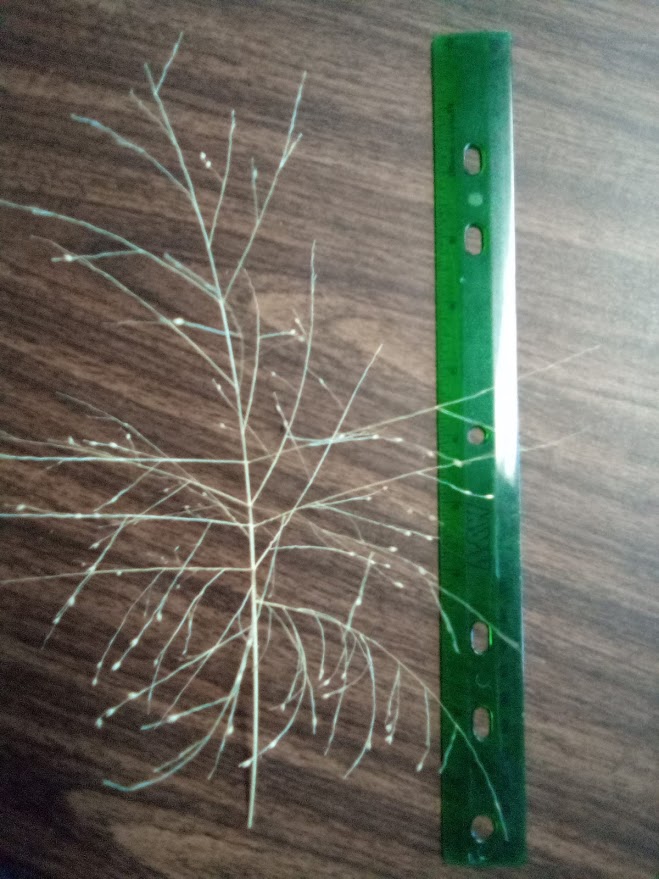
We’ve been getting these cute little tumbleweeds around here lately:

That’s a 12-inch ruler for scale. It took a while for me to identify this plant but it has to be Panicum capillare also known as witchgrass.

The part of the plant you see is the inflorescence, that is, the flower head, and this type of inflorescence is called a panicle. If you like goofy words, you should check out botany.

Here’s a bit from the entry in Munz & Keck’s A California Flora, p. 1546:

. . . papillose-hispid to subglabrous . . . attentuate at tip, subsessile along the ultimate branchlets . . .

Botany books go on like this for days. You need a specialized glossary to make sense of the stuff—a little book to de-code the big book!

What made this one tough is that the dry panicles become tumbleweeds and they float around on the lightest of breezes and attach themselves to other plants. I finally had to pull some of the bunchgrass out by its roots before I could be sure which inflorescence went along with which plant.

There are places in the world, mostly deserts, where the tumbleweeds can be so bad that cars and houses get buried after a windstorm. Out in the dry valleys east of here there are several species of plants that dry up at the end of the summer and turn into tumbleweeds and become a potential nuisance. Here in town the open fields are small and broken up by neighborhoods with their cultivated lawns and gardens. There’s not much chance of a tumbleweed problem. As you can see the witchgrass tumbleweed made by Panicum capillare is a light and delicate thing, and absent of thorns or sharp edges.

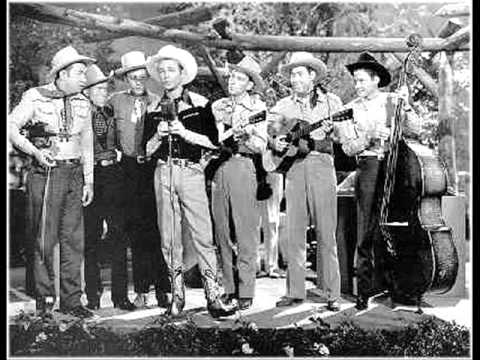
Of course, any talk of tumbleweeds leads naturally to The Sons of the Pioneers:

See them tumblin’ down

Pledging their love to the ground!

Lonely but free I’ll be found

Drifting along with the tumbling tumbleweeds

Songwriter: Bob Nolan

Stay safe out there on the trail, pardner!