Spring

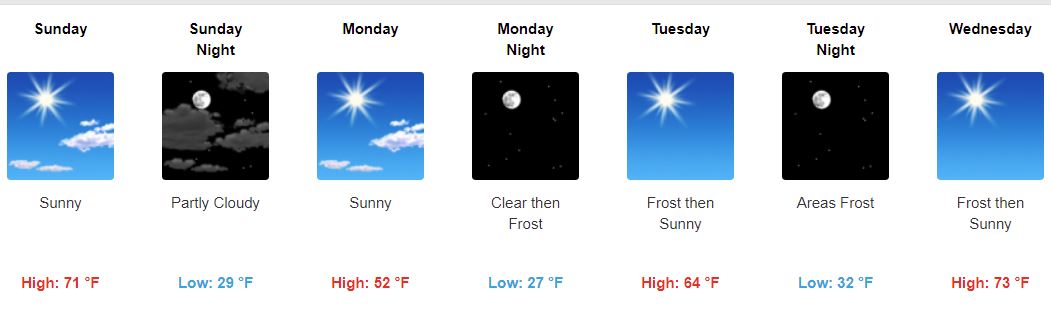
I’m not ready for this. I still expect it to be winter. In fact, we will still—as you can see above—have freezing temperatures in our future. But spring has sprung and I’m not sure how I feel about it.

My left elbow has been barking at me for weeks now and I suspect it is tendinitis. The dreaded “tennis elbow” can strike anyone, even those of us who don’t play racket sports. It’s robbed me of my desire to ski and thus my raison d’être for loving the winter months. Routine tasks like picking up a glass of water with my left hand are currently a challenge. And not much can be done for lateral epicondylitis except resting and waiting.

But spring has sprung and that means weed pulling, weed whacking, pruning, prepping, composting, irrigating and all the other landscape and garden tasks that emerge with the warmer weather and longer days. I’ll need both arms for those things and thus I’m avoiding strenuous athletic endeavors like alpine skiing.

When we go for our daily walks around the neighborhood, which we do rain or shine, we often encounter our neighbors. They almost always want to comment on the weather, especially when the days are warm and sunny.

“Lovely weather we are having, isn’t it?”

“Don’t you just love these gorgeous days?”

“Oh, I’m so happy the sun is shining!”

I bite my tongue and smile and nod. I want to scream “NOOOOOOOO!” I want to shout “I WANT SNOW AND STORMS AND COLD AND WET AND RAIN!!!”

No one wants to hear that. Everyone expects you to happily agree with them that sunshine and blue skies are what we all want and what we all enjoy.

Don’t get me wrong. I like nice days, too. But we have to have winter. We have to have snow and rain and all that because the dry season is coming and we won’t get any more snow and rain for six months. And we all know that California is drought-prone and vulnerable to severe wildfires. So I don’t want it to stop raining and snowing until all our reservoirs are full to the brim and all our snow stations are reporting record levels.

Here’s the state of our major reservoirs:
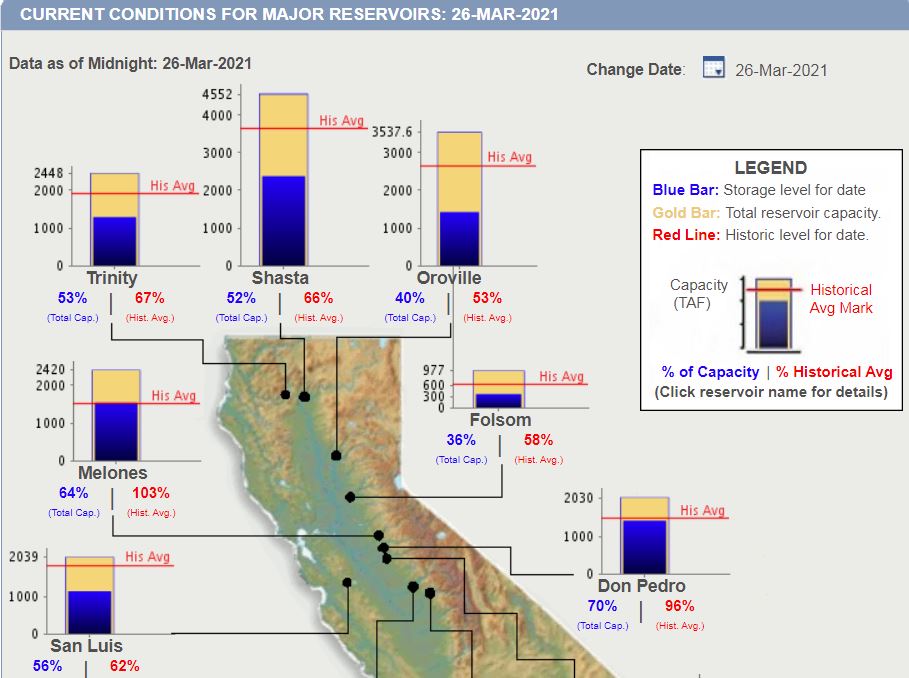
That’s just a snip. As you can see I clipped off the Southern California portion, but I think the rest speaks for itself. Right now we are a little short of where we ought to be.

Here’s a look at the snowpack:
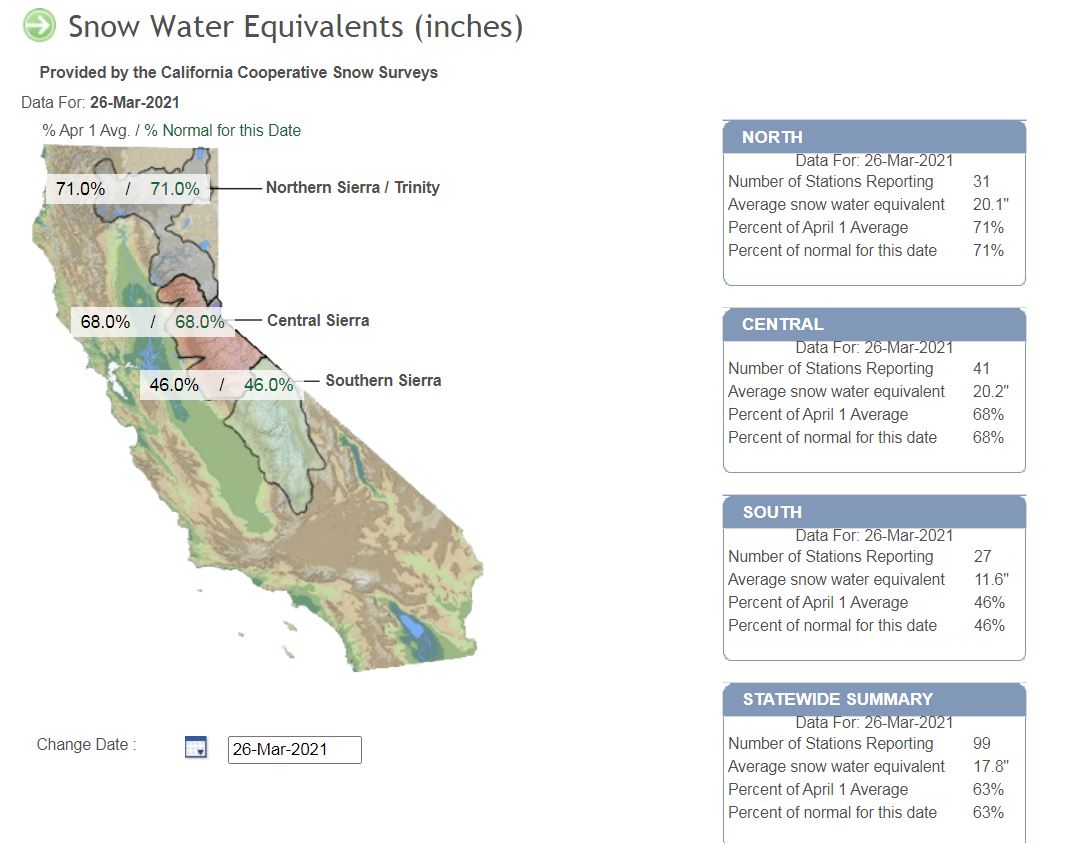
Once again you can see that we are a little short of where we’d all like to be. The bottom line is that WE NEED MORE RAIN AND SNOW! (These charts are from the California Department of Water Resources.)

Here’s some disturbing news from the DWR director:

“We are now facing the reality that it will be a second dry year for California and that is having a significant impact on our water supply,” said DWR Director Karla Nemeth. “The Department of Water Resources is working with our federal and state partners to plan for the impacts of limited water supplies this summer for agriculture as well as urban and rural water users. We encourage everyone to look for ways to use water efficiently in their everyday lives.”

https://water.ca.gov/News/News-Releases/2021/March-21/SWP-Allocation-Update-March-23

I think we all knew the drought conditions we experienced last year were continuing through this year. Despite the many storms we’ve experienced this winter the accumulation did not occur. We’ve had several stretches of warm, sunny weather in between the storms and that melted the snowpack and increased evaporation from surface water sources.

I note that today is Passover and tomorrow is Palm Sunday. Next Sunday is Easter. People are celebrating the arrival of spring. One of my neighbors already has her house decked out with balloons and Easter eggs. I don’t want to be that grumpy old man who complains, but goddamnit, I don’t want to hear any more about “nice” days ahead! I want more snow and rain and “foul” weather.

But I probably won’t get it. So I think we should all prepare ourselves for another long, hot dry season.

Happy spring!

Hype and Hope

Mars has been in the news lately because of NASA’s stunning success with Perseverance but it seems like we might be missing the point of the entire enterprise. For example, why go to Mars at all? There are plenty of Earth-bound problems to solve, so why spend the enormous intellectual and economic capital required to explore space?

In 1969, when Eagle landed on the moon, the technological achievement played second fiddle to the political triumph. This was the Cold War after all, and beating the Soviets at something was the first priority. No one who watched the Olympics in those days, for example, could avoid the commies-vs.-capitalists or Free World-vs.-Iron Curtain vibe in every event.

Landing on the moon turned out to be a sensational international coup for Americans as the entire world tuned in to Armstrong’s first steps. People actually felt a sense of universal brotherhood in that moment. It was as if anything was possible, and that humanity, because of technology, had a brighter future. What people forget about that time is how quickly everyone forgot about the moon landings! By the time of Apollo XVII (the sixth and final successful moon mission) in 1972 only a fraction of the original audience was tuning in. NASA, unfortunately, made the missions seem routine. They were anything but routine, but the viewing public was bored and moved on to other things. Not to mention that Congress was getting increasingly leery of NASA’s growing budget and was eager to trim the fat from the program.

It turns out the men walking on the moon, as amazing as that was, looks in hindsight more like a stunt than anything. Neil Armstrong was my childhood hero and I don’t mean to diminish his courage and skill nor the tremendous effort thousands of people made to make his journey possible. But all that drama up there in space was more about human sentiment and social aspirations than it was about science and engineering. After all it wasn’t until the final moon flight that NASA decided to add a geologist to the crew! The science, and its applications to human needs, was secondary to the dream, to the yearnings of the people. We are a culture that venerates explorers, and spaceflight takes us to that elusive “final frontier” that the TV-show Star Trek articulated so memorably.

Even after all the challenges of the Space Shuttle and the International Space Station, and the continuous reminding that it is very difficult for humans to live and work in space, NASA still says stuff like this:

[Mars] could someday be a destination for survival of humankind.

Uh, no. If by “someday” they mean many decades in the future, then maybe. But anytime soon? Don’t be silly.

Mars is not, by any reasonable definition, habitable. Humans cannot live there. It is too far from the Sun and so it isn’t warm enough. In fact it gets really cold there. The atmosphere is too thin for a greenhouse effect, so Mars does not trap heat and there are very large temperature swings. The atmosphere is mostly carbon dioxide, so you’d have to wear breathing apparatus, and the atmospheric pressure is minuscule, so you’d have to wear a pressure suit. That would be offset a bit by the much lower gravity, but that has its own deleterious effect on the cardiovascular and musculoskeletal systems. There are regular, planet-wide dust storms. There is no magnetosphere so you’d be constantly bombarded by cosmic rays and any human habitation would require so much shielding that you’d have to live underground. There’s not much in the way of soil, and what soil is there is toxic. Water is scarcer there than any of the most arid places on our home planet.

Now I’m all for interplanetary dreaming. I love science fiction. And I also think that the stuff we will learn about ourselves and our terrestrial abode will more than pay for the costs of these space journeys. I’m all for going into space. But I think putting humans on Mars is mostly a bad idea. We can do so much really good work with robots and remote probes and rovers and such. We, the two-legged we, don’t have to be there. The logistical challenges of sending humans to Mars would only work if they were one-way trips. Perhaps in the 22nd century or something we’ll be able to terra-form the planet and make a viable colony, but I’m not holding my breath. We are stuck here on the third rock for the foreseeable future.

Then there’s this guy:

Mars is one of Earth’s closest habitable neighbors.

Elon Musk is a hell of a salesman. And he’s obviously a great businessman—he has the billions to prove it. But he doesn’t know shit about space. We don’t have any “habitable neighbors!” And 140 million miles away is not exactly close. For comparison, the moon is about a quarter of a million miles away and that trip took the world’s biggest-ever rocket.

Studying Mars will enlarge our understanding of our own origins, and of our home the Earth and its many systems. The scientific and engineering achievements will lead to many advances for our civilization. But we aren’t leaving home just yet.

It’s a small world, after all

Humans like to think big. Skyscrapers, bridges, interstate highways, that sort of thing. Lake Powell has about 1900 miles of shoreline. The Bingham Canyon open-pit copper mine is 2-1/2 miles wide and covers almost 2000 acres. The Great Wall of China stretches for 13,000 miles.

But the world is small, really. The coronavirus responsible for COVID-19, SARS-CoV-2, is big for a virus but still really small. A typical virion is about 100 nanometers across. Nano– means 10-9 so that’s 0.0000001 meters in length. You’d need 10 million of them laid end-to-end to get a meter’s worth. One virion has a mass of about one femtogram. The prefix femto– means 10-15 or 0.000000000000001 grams. It would take a quadrillion coronaviruses to get a gram!

Micro-organisms rule your world. You harbor a bacterial colony in your gut. Without them you can’t digest food, so you’d die. Plants need nitrogen to live. They have bacteria on their roots that extract nitrogen from the air and convert it to a usable form. Without those helpers living there, the plants would die.

Microbes are the oldest and most diverse of all life forms. When microbes started to photosynthesize and produce oxygen the planet eventually became inhabitable for species like us. Microbes are found in every possible habitat. No ecological process is possible without them.

Now a virus is not like a bacteria or other microbe. It doesn’t really meet the textbook definition of “alive” although it certainly acts like a living thing once it gets the chance. A bacterium is huge by comparison, about 10 times bigger or 1000 nanometers across. But on a human scale that is still tiny.

I got to thinking about very small things because I got my first dose of the Moderna vaccine. The dose is 100 micrograms (10-6) or 0.000001 grams. With two shots you get 200 micrograms of the mRNA vaccine.

A COVID infection is estimated to be between 109 and 1011 virions per person. That’s a mass of between 1 to 100 micrograms. So, if you want to fight a war on a very small front you need very small soldiers but you still want to have more than the other guy!

The number of coronavirus cases in the world is about 115 million. That means all the SARS-CoV-2 in the world has, roughly, a mass* of no more than a dozen kilograms. That’s it. Somewhere around 25 pounds!

We humans spend our days in the macro-world. We drive cars and watch TV and play golf and all of those things we can see and touch and feel. But the REAL world is the micro-world, and especially the nano-, pico-, and femto-worlds. An atom is on the order of 100 picometers (pico- is 10-12) in size, and in the end, all we are is collections of atoms.

So, like I said, it’s a small world, after all.

*1 microgram times 115 million (1 E-6)(115 E6) is 115 grams (0.115 kg) and 100 micrograms times 115 million (100 E-6)(115 E6) is 11,500 grams (11.5 kg).