We landlubbers are used to crowds and queues. You have to wonder how sailors feel about such things. Here’s a look at the traffic jam in the San Francisco Bay. All the yellow dots are cargo ships waiting to unload at the Port of Oakland.
The image is from Vessel Finder which is a really cool website. Ocean-going ships use a technology called AIS or Automatic Identification System which uses transceivers to broadcast position, course, and speed. This is analogous to air traffic control but for marine applications. We civilians don’t have to worry about preventing collisions or managing maritime traffic but that stuff obviously needs to get done. The world’s oceans may be vast, but the sea lanes get congested at choke points. Harbors, bays, inlets, straits, and the like constrict the passage of ships and sometimes they get jammed up, just like commuters on the Bay Bridge.
When you see cargo ships moored in SF Bay that usually means they are waiting to off-load. The yellow dots on the map are almost all container ships. (The orange dot labeled MTM Tokyo is a oil tanker.) The Port of Oakland is experiencing unprecedented volumes at this time. It seems the pandemic has increased consumer spending, thus increasing shipping demand. At the same time, the Port can’t deploy as many people to handle the increased traffic, which is also a pandemic issue. So, we get a traffic jam.
The pandemic has heightened our awareness of supply chains and global inter-connectedness. (Is that a word?) Going forward, we need to improve the resiliency of these systems as domestic economies cannot “go it alone” any more. We are all one big “marketplace” these days.
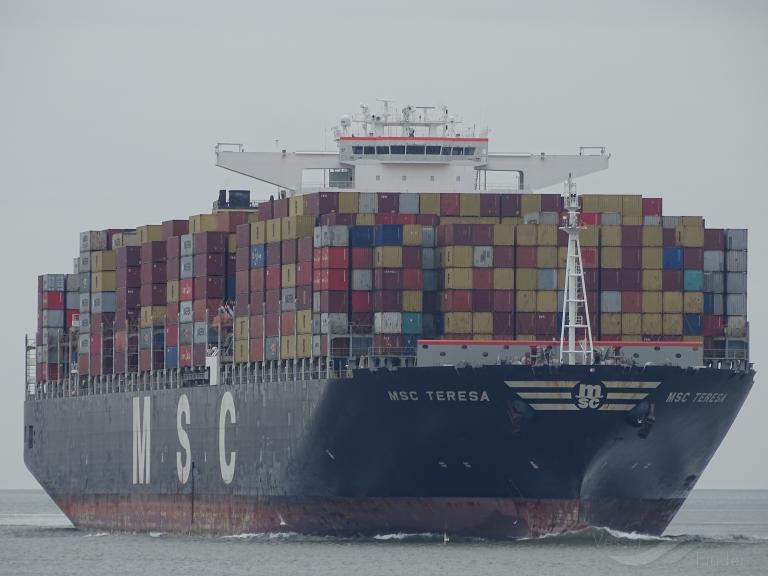
Here’s what MSC Teresa, the yellow dot at the bottom of the picture, looks like:
Certainly would not want to bump into that fella if I’m out kayaking or pleasure sailing!
MSC Teresa was built in 2011 and flies under a Panamanian flag. It’s 366 meters (1201 feet) in length and its width (or “beam”) is 51 meters (167 feet). This particular voyage originated in Yantian, China, and had a stopover in Long Beach before steaming north. The Port of Oakland is the fifth-busiest in the nation behind Los Angeles, Long Beach, New York-New Jersey, and Savannah.
We read a lot. We need to re-stock the book larder regularly. Good thing there is Zeising Books. The Zeisings—Cindy & Mark—live in Shingletown, California, an alpine hamlet in Shasta County. They sell books out of their home. You can order by snail mail, or call them on the phone, or send them an email, or visit their website. They like the kind of books we like, and they will get books for you that they don’t have. We buy lots of books from them. You should, too.
Starting from the top is the Black Gat line at Stark House Press, an independent publisher in Eureka, California. They specialize in genre reprints: mysteries, westerns, fantasy/horror, that sort of thing. Cut Me In, by New York author Jack Karney, is from a 1959 Pyramid paperback. American post-WWII crime fiction from the heyday of the paperback, with labels like Fawcett Gold Medal, Dell First Edition, Avon, Monarch, Signet, and Pocket Books, might be my favorite literature.
Escaping Exodus by Nicky Drayden is contemporary SF, she is a new author for us. I’m always looking for good, futuristic stuff.
Speaking of good, futuristic stuff, you can’t go wrong with William Gibson. The Peripheral is from 2014 and is set in the same world as 2020’s The Agency. We’ve read most everything of his since Neuromancer in 1984 and somehow we missed this one!
Stark House Press puts together doubles and this one features contemporary mystery writer Wilson Toney’sNot Worth That Much and Money is the Drug of Choice.
One of the best writers in any genre is Walter Mosley, who came to fame with the Easy Rawlins series that started with 1990’s Devil in a Blue Dress. Denzel Washington played Easy in the movie version of that novel. He has SF and “mainstream” novels along with his mysteries and crime fiction. Debbie Doesn’t Do It Anymore is from 2014.
John Shirley has always been (like Mosley) one of our very favorite writers. Stormland is brand new from Blackstone Press and is set in a near-future climate dystopia.
On the bottom is a fancy art book by one of those true originals, Ralph Steadman. He became famous for illustrating Hunter S. Thompson’s Fear and Loathing in Las Vegas, but that is but a small part of his work. I have a book called Still Life With Bottle, written and illustrated by Steadman, that’s about Scotch whisky!
I would have signed up to participate in the original vaccine trials if I had know how to do so. Not that they would have picked me, but I was ready to say “yes” if given the chance. I was willing to be jabbed as soon as one of those biotech outfits starting jabbing.
My parents had classmates who got polio. Now you say “polio” and people wonder what you are talking about! That’s proof that vaccination worked. When you get rid of a disease, people forget about it. Unfortunately they also forget about the remarkable scientific and technical accomplishments that led to eliminating that disease threat.
My mom had whooping cough (pertussis) as a child and almost died. This bacterial disease is widespread but there is a vaccine, the so-called DTap vaccine, which includes diptheria and tetanus. There were 9,000 cases of pertussis in California in 2010, with many hospitalizations and several infant deaths. All of those were preventable with a simple, safe, cheap, and easily-accessible vaccine.
Infant mortality was a fact of life for the human race until very recently. In modern countries the likelihood a child will live to be an adult is very high. That was not the case not that long ago and it is still a problem in developing countries. Every family had children who died of diseases that are now mostly eliminated. Americans don’t remember their own past. Anyone who takes the time to trace their ancestry will inevitably discover that large families were the norm as it was expected that one or more children would get sick and die before adulthood.
Hunger and malnutrition were commonplace, too. Now our biggest issue in the States is too much food. And too much food of dubious nutritional value. We can go to the store and be very picky about which meat we will eat, or even if we’ll eat meat at all. We can demand “organic” produce and cast a dismissive eye on things that don’t meet our stringent personal criteria. Not that long ago people were happy just to get enough food. In some places on the planet people wait in lines for basic stuff like bread.
When you grow up in a wealthy country you forget how lucky you are. The abundance seems limitless. In fact, to survive and thrive you have to be disciplined and not over-indulge. It is so easy to eat too much in this day and age. We throw away enough food to feed entire nations!
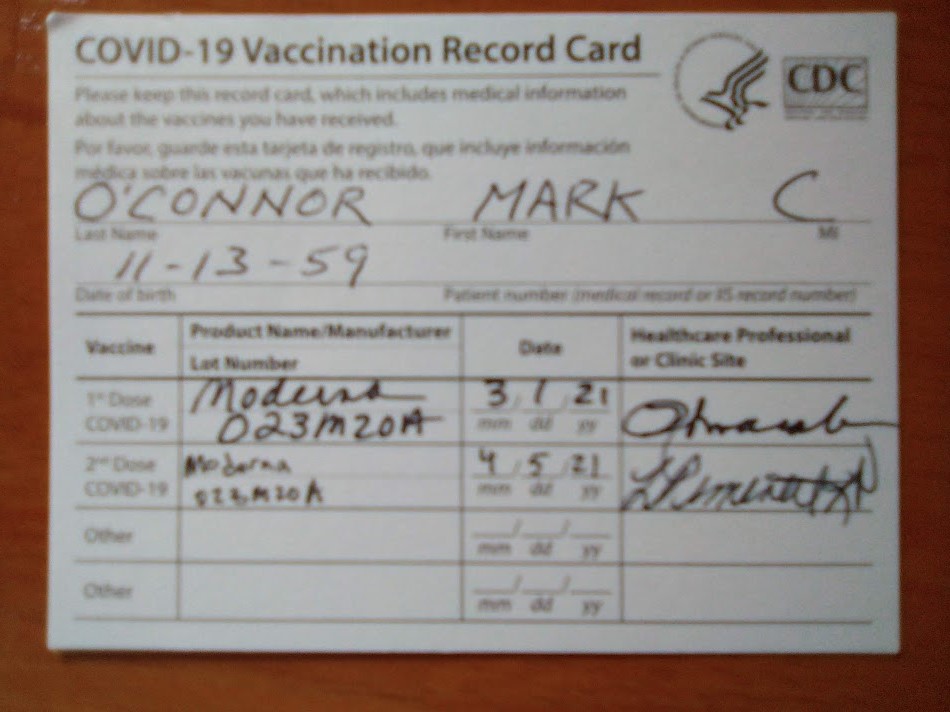
I was very fortunate to get the COVID vaccine a little ahead of schedule. I’m only 61 but I have had, as you can see, both of my shots. The creation and distribution of the coronavirus vaccines is a triumph of modern science and medicine. It is something worth highlighting and celebrating. The vaccines are a fantastic accomplishment and are crucial to restoring health and prosperity in the midst of this pandemic. I urge you to go out and get yours as soon as possible.
The Moderna vaccine, like the Pfizer, is particularly exciting. The technology uses mRNA, or messenger RNA, and generates an immune response without using an infectious agent. The mRNA vaccines encode for the “spike” protein that the coronavirus uses to attach to cells. When you get the vaccine, you produce antibodies to that protein. If you get a COVID infection, your body now has an immunological “memory” and can fight off the infection. Marvelous stuff. Imagine using this technology to customize therapies against other diseases. With cancers, one typically has to have surgery or get broad-based drug treatments that kill the tumors. These chemicals are hard on your healthy cells. An mRNA vaccine could be designed to be more specific, to target particular cancer cells. That would be an enormous therapeutic improvement.
The way we advance this medical knowledge is by being guinea pigs. People have to volunteer to participate in studies. Once the safety and efficacy of the new treatment is established, it can become part of the standard repertoire of medical practice. The pandemic increased the urgency for a vaccine, and all the vaccines in use are actually on an emergency authorization. The clinical trials weren’t any different, but the government approval process was accelerated. That’s actually proof that the safety systems work. Big Pharma may be experimenting on us, but it’s got a safe, well-designed product. They aren’t experimenting with the safety aspect as that’s been established. No, we are the guinea pigs for the effectiveness part. No one knows for sure how long the immunizations will last or whether the mutations to the virus will render them obsolete. Maybe we’ll have to get an annual shot, like with the flu. Tetanus is one of those things you have to get re-inoculated for—you need a booster every ten years.
Like I said I’m happy to do my part. I signed up for the V-safe follow-up where the CDC collects information on side effects. It’s all done via my phone. The second dose of the Moderna can have some side effects and they would like to get that data. No problem: you stick me and I’ll tell you how it went. I figure side effects are a small price to pay for some significant protection against a nasty new respiratory disease. A nasty new global respiratory disease.
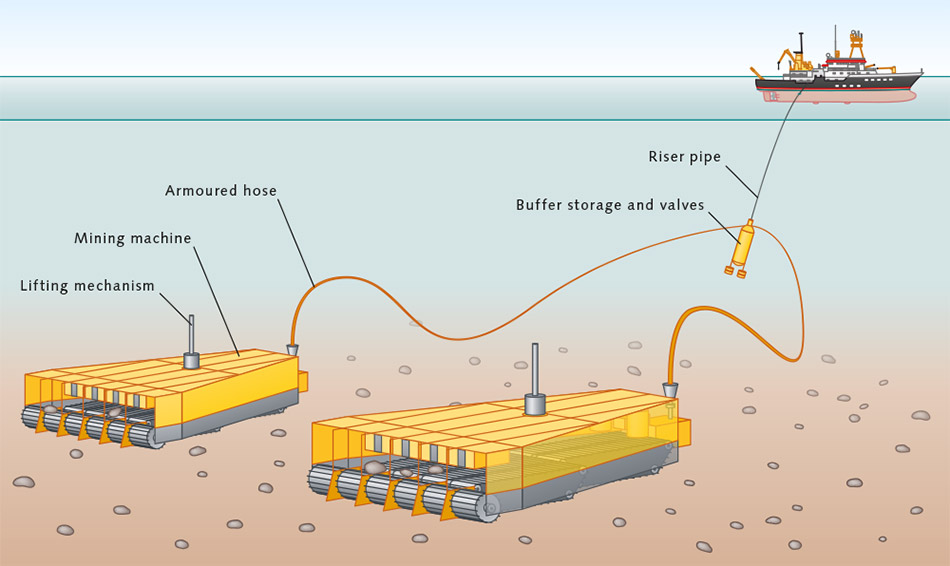
Mining the sea floor sounds like science fiction but it isn’t really that far-fetched. The folks at DeepGreen think the commercial opportunity is right around the corner. Manganese nodules are abundant on the enormous abyssal plains of the world’s oceans. Besides manganese, these nodules contain high concentrations of other key materials like cobalt and nickel making them potentially attractive future sources.
This has stirred some folks up, much like the stirred-up sediments such mining will undoubtedly create. The sea floor miners believe they can harvest the materials with less environmental impact than terrestrial mining. A whole bunch of other folks don’t think so.
Everything that can’t be farmed has to be mined. The greening of America’s infrastructure will require huge amounts of the above-mentioned elements, in addition to even more copper than we now consume, as well as increasing quantities of the lanthanides (rare-earth elements), not to mention boring old stuff like zinc and aluminum and ad nauseum.
This means great demand will be put on terrestrial miners to dig this stuff up. And no one likes the impacts that mines and mining make on the landscape. Do you want a new copper mine in Arizona? Some folks do, some folks don’t. The folks that do say “we gotta have this stuff” and they are right. The folks that don’t say “you’ll make a bloody fookin’ mess and walk away rich” and by golly they are right, too.
I don’t think sea floor mining is practical in the short-term. But I say “good luck” anyway because we will certainly need continuous sources of these crucial minerals. And I think mines are good. We need them. But we need them to behave responsibly. It is too bad “the marketplace” can’t create the environmental stewardship and resource conservation ethic necessary to do things the right way. It seems the government, and public political pressure, as well as shareholder activism, will be the drivers of those things. At some point the corporate world, as dependent as it is on big banks and investment funds for fresh capital, might have to answer to those funding sources about their carbon footprint and other measures of good management. I hope so.
Meanwhile, the great unexploited resource of the world remains our trash heaps. E-waste, the detritus of the computer age, is on the scale of 50 million metric tons annually. This is expected to grow to 75 million metric tons in 2030. We are lousy at recycling, despite decades of encouragement and opportunity, and single-use plastics still dominate our packaging industry. If we mined our landfills—better yet we mined our trash bins—we could recover many important materials.
We live in a consumer world, and we have to buy products to keep our economy afloat. But we could buy better, longer lasting products that can be repaired and/or recycled. We could expect our manufacturers to build things that can be re-used, or re-claimed in order to be re-imagined. When we pull stuff out of the ground like coal or crude oil or copper ore or anything we have to “use” we have to see it as the precious commodity it is. How can we make the very most of this amazing and remarkable substance? How can we do it so we all can benefit? How can we use human ingenuity to sustain our civilization and the earth it treads upon?
I don’t think those questions are that hard. We’ll have to come up with some answers. Or we might start to see more stuff like this:



 Mark C. O'Connor