Trillions

How many different types of living things are there in the world?

I don’t know, but two fellows at Indiana University took a stab at this question. They focused on microbial life, which is smart, because there is more of that than any other kind of life.

Plants are the dominant life form on earth if you measure by mass. The amount of carbon stored in plants is estimated at 450 Gt. Bacteria weigh in at about 70 Gt. Those units are giga-tonnes. The giga- prefix means one billion or 10^9. So a Gt is over two trillion pounds!

A trillion is not an easy number. It’s a lot of zeroes:

1 000 000 000 000

Or if you prefer commas:

1,000,000,000,000

An easy way to think of one trillion is “a million times a million.”

I suspect that one million is about as big of a number that most people can visualize. There are about a million seconds in twelve days, for example (12 x 24 x 60 x 60 = 1 036 800).

One million times one thousand will get you a billion. So 12 000 days (~32 years) is about a billion seconds.

One billion times one thousand will get you a trillion. So 12 000 000 days (~32 000 years) is about a trillion seconds.

The latest infrastructure bill from Congress and the President comes to about one trillion dollars!

Back to the first question: how many different kinds of living things are out there in the world?

Biologists Kenneth J. Locey and Jay T. Lennon suggest in their study (“Scaling laws predict global microbial diversity” in PNAS vol. 113 no. 21) that the earth is home to one trillion species of microbes. This does not include insects or mammals or other such creatures. Just micro-organisms.

Now that’s not one trillion total microbes, but rather one trillion different kinds of microbes. As far as the total number of microbes on the planet, that’s a really, really big number. Case in point: the number of bacterial cells in your gut biome is at least as large as the total number of cells in your body.

According to IC Insights, the number of semiconductor devices that will be shipped to users in 2021 exceeds one trillion. This milestone was also achieved in 2018 and 2019, and even in the midst of the pandemic, 975 billion were shipped in 2020. Seems like one trillion is the new benchmark. Here’s a graph:

From roughly 33 billion in 1978 to 1.1 trillion in 44 years is about five doublings. That is, the number doubled every eight years or so. That’s about 9% annual growth! Wouldn’t you like to earn 9% every year?

There are not one trillion different kinds of semiconductor devices of course, but there are certainly many hundreds and perhaps many thousands of them, and that number keeps growing. There are about 9 500 different kinds of mobile phones, for example. If you add in all the bits and pieces that make up these devices the number of different artifacts humans have created becomes enormous. Just imagine all the different kinds of fasteners—screws, nails, nuts, bolts, rivets, etc.—and the staggering variety of objects they are needed for. My head is going to explode. I’m still trying to get a handle on “trillions.”

At some point the manufactured world will exceed the natural world in both number and variety of things. Are you ready for that?
“OK, well, maybe . . .”

The precursor to the laser was the maser. A maser is a laser that uses microwaves. Or you could say a laser is a maser that uses visible light. Either way, the maser came first.

The words are acronyms: Microwave (or Light) Amplification by Stimulated Emission of Radiation.

A fellow named Charles Townes had an idea for a maser one day back in 1951 and sketched it out to his colleague Arthur Schawlow. Both men were experimental physicists and three years later they produced a working maser.

But that’s not the story. The story is that when Townes went to his friend with the idea Schawlow said:

OK, well, maybe . . .”

I love that answer.

It doesn’t sound like much, but it’s the perfect balance of enthusiasm and skepticism. By enthusiasm I mean the openness to something new. By skepticism I mean the lack of credulity.

Both are essential. You have to be receptive or you’ll miss out. But you also have to be critical. That way you won’t get fooled. Experimental physicists are more like engineers. They like to keep their feet on the ground. Two renowned theoretical physicists, Neils Bohr and I.I. Rabi, both told Townes his idea wouldn’t work. You never tell an engineer that something won’t work. These people spend their lives making things work!

Neils Bohr was one of the few physicists in the world that could go toe-to-toe with Albert Einstein. Their debates about quantum mechanics are famous in the scientific world. The theory of quantum mechanics is about 100 years old and one of the most significant results of that theory is, you guessed it, the laser.

Einstein’s paper “On the Quantum Theory of Radiation” introduced the concept of stimulated emission which is the basis of lasers. That was in 1917. In a weird twist, Einstein spent much of his professional life opposed to quantum mechanics, a field he helped create, and one in which Bohr holds an esteemed place. The Einstein-Bohr debates were mostly philosophical as quantum mechanics raises many interesting questions about reality and our attempts to perceive it.

Engineers and experimental physicists are feet-on-the-ground types, like I said, and don’t have much use for philosophy. Inventors always believe a solution is just around the corner, and that means they can’t be too particular about theories. They have to be flexible, and know that their working assumptions are just that. Philosophers and theoreticians spend a lot of time building their intellectual constructs and are quite invested in them. They can’t pull them apart so easily.

I don’t mean to disparage those with their heads in the clouds. There’s no laser without Einstein’s paper and Bohr’s theories. And those were built on theories from others like Max Planck and James Clerk Maxwell. Inventions don’t happen in a vacuum. There are a lot of people thinking and working at the same time. We love the idea of the lone genius but it is mostly a myth.

In fact, we are all inventors. We invent our own reality every day. And reality presents us with a lot of problems. That means we need solutions. And what do inventors say when considering solutions?

“OK, well, maybe . . .”

PM 2.5

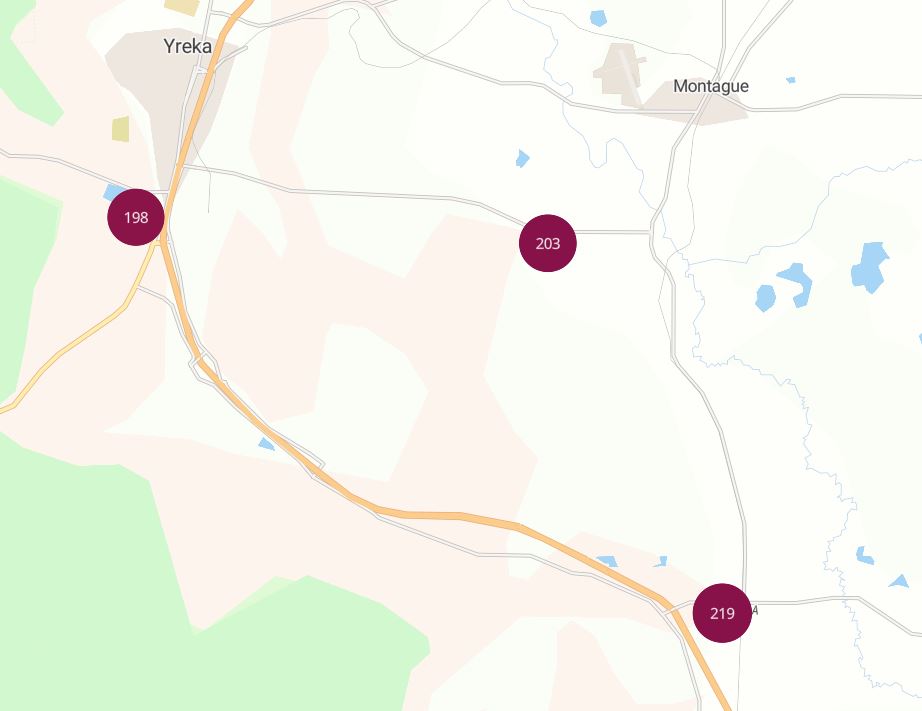
The SARS-CoV-2 pandemic gave us the Isolation Apocalypse. Wildfires are giving us the Inhalation Apocalypse. Here’s the report this morning from Purple Air:

https://www.purpleair.com/map?opt=1/mAQI/a10/cC0&select=1312#11.38/41.676/-122.5569

The numbers are PM2.5, or particulate matter less than 2.5 micrometers in diameter. The measurement is in micrograms per cubic meter of air. A cubic meter is about 35 cubic feet or 264 gallons. You can fit about two cubic meters of air into the bed of a compact pickup truck. A microgram is really small, 0.000001 gram. A dollar bill weighs about one gram which is one million micrograms.

It’s hard to imagine that 200 micrograms of tiny stuff, dispersed into a big ball of air, could be hazardous to your health. A human hair is about 70 micrometers across, so we are talking about things too small to see with the naked eye. We get a lot of haze around here and that is often the result of suspended fine particles like these. You can’t see them but you know they are there because, off in the distance, visibility is reduced. You are looking at the accumulation of refracted, reflected, and diffracted sunlight. Here in wildfire country we also get large particles—ash and smoke—that you can see just fine!

Fine particulates enter your lungs and get to your bloodstream. It often does not matter what the source is, or what the particles are made of. You don’t want to get that stuff in your body. Wildfires may be organic and all-natural, but you still don’t want to breathe in the by-products. After all, we burn wood in our homes but we have chimneys! If wood smoke was good for you we’d just let it fill the house. And on camping trips everyone stands around the fire pit but if the breeze pushes the smoke in your face you move to a new spot.

So make no mistake particulate pollution from wildfires is a serious health issue. I’m in good health but I’m also 61 so I’m in those risk groups they always talk about. I don’t have heart disease or anything, thank goodness, but I still stay indoors when the numbers are bad. I’ve missed out on walking and bicycle riding, two things I count on to stay healthy, but the trade-off isn’t worth it. Breathing fouled air isn’t good. The fitness gain from outdoor activity is negated by the exposure to pollutants. Worse, exertion means more breathing, which means more bad air in the body. So it’s not a break-even, it’s a loss.

For the PM2.5 air quality measurement 0-50 is considered satisfactory, 51-100 is moderate, 101-150 is unhealthy for sensitive groups, and 151-200 is unhealthy for all. Anything over 201 is obviously very unhealthy and by the time you get to 301 the air is hazardous to breathe.

You can keep track of air quality in several places. The EPA has AirNow.gov and I already mentioned Purple Air, which I use all the time. Windy.com is another useful website for keeping tabs on the air quality.

Let’s hope for some fresh air soon.

The Big Con

I’ve always been fascinated by con artists. These folks flourish in a free market economy. In capitalism everything is for sale because everything is a commodity. You can sell your soul. You can buy love. You can sell your house. You can buy crypto-currency, and so on.

Con artists sell you back to yourself. They play on your vanity, your sense of importance. They exploit your fear of missing out. They encourage you to open your wallet so that you can fulfill your wishes and buy your dreams.

We’ve all heard P.T. Barnum’s “there’s a sucker born every minute.” And we’ve all heard some version of caveat emptor (buyer beware) from our elders.

But we still get suckered. Bernie Madoff showed the world that you can bilk famous, highly accomplished celebrity-type people, and do it for years before they’ll catch on. It was just too cool to be one of his special clients and it was just too easy to believe in his impossible investment returns. After all, when you are a famous, highly accomplished celebrity you won’t get suckered by a common huckster. Madoff was a huckster, that’s for sure, and good thing he seems to have a been an uncommon one.

L. Ron Hubbard created a religion for rich people and other famous, highly accomplished celebrities. It was a stroke of genius to target people with lots of money. I’ve thrown money at nonsense, but I don’t have the means to do it on the scale the Scientologists work on. Rich people do and it doesn’t hurt them—financially, that is—to swallow that nonsense.

Recently we’ve had the Power Poop Couple. Zachary Schulz Apte and Jessica Sunshine Richman created uBiome, which was breathlessly promoted on a TED talk (among other places), and it turned out to be a fraud. These two phonies are now fugitives and face federal fraud and money laundering charges. The scary part of this disaster was how easily they conned their way to fame and fortune. People were falling over themselves to give them money and praise them for their supposedly revolutionary approach to health care.

It was all jive. But they knew the con artists greatest trick which is “tell people what they want to hear.”

And then there’s Elon Musk. He literally robs Peter to pay Paul, raiding one company to pay off the debts of another. He talks constantly and relentlessly assures his fanbase that the next big breakthrough is just around the corner and it will be even better than the last one. I’m still waiting for the first one! Like a Musk company that makes a profit, for example. Or pays a dividend. Or does not depend on government contracts, handouts, subsidies, or tax incentives.

I’ll give Musk his due. He gets more free money than anyone. Venture capital flows into his gaping corporate maws. When he spends it he asks for more and more flows in. It’s the greatest of all capitalist acts: selling nothing!

I suppose he’s selling dreams. Dreams of hyperloops and Martian colonies and neural links or whatever. Those dreams DON’T COST ANYTHING. They are already FREE! You don’t need Elon to dream, and if you do you might think about watching less TV or eating fewer potato chips or something because your mind has been poisoned.

America is the home of the con artist. Upward mobility and dreams of riches are essential to the American character. We all believe we will find our own land of milk and honey. And those of us who don’t will have plenty of schemes to choose from. The con artist will come into our lives with his (or her) charm and effortless grace and convince us that we are SO IMPORTANT we have to open our wallets to them.

And then they will take us for a ride. And if you don’t want to go on that ride, watch out for the bilkers, fleecers, and grifters of the world. Some are low-lifes. Some are rich and glamorous. But they are easy to spot. Here’s the rule: if it is too good to be true, then it (most likely) isn’t true. Anything that promises the moon (like Musk) is lying. All you get out of that is an airless rock!

It would be great if some of the bullshit was actually true, but that just doesn’t happen. Real life has a way of barging in and writing all the rules. That sucks, I know, but it’s the reality we inhabit so we might as well get used to it. And real life is in fact much better than any fantasy these hustlers and tricksters can try to sell us. And if it isn’t, you need a new life, not a new sales pitch.