Flying footprint

The last time I was on an airplane flight was in 2008. That was international—we went to México. In a couple of weeks I’m getting on a plane for a trip to the Big Island—Hawai’i. It’s a domestic flight of course but it doesn’t feel like it. It’s almost 2400 miles from the airport in San Francisco to the one in Kona. That’s about two hundred miles less than the distance from San Francisco to JFK airport in New York City. But the flight to Hawai’i is entirely over the Pacific Ocean!

Jet travel changed the world forever. Cargo ships take five days to cover the SF to Oahu route with extra days needed for the outer islands. Our 737 will make the trip in less than six hours. And a regular middle class guy like me can actually afford the fares!

When you search for fares on Google you get stuff like this:
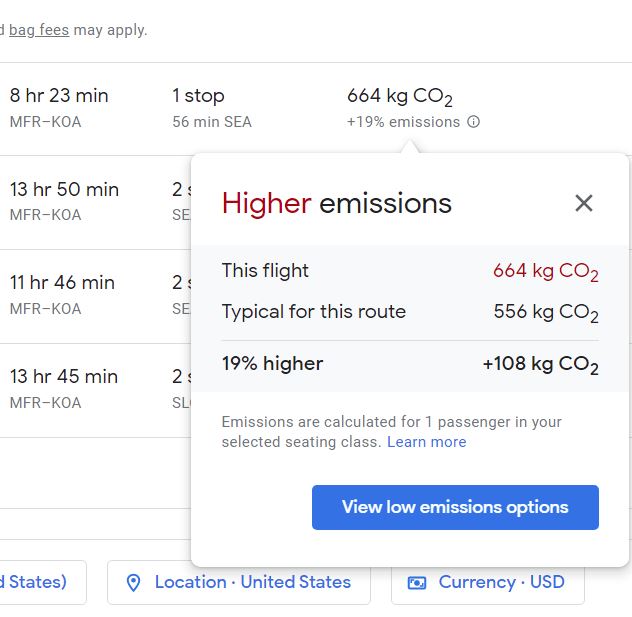
This is not our flight, just the result of a MFR-KOA (Medford, Oregon to Kona, Hawai’i) entry in the search box. And I clicked on the circle-i “information” icon under the 664 kg CO2 to get the pop-up.

Average fuel consumption over the entire flight of a 737 (takeoffs and landings take a lot, cruising not so much) is about 2400 kg per hour. For a six-hour flight that’s 14,400 kg or about 18,000 liters (4800 gallons). A 737 can carry over 6000 gallons of fuel and fly over 3000 miles without refueling.

Using the graphic above I’m going to estimate that a six-hour flight makes 600 kg of C02. (I’m splitting the difference between 556 and 664.) That’s 100 kg/hour. PER PASSENGER! Here’s a link to how Google comes up with these numbers.

There are about 180 seats on the Boeing 737 we’ll be flying. 600 kg times 180 is 108,000 kg of CO2! How is that possible? We are only burning 14,400 kg of fuel! But fuel does not burn by itself. It requires oxygen. A modern jet engine consumes over 400 kg of air per second. That’s how it is possible to produce so much exhaust.

Let’s put it all in perspective. Our friends at Our World in Data (a remarkable site) say aviation accounts for about 2.5% of global CO2 emissions. Here in the States, we account for about 16% of all emissions from domestic flights. (Calculating the contributions of international flights is a little trickier and I’m flying domestic so I’m sticking with these numbers.)

The U.S. retains its familiar role as world leader. We make the most airplane exhaust!

It seems the only way the world will get a handle on global air pollution and the climate impacts of greenhouse gases is by some sort of carbon pricing. Whether it is cap-and-trade, a carbon tax, or some other scheme, we have to start including the externalities that our activities produce. Nothing is for free. If flying makes a goddamn mess, then we have to bear the cost of the cleanup. And we all know the best way to keep things clean is not to make a mess in the first place!

I’ll be polluting my way over to Hawai’i in a couple of weeks, like I mentioned. We will fly to Kona but will stay in Hilo. I’m really excited about being on the windward side of the Big Island where it is rainy and wet. I live in a near-desert so I need a break from sere, arid landscapes. We are going to watch some baseball at the University and then have a week of adventures. I’m going to buy a really nice Aloha shirt and some groovy board shorts. I’ve been given so many recommendations of places to go and things to do that I figure no matter what we actually do it will all be really fun. I’m a pretty relaxed, happy-go-lucky traveler. If I’m in new place I enjoy myself just kicking around and living life. And drinking beer, of course. My first selfie will probably be at the Hilo Brewing Company. I’ll bet that Mauna Kea Pale Ale is mighty tasty!

Gambling 101

What’s a fair bet? To me, a fair bet is one is which the payoff accounts for the odds of the outcome. Say I’m flipping a coin with you. Each of us puts a dollar on the table. If it comes up heads I get both bucks. If it comes up tails then you get ’em. That’s fair. The outcome—heads or tails—is a fifty-fifty chance. My risk (one dollar) is equal to my reward (one dollar).

Casinos don’t work that way, of course. If they paid “true odds” they’d go out of business. A casino has a lot of overhead so they have to get a cut of all the transactions (the bets) in order to keep the lights on. Take roulette, for example. There are 38 numbers on the table (1-36 plus 0 and 00). If I bet on “red” I’m betting on 18 of those 38 numbers. The odds of getting red are 18/38 or about 47%. That means the house wins 53% of the time.

The house pays 2-to-1 on a red bet. But I have 38/18 chance (53%) of losing that bet! That is, I have about 2.11-to-1 odds against me (38÷18 ≈ 2.11) but I only get 2-to-1 if I win. So the house makes a little bit (0.11) on every bet.

“The house always wins.” This is a truism. All gamblers know this. Yet they continue to gamble. And interestingly, gambling is becoming more and more acceptable as a form of recreation. Once confined to Nevada and New Jersey legal gambling now exists in thirty states due to the emergence of tribal casinos. Not only that, on-line betting has exploded and America’s professional sports organizations have endorsed and embraced fans betting on games. This was unthinkable only a few years ago.

I have to say that this new-found, relaxed attitude about gambling is a bad thing. People are going to be stupid and throw away money that should be used to feed and clothe their children. And the sports industry, already engorged with TV and merchandising money, will only grow fatter and uglier, and the juvenile, anti-social attitudes it celebrates will only become more normalized. That being said, regulating behavior like gambling by making it illegal certainly does not stop people from throwing away their money (and their lives). I can live with gambling being legal. What I don’t like is making gambling seem like harmless fun. It’s not. It’s a gigantic money pit that people throw themselves into and then get chewed up and spit out, much worse for wear than if they hadn’t.

I’m obviously not talking about a Super Bowl pool. Or a handshake bet on a ballgame in a bar. I’m talking about apps on your phone that allow you to monetize every sports opinion your feeble brain can hold. It’s too easy, and there’s too much money involved, and when those two conditions are met bad shit will follow.

The problem with professional gambling houses is that they don’t play fair. I gave you an example of how the house wins on every bet in roulette even if they have to pay out. OK, fine, they have to make a living. As long as the odds and payouts are transparent the gambler can at least see what’s coming. If a gambler gets really lucky and the house starts paying out big money, the pit bosses make every effort to stop the run. They change the dealers, for example, and try to “break the momentum” of the win streak while they ply the players with free drinks delivered by pretty girls, anything to throw them off their game. All of that is perfectly legal. They have betting rules like pot limits, too. In the end, houses can simply close the tables if bettors win too much. A casino can just stop doing business if they see a winning run they don’t like. It’s bad for business and your reputation to do that but going out of business is worse.

Sports betting oddsmakers are really good at what they do. They “pick ’em” with winning regularity. If the big books agree on a result it is almost always a good bet to play the favorite. The average individual bettor really doesn’t have access to better or timelier information and thus cannot come to a consensus about the odds on a game. The pros can do this and so the part-time player, amateur, or wannabe-pro has no chance. They will lose more often than win over the long run if they bet against the odds.

I came across a paper by Lisandro Kaunitz, Shenjun Zhong, and Javier Kreiner titled Beating the bookies with their own numbers—and how the online sports betting market is rigged. (I was directed there by Tyler Cowen’s blog.) These three people figured that most bets were priced correctly. But they also figured that meant some small but significant number of bets were not priced correctly. These bets inadvertently favored the bettor. In order to attract betting on an underdog oddsmakers give enticing payout possibilities. They “sweeten the deal” for the riskier bets. And oddsmakers have to hedge, too. So they have mispriced bets out there to move money around and balance their risks. The writers of the paper figured out how to identify these opportunities. When they tried out their model with hypothetical bets they were successful and made money. They switched to real money and starting winning consistently.

Then the other shoe dropped. The on-line betting places simply starting restricting them from betting. The bookmakers placed limits on the bet amounts and what contests could be bet on, ultimately rendering the strategy impossible to implement. The authors describe it as “discrimination against successful clients.” That’s certainly true. The game is rigged.

The paper concludes:

https://arxiv.org/ftp/arxiv/papers/1710/1710.02824.pdf

If we are going to allow and even encourage betting then we should certainly require the industry to “play fair.” The SEC regulates much of the securities market. When I buy a stock or an ETF I have access to all kinds of information about the investments, the costs, and the nature of the risks. This is required by law. Investing is gambling and amateurs get hosed all the time by the big boys but at least there is some oversight by the authorities and some remedies available to the retail customer. Not so with sports betting.

In the end, gambling is stupid. Leave it to the pros. Have fun at work with lottery pools and NCAA bracket-ology. Slap a twenty on the bar now and then to spice up a TV contest and when you win buy the loser a beer. Like I said, have fun. But stay away from the betting apps. Serious betting isn’t fun—that’s why they call it serious.

And if you think of yourself as a serious bettor, then I suggest you read Kaunitz, Zhong, and Kreiner’s paper. And if you can’t do the relatively straightforward math they discuss then change to another field or go back to school because that’s way better than getting schooled!

Oil and you

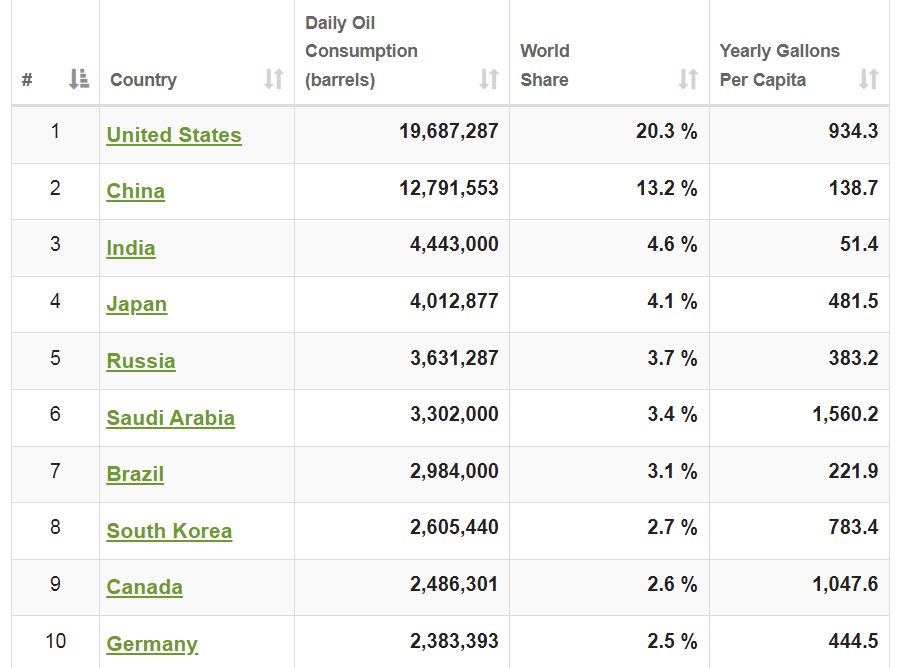
Russian oil is in the news. This concerns Americans because, well, take a look:

https://www.worldometers.info/oil/oil-consumption-by-country/

Here in the States we consume the most oil in the whole wide world. It’s worth noting that America consumes a lot of oil because Americans consume a lot of oil. Note the per capita figures! Only the Canadians and Saudi Arabians can match or beat the Americans.

Germany and Japan are modern countries with high standards of living, representative governments, and the rule of law. Note that per person they consume about half as much oil as we do here at home. Another modern, civilized place is South Korea. They use more energy than Germany and Japan but less than the U.S. (per capita). That’s most likely due to more a more extreme winter climate. Both Japan and Germany modernized sooner than South Korea and thus have more developed and more sophisticated infrastructures. Countries improve their energy efficiency over time. They get better at utilizing their resources. All three nations are dependent on large imports of crude oil and refined products as they have little or no domestic oil industry.

Canada is a very large country and of course it has very cold winters. To maintain their standard of living they have to consume a lot of oil. Canadians, like their southern neighbors, have huge transportation needs. Big countries need big roads and lots of trucks, planes, and ships. All require oil. Saudi Arabia also has an extreme climate, just in the opposite direction, and their energy needs involve not only cooling but the desalination of salt water. The Arabian peninsula is mostly desert. The sheikhs that run that place are also very grandiose fellows and love big, flashy, capital-intensive building projects. Those need a lot of oil. Canada, the U.S., and that Middle Eastern Kingdom are blessed with very large domestic oil reserves. So large in fact that they all export oil.

Russia exports a lot of oil. About 10% of the global supply. In fact, if you have a lot of oil, you export a lot of it. Countries don’t supply their needs exclusively with their own oil. The U.S. and Canada, for example, both import oil despite being major world producers.

Oil is a global commodity. International markets determine the price. Even OPEC can’t set oil benchmarks any more as the worldwide demand is too large and too inter-connected for any one entity to control the outcomes.

We hear a lot about “energy independence.” American politicians and pundits of all political stripes pull out this canard whenever we see spikes in oil prices. We have this notion that we can drill and pump and refine and consume in an entirely domestic market. It’s sort of a quaint, 19th century idea of how capitalism works.

We don’t live in that world. Oil in the U.S. (and other modern democracies) is produced by oil companies, not governments. Oil companies have shareholders and other investors and they are obligated to create returns for those folks. So they sell oil on the international market. Oil companies need a steady supply of crude for their refineries. So they buy oil on the international market in order to manage their inventories. Think of the world as a giant bathtub filled with oil. There are lots of spigots—some dumping oil in, some sucking oil out. The bathtub goes up and down, and the rates of change set the prices.

I can’t imagine any thinking person supporting Putin’s invasion of the Ukraine. He’s a crude, stupid bully, and moreover a powerful and dangerous one. Whether the sanctions (including the oil import ban) will have the impact on his regime and his ambitions that the West is seeking I can’t say. I hope so, but I don’t have a crystal ball. And I don’t have a deep enough understanding of economics or international relations.

But I do know that this problem of higher oil prices is as much our making as it is Putin’s. We are gluttonous consumers of the stuff. We can’t get enough of it. Our entire vision of the American Way and the American Dream depends on massive expenditures of energy, and that energy comes mostly from oil.

We have always enjoyed relatively low prices for things like gasoline. Lately gas prices have taken off as well as prices for heating fuels and other important petroleum products. Those price increases hit consumers hard as they ripple through the entire economy. Everything costs more when it costs more to transport stuff. Those low prices are a thing of the past and not just because of Putin and the Ukraine.

Oil is messy stuff. The impacts of oil exploration, production, refining, distribution, and consumption are enormous. We pollute our air, water, and soil with oil and its by-products. The consequences are real. People get sick and die. Locales become uninhabitable. Natural regions and their wildlife are altered and disrupted, even destroyed. These things are called “externalities” by economists. Prices for commodities don’t generally include the costs of these externalities. In other words, when we pollute our world we don’t pay the price at the pump. We pay it later, but it’s dispersed, and we don’t see it.

Californians know a little about this. We pay more for our gas because it has to meet certain clean-burning standards. And excise taxes are high because 40 million people beat the hell out of the roads and freeways. So some of the externalities are included in the price we pay. These things work, actually. If you remember the air quality in the LA basin in the 1970s, for example, and compare it to today, it’s way, way better now even though there are more people and more cars.

This is only going to continue. Just about every strategy for combating the impacts of climate change involves paying higher prices for energy because we have to include more and more externalities. Prices for energy in developed countries are generally pretty low because modern societies depend on large per capita consumption rates. We can’t have wealth and freedom without abundant, low-cost energy sources.

Ultimately, the transition to lower-impact, less polluting energy sources will require enormous expenditures of both dollars and fossil fuels. Producing a solar panel, for example, needs a hell of a lot of electricity! We are all going to pay for this. In the short term, we’ll see lots of fluctuations. But the long-term trends are pretty clear. Energy prices will go up. Consumer costs will go up. A larger and larger share of our income, over the long haul, will go to cover our energy needs. And to taxes as well as governments will take an increasing role in national energy strategies that will include the associated external costs.

This doesn’t have to be a bad thing. Maybe it will force us to think more like conservationists. Maybe we’ll be encouraged to be less wasteful and to consume resources more thoughtfully. There are happy people in this world who enjoy high standards of living as well as personal liberty and yet don’t waste as much energy as we do here at home. What can we learn from them?