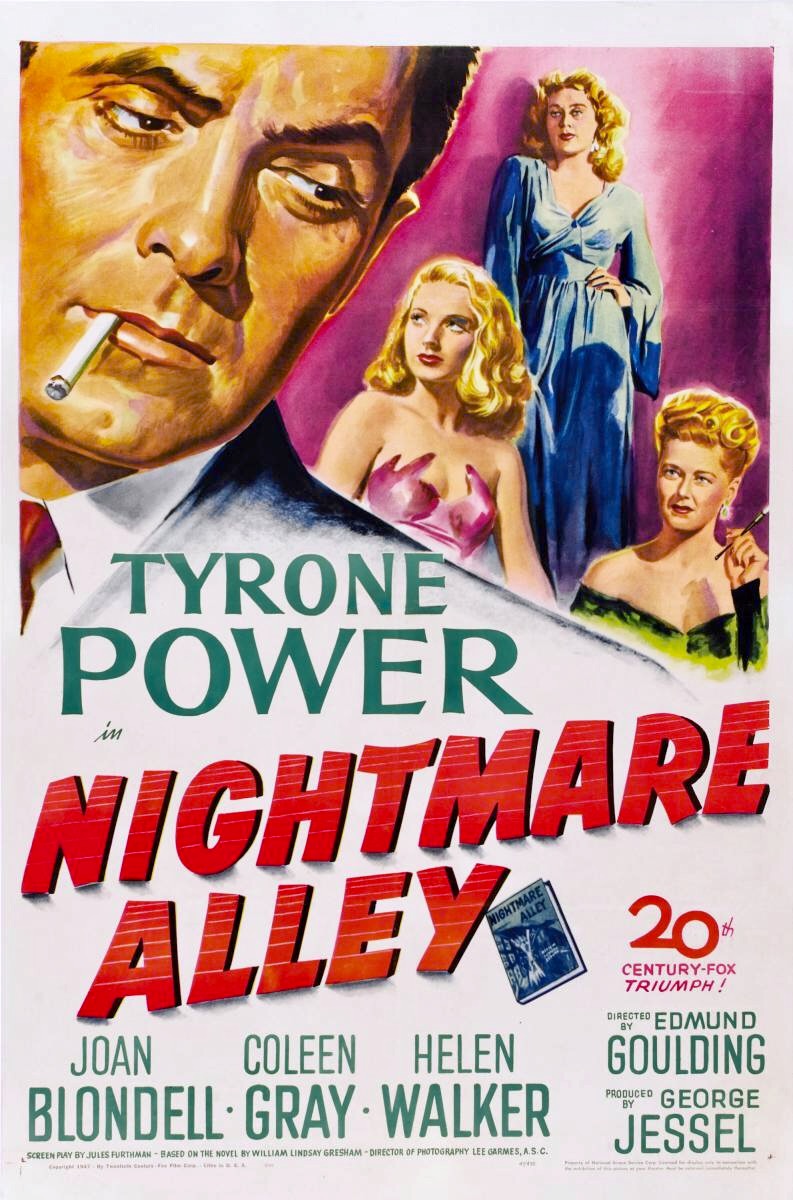
Tyrone Power was something of a Brad Pitt/George Clooney heartthrob in 1947, famous for swashbuckling roles and manly action movies. The former Marine pilot was a serious actor however, and wanted to stretch himself to play more complex figures. He convinced his studio bosses to buy William Lindsay Gresham’s recently-released novel Nightmare Alley and make a movie of it, casting himself in the lead. The movie was a flop then but has cemented itself as a noir classic today.

Gresham, it seems, was a dark soul. Fighting in Spain for the doomed Republican cause against Franco’s Fascists, he heard stories of carnival life from a fellow traveler. Gresham was particularly enthralled (and horrified) by the geek, a peculiar attraction in these roadshows, a man so desperate he made his livelihood in a cage biting off the heads of chickens and snakes. I should note that Billboard continued to place ads by carnivals looking for geeks up until the 1960s.
In the story an ambitious, intelligent, but aimless young man, Stanton Carlisle, takes a job in a carnival. Like Gresham he’s shocked by the depravity of the geek and vows to never let himself get so low. In fact he climbs the ranks of the carny hierarchy to the mind-reading act, ultimately stealing the secrets from an older performer and then killing him to cover up his theft. Carlisle leaves the two-bit tent parade with one of the young women in the show and they make it on the vaudeville circuit and settle in New York City. But life as a “mentalist” is still too low-brow for Stanton and he decides to go for the big time and he enters the “spook racket.” Spiritualism was popular stuff then—séances, communicating with the dead, that sort of thing. Stanton attempts his biggest con, fleecing a rich industrialist with a shady past with an elaborate con involving a long-dead girlfriend. In the end his young partner can’t follow through on the deception and the whole scheme falls apart. Stanton had hooked up with a crooked psychologist, Dr. Lillith Ritter, who was a silent partner in the grift. She winds up double-crossing him so even the payoff goes sour.
Carlisle goes on the lam and, in the end, finds that his only choice is to become, you guessed it, the carnival geek. It’s a dark tale, to be sure. Gresham’s nightmare alley is life itself. It’s a recurring motif in the novel, a vision of the walls closing in and a desperate run to a daylight escape that Stan never reaches. Gresham himself was an alcoholic and his life was a series of tragedies despite the success of his book. He wrote extensively on carnivals, con men, hucksters, fake spiritualists and the like and his work today is considered authoritative. He committed suicide in 1962 at the age of 53.
The movie had to be tamed a bit, this was Hollywood after all, but much of the book’s bleakness remains. Power is superb and he’s backed by noir stalwart Coleen Gray as Molly, his luckless assistant, and Helen Walker does a terrifying femme fatale as the coolly detached Dr. Ritter. The producers even built a full working carnival and hired some genuine acts to give the film authenticity. The novel is far more depraved and cynical and revels in the underground argot of that subculture but it is thoroughly gripping. It’s structured using a tarot deck (all the chapters are the cards of the major arcana) and the symbolism is woven throughout. In the movie former vaudevillian Joan Blondell gets the role of Mademoiselle Zeena, the fortune-teller who first takes Stan under her wing. Unlike her protégé she takes the readings of the cards seriously and they foreshadow his fall.
There’s a remake of Nightmare Alley out there. Director Guillermo del Toro’s big budget feature was released in December. I’ll get a look at it soon I hope and report back. I’m intrigued, for sure.
The carnival circuit may be a thing of the past but we certainly are not without its barkers and come-ons and phony acts. The working carny saw the world filled with rubes and suckers. Anyone not in on the “gaff” was fair game for a shakedown. That was small-time stuff, though. We live in the big-time world of grift, from Donald Trump to Elon Musk to Mark Zuckerberg to Dr. Oz, and those guys mean business. They work on a global scale, not just on small-town hicks. Whether it’s crypto-currency or multi-level marketing we live in a new golden age for the con man.
Keep your wallet in your pocket. And watch the movie (or read the book) if you need reminding!

 Mark C. O'Connor