Let’s go shopping!

Here’s what I noticed the last time I looked at the plastic shopping bag from Raley’s:

The bag is “manufactured” by IPS Industries but “made” in Malaysia!

I looked up IPS. They are a privately-held California-based company (Cerritos, LA County) and their homepage says “Intelligent Packaging Solutions.” I suppose that’s where they get their name.

If you go to the Products tab you can see a great variety of trash bags, grocery sacks, can liners, deli sheets, poly mailers, etc. They have plastic, paper, fabric, disposable, compostable, recyclable, reusable, you name it. They can customize your containers and do the art, color, and printing as well.

I’m guessing that for this particular product the plastic comes from Malaysia and it gets turned into a bag at IPS. Turns out that Malaysia is a major supplier of plastics with over a thousand companies involved in making the stuff of which about half goes into packaging. Malaysia and its neighbor Indonesia each sit on over three billion barrels of oil reserves putting them in the top 30 of countries worldwide, ahead of the United Kingdom but below Egypt.

You see the “recycle” logo on a lot of plastics with the polymer code beneath it. In this case HDPE (no. 2 plastic) means High Density Poly-Ethylene. Despite the claims to the contrary it’s not really a recyclable commodity like aluminum or glass. They do collect HDPE and make new stuff with it (that’s what “post-consumer waste” means) but it’s hard to develop a true closed-loop. Plastics have to be sorted, not just by type, but by size (thickness), and they have to be clean. HDPE is typically shredded and then melted and formed into pellets. These pellets are then turned into various products like plastic lumber. HDPE isn’t really recycled so much as re-purposed or “down-cycled.”

The problem is that virgin plastic is usually cheaper than the re-used stuff and it lacks the impurities and irregularities that crop up with post-consumer waste supplies. HDPE is made from ethylene gas which is extracted from petroleum. Half the world’s ethylene goes into producing polyethylene plastics.

This industrially-produced ethylene is the same gas used to ripen fruit. Plants produce ethylene naturally, that’s why storing some fruits in a closed bag will help them ripen. It’s a common practice to harvest fruits before they ripen and then treat them in a warehouse with externally-applied ethylene. This is how bananas get to market. They are picked when mature but still green and then “yellowed” by ethylene before they hit the shelves.

Without packaging we would have a hard time getting fresh, high-quality food. The trade-off of course is the waste and pollution from these packaging products. Single-use plastics are getting a justifiably bad rap these days but the solutions are not simple. The ubiquity of chemicals like HDPE and their amazing versatility means they can’t be replaced easily. Perhaps if things like these shopping bags were stamped with “probably wind up choking a fish or turtle in the ocean” instead of the misleading “recyclable” we might be more aware of the impacts and start to find alternatives!

#26, Iron

Iron—measured by mass—is the most abundant element in the earth. It forms much of our planet’s core. In the crust iron is the fourth-most abundant after oxygen, silicon, and aluminum.

Like most metals iron is not found in its metallic state, except for the occasional meteorite. Crustal iron is almost entirely oxides. All of us are familiar with rust. The chief ores of iron are the oxides hematite (Fe2O3) and magnetite (Fe3O4).

The symbol for iron is Fe from the Latin word ferrum. The pigment Prussian blue is created by the oxidation of ferrous ferrocyanide to the ferricyanide form. Ferro- means iron in the +2 oxidation state and ferri- means iron in the +3 oxidation state. Nowadays they use the old prefixes less and less and instead call Fe 2+ Iron(II) and Fe3+ Iron(III). You can see (if you remember your high school chemistry) that hematite is an iron(III) compound and is sometimes called ferric oxide. (Hint: oxygen is a -2 ion!) Magnetite is an iron(II)/iron(III) mix and is sometimes called ferrous-ferric oxide.

Iron is the most important commodity in the global economy except for perhaps oil. Iron is used to make steel and the modern world is built with steel. 98% of all the iron ore mined in the world goes into steel-making.

Iron ores are hard to smelt. You need a furnace or kiln that can get to 1500 degrees Celsius (2700 ºF). This is about 500 ºC (900 ºF) higher than copper. This is why the so-called Bronze Age happened first. Bronze is an alloy of copper and tin. Iron working didn’t emerge until about two thousand years before Christ.

In the modern world iron ores are heated in blast furnaces with coke (charcoal made from coal) to produce a high-carbon alloy called pig iron. This is further refined to reduce the carbon content to make cast iron. Further purification results in steel. There are many dozens of varieties of steel. Small amounts of elements like chromium are added to improve strength and corrosion resistance.

Steel-making is very energy intensive and is one of the biggest contributors to global greenhouse gas emissions. On the flip side, steel is one of the most recycled commodities in the global economy. Scrap steel is heated in an electric arc furnace to remove impurities so that alloying materials can then be added to the batch and new steel formed.

Iron is also biologically interesting. An adult human body has about four grams of iron in it. Hemoglobin and myoglobin both contain iron. Hemoglobin is necessary to transport oxygen in the blood. Myoglobin is found in the muscles and is also important in oxygen metabolism. Whales for example have a lot of myoglobin in their muscles. This allows them to function without breathing for long periods. Myoglobin contains iron compounds called “hemes” that give red meat its color.

Iron and its primary alloy, steel, are so ubiquitous that we probably don’t appreciate them much. We just go to work in our steel cars, cook in our steel pots, eat with our steel cutlery, garden with our steel tools, and watch the steel cranes unload the steel containers from the steel ships that carry everything across the world.

The Outsider

The Outsider (1980) is a dark and depressing film about The Troubles in Northern Ireland in the mid-70s. It’s fiction but you could be forgiven if you thought it was a documentary. An American comes to Ireland in order to volunteer to fight with the IRA. He’s naive and ignorant and quickly discovers a complex, shadowy world that doesn’t match his simplistic, foreigner’s view of the conflict.

The movie does a great job of immersing you in a blasted-out urban war zone. The bleak setting magnifies the grim resolve of the characters and you lurch along with them in their grubby, chaotic fight. Neither the Republican nor the Unionist Irish come across as freedom fighters but rather as opportunistic gang-bangers. The enlisted British troops are portrayed sympathetically but their officers are thoroughly cynical. The ordinary citizens caught in the morass are the chief victims. It matters not if they collaborate with one side or the other as everyone is so suspicious of everyone else that you are guilty by association alone. Those who try to stay above the fray find it impossible not to take sides at some point.

The acting overall is very strong and the pace and tension of the (rather weak) story is maintained despite the two-hour length. Unfortunately the lead character (played by Craig Wasson) is unsympathetic. He’s a petty, spoiled whiner who oddly wins over his handlers despite their suspicions of his motives. He’s told by multiple people to “go home” and stay out of a fight he doesn’t have a real stake in but listening is not one of his skills. Perhaps the movie makers wanted to highlight the naivete of Irish-Americans who happily opened their wallets to support Irish “relief” societies that really just funded more guns and bombs for IRA killers.

Both the Irish and their British antagonists seek to manipulate the American for their own propaganda purposes and he eventually realizes he’ll never really be able to fight for the cause he thinks he believes in. He’s motivated, we come to understand, by his disillusionment with his service in Vietnam and by tall tales of rebellion told to him by his Irish immigrant grandfather (a nice cameo from Sterling Hayden). Ultimately our hero gets out of Ireland with the help of a woman he falls for (played by Patricia Quinn) and goes back home to Detroit. Although he’s from a comfortable upper-crust background his cab ride takes him through the ghetto and it’s hard to tell which is worse, the American urban wasteland or the bloodied areas of Belfast. In the end he learns some things he wishes he hadn’t and all he can do is rage helplessly about his lost and shattered illusions.

The occupation of Northern Ireland was a political and military disaster for the UK as well as a long-running humanitarian crisis. The denial of civil liberties and the brutal suppression of dissent practiced by the government at Westminster upon their own citizens and within their own borders is among the most shocking of all the atrocities committed in service of The Crown and The Empire. The Outsider is a stark and unforgiving portrait of that time.

#18, Argon

Argon is one of the inert gases. Once they were called “noble” gases because they apparently didn’t mix with the more “common” elements! It actually is possible to create compounds with argon but it’s not something of much interest. Argon gas makes up about one percent of our atmosphere. One percent may not sound like much but the earth is big and it is surrounded by a big ring of gases so there is a lot of argon in our world.

Most people know about argon because of welding. Inert gases are used to bathe or blanket welding electrodes and the welds they produce to prevent oxidation. Our atmosphere is about 20% oxygen which is why we can live in it. But oxygen is potent stuff. It reacts readily with many things, especially metals. Welds are used to join metals and involve melting and fusing. Welds come out better when they are free of contaminants. One of the chief contaminants is air with all its attendant particles, and the other big contaminant is oxygen. Argon and other inert gases like xenon are used in many manufacturing processes where something has to be protected from air (and thus oxygen).

Double-pane windows often have argon gas in the gap rather than air. Argon is denser than air and thus a better insulator. Air is about 80% diatomic nitrogen (N2) and about 20% diatomic oxygen (O2). Nitrogen has an atomic mass of 14 and oxygen 16. Thus the mass of a mole of air is [0.8*(14*2)] + [0.2*(16*2)] which is 22.4 + 6.4 or 28.8 mass units. Argon has an atomic mass of 39.9 so a mole of of it is nearly 40% heavier. (Actually as I mentioned earlier air is about 1% argon so I’d have to adjust my nitrogen number to 79% but the difference is small.)

Other inert (noble) gases are helium, neon, krypton, xenon, and radon. They make up the right-most column or group number 18 of the periodic table. All have filled electron shells and that is the main determinant of their chemical behavior. Argon is obtained by the fractional distillation of liquefied air.

#39, Yttrium

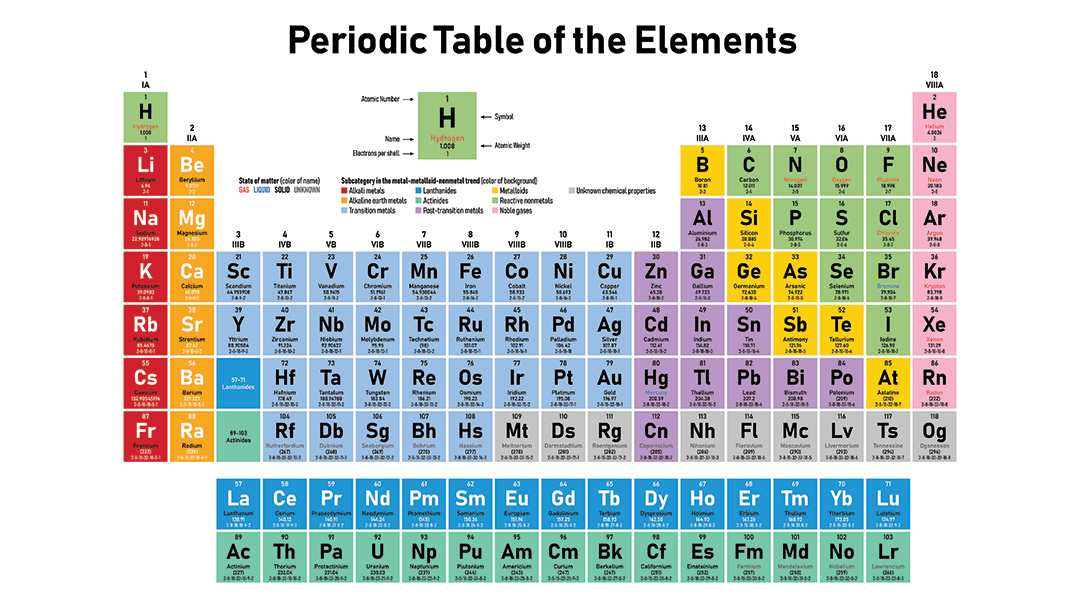
Take a look at the periodic table of the elements:

https://www.sciencenewsforstudents.org/article/scientists-say-periodic-table

You will find Yttrium (symbol “Y”) just below Scandium (#21, Sc) in column three. Beneath that you see the box for the lanthanides, elements 57 through 71. You have to imagine that row of blue (La to Lu) squeezed into the space between Barium (Ba, #56) and Hafnium (Hf, #72). I’ve even seen it represented in 3-D with the blue row of lanthanides popping out of the page toward the reader.

Columns on the periodic table are called “groups.” Elements in the same group have similar properties. This is due to their electron arrangement. All the elements in group one, for example, have one electron in their outer shell and this makes them highly reactive. They readily form positive ions. All the way to the right, in group eighteen, the elements have filled outermost electron shells and are thus inert. They don’t readily ionize.

You’ll see that the element yttrium is in the same column as the element lanthanum, #57, the “head” of the group called lanthanides. We talked about this group in a previous post. These materials, for historical reasons, are called “rare earths.” Yttrium and lanthanum have the same outer shell electron configuration and thus have similar properties. Although it is not technically a “rare earth” like lanthanum and the rest of that row (57-71) it is close enough to be classified with them.

Yttrium is more abundant than silver, being found in the earth’s crust at 31 parts per million. Silver checks in at significantly less than 0.1 ppm. Yttrium, like all the lanthanides, is never found in nature as a pure metal. It is mined from the same sources as the rest of the rare earths.

Yttrium is used in video displays to make red colors. It is used to make synthetic garnets and as an alloying agent for magnesium and aluminum. It is also used in lasers. Yttrium, like erbium, terbium, and ytterbium, is named for the village of Ytterby in Sweden.

The United States consumes about 700 metric tons of yttrium annually.

#11, Sodium

Sodium’s symbol Na is from the Latin word natrium. The Romans did not know about free sodium metal as it does not exist in nature. Humphry Davy first isolated pure sodium metal in 1807. Natrium probably referred to one or more of the common salts of sodium metal, like table salt (sodium chloride, NaCl), or perhaps soda ash (sodium carbonate Na2CO3), baking soda (sodium bicarbonate, NaHCO3), or caustic soda (sodium hydroxide, NaOH). All of those chemicals are of immense importance in modern manufacturing and have also been used domestically for millenia.

Sodium metal is not much in demand. It is too hard to store as it reacts quickly with air to form an oxide and reacts explosively with water. Sodium is bound up in crustal rocks in a dizzying variety of minerals and is among the most abundant of all the terrestrial elements. It is the compounds of sodium that matter, particularly sodium chloride, as sodium ions (Na+) are essential to metabolism. The free sodium ions play a role in regulating blood volume, blood pressure, and blood pH.

When you discuss dietary sodium with your doctor you are really talking about your salt intake. Adult humans need about 500 mg per day. Dietary recommendations are for 1-2 grams per day but most Americans consume twice that. Salt is present in packaged foods and common preservatives include sodium benzoate, sodium nitrite, and monosodium glutamate. If you need to limit sodium you need to avoid prepared foods! Take a look at the sodium content of your groceries the next time you go shopping—you will find it an eye-opening experience. Too much sodium in the diet can lead to cardiovascular complications.

One interesting use of salt is in nuclear reactors. Molten sodium chloride can be used as a coolant. Its high temperature (700 Celsius) means it can more efficiently transfer heat from the reactor core to the boiler. Some reactors actually include the nuclear fuel as part of the molten salt mix! The technology is well-studied and has proven to work but has not been widely adopted. Interest in nuclear power as an alternative to carbon-based energy is increasing. Perhaps we’ll see a nuclear renaissance in the coming decades.

Sodium finds a use in sodium-vapor lamps. You’ve seen them in every parking lot and along every freeway. Like fluorescent lights they are efficient (about 100 lumens per watt) and long-lasting. Sodium light has a distinctive yellow color. A flame test with table salt or other sodium compounds will also give a yellow result.