San Bernardino is the largest of the Golden State’s 58 counties. It’s twice the size (~20,000 square miles) of second-place Inyo (~10,000 sq. mi.). Inyo County, by the way, is about the same size as Massachusetts. Kern County comes in third place, roughly 8,000 square miles.
At the southeast edge of Kern county, abutting the San Bernardino County line, is the town of Boron. It sits on the western edge of the vast Mojave Desert. It’s about 85 miles east of the San Joaquin Valley metropolis of Bakersfield. SR-58 climbs from there over Tehachapi Pass to get to Boron. Continuing eastward you’ll cross the junction of US-395. Barstow and I-15 are forty miles away. South of Boron is Edwards Air Force Base and its massive dry lake bed landing strip.
Two thousand folks live in Boron. Once it was nowhere, and then it was somewhere. Prospectors discovered borax in the early part of the 20th century and that changed everything. A mining town was born. Today the open pit mine (owned by Rio Tinto) is the largest in California and supplies half the world’s borates.
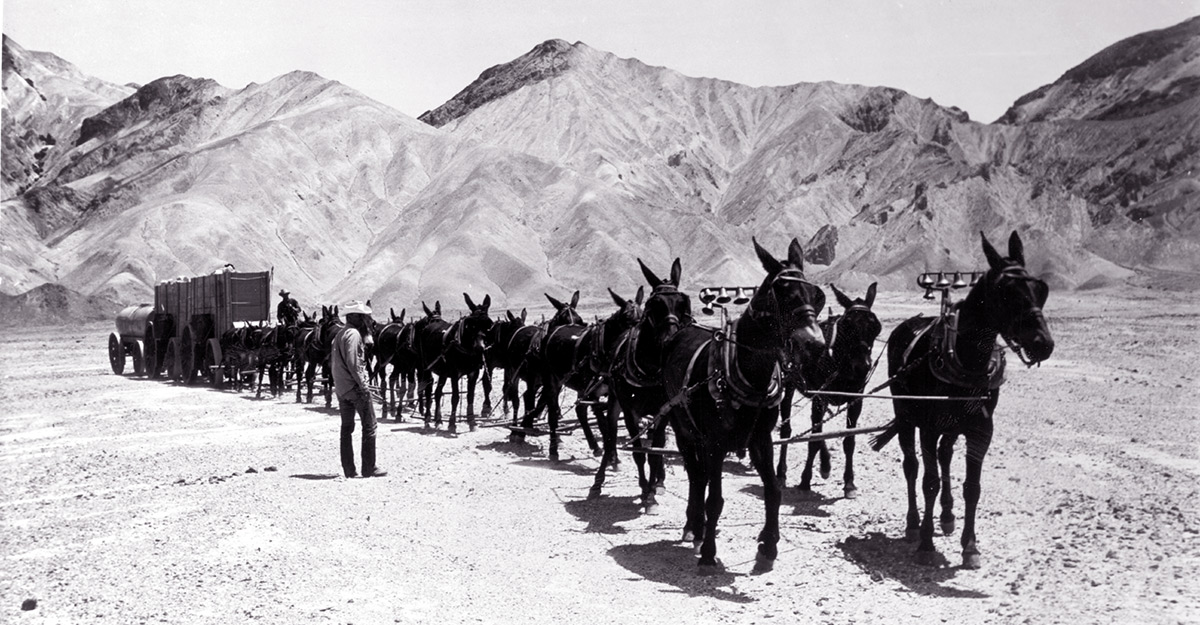
Sodium borate (Na2H20B4O17) aka “borax” is the primary ore. It was made famous by the 20 Mule Team brand of detergent additive. You’ve seen the iconic images of the wagon trains that hauled borax from mines in Death Valley to the railroad in Mojave:
Boron compounds have a huge number of applications. They are used in glasses, ceramics, flame retardants, fluxes, alloys, insecticides, adhesives, wood preservatives, lubricants, fertilizers, and much more. Elemental boron, a metalloid, is a neutron absorber and is used in nuclear reactor control rods. It is also an electron acceptor (or “p-type dopant”) and added to silicon-based semiconductors. Boron is also an essential nutrient for plants but it is not clear if boron is necessary in animal physiology.
About four million tonnes of boron minerals are produced annually.
 Mark C. O'Connor