But not in a good way. Strontium, in its pure metallic form, is soft and silvery-white but tarnishes readily. It’s not found in nature except in compounds. Like its neighbors in columns 1 and 2 on the periodic table strontium is quite reactive. Humphry Davy first isolated it in 1807.
The primary isotope of strontium has 38 protons and 50 neutrons and thus an atomic mass of 88. A radioactive isotope of strontium, Sr-90 (52 protons), is a product of nuclear fission. Nuclear reactors are a source and the long half-life (29 years) makes it a serious high-level waste issue. Sr-90 is also in the fallout from atomic bombs.
Strontium sits right underneath calcium on the chart and is biochemically similar to this crucial, bone-building element. Sr-90 has a nasty habit of substituting itself for calcium in bones. Exposure to fallout can result in bone cancers and leukemia. Typically the Sr-90 is inhaled or ingested unknowingly. Fallout is composed of a large variety of particulate debris, much of which is too small to see. And soils and water tables can be contaminated miles from any blast as the fallout can be borne aloft by the winds.
Those of us born after the atomic testing of the 1950s and 1960s have radioactive isotopes in our bodies. Sr-90 would be a likely one. Fortunately the amounts of these materials are pretty small, and the major events since then (Three Mile Island, Chernobyl, Fukushima) were insignificant by comparison to the wanton and irresponsible testing after WWII.
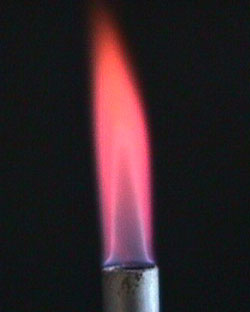
Strontium was added to glass to block the X-rays produced by cathode-ray tubes. Those CRTs were common in the early computing days, but have since been replaced by newer technologies. Strontium compounds are used in fireworks, where they give off bright red colors. I remember well doing flame tests with my students and seeing the lovely scarlet hues produced by strontium chloride:

 Mark C. O'Connor