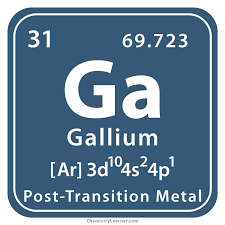
Dmitri Mendeleev predicted the existence of Gallium when he created his first periodic table. He expected to find an element similar to aluminum (and in the same column, group 13). Mendeleev called the element eka-aluminum, meaning “beyond” aluminum, and his prediction was confirmed by a French scientist in 1875. Paul-Émile Lecoq de Boisbaudran named the new metal after his native country (Gallia is Latin for France).
Gallium is surprisingly abundant in the earth’s crust but it is too reactive to exist in its native state and it forms no significant minerals by itself. It is obtained as a by-product from the processing of aluminum and zinc ores. China and Russia have the largest reserves.
Only a few hundred tonnes of gallium are produced worldwide but it is nonetheless an essential material in the semiconductor industry. Gallium arsenide, gallium nitride, and indium gallium phosphide compounds are critical parts of integrated circuits, logic chips, diodes, pre-amplifiers, lasers, and solar cells.
If you had a chunk of gallium it would melt in your hand (much like chocolate!). Gallium has no known biological role but clearly we can’t live without the stuff.
 Mark C. O'Connor