The Seven Seas

We know more about Mars than we do about our own oceans.

From phys.org*:

An international group of scientists, co-led by researcher Ariadna Mechó of the Barcelona Supercomputing Center—Centro Nacional de Supercomputación (BSC-CNS), observed 160 species on seamounts off the coast of Chile that had not yet been known to live in the region and suspect that at least 50 of these species are new to science.

This illustrates the folly of deep-sea resource extraction. We barely know what we are getting into. Terrestrial mining is a well-understood, long-practiced human endeavor. If we are going to mine for the things we need, we ought to do it in a way that we understand. The ocean is the source of all life on earth Recklessly digging it up is foolish. We have too much to learn first.

The seamounts are part of the Salas y Gómez Ridge which is an underwater mountain range extending from Chile to Rapa Nui (Easter Island). Here’s more:

This ridge hosts one of the most unique and biodiverse seascapes on Earth, with an extremely high rate of endemism, critical habitats for benthic organisms, essential migration corridors for highly mobile species, and the presence of over 80 threatened or endangered species.

Here’s a dragon fish that lives there:
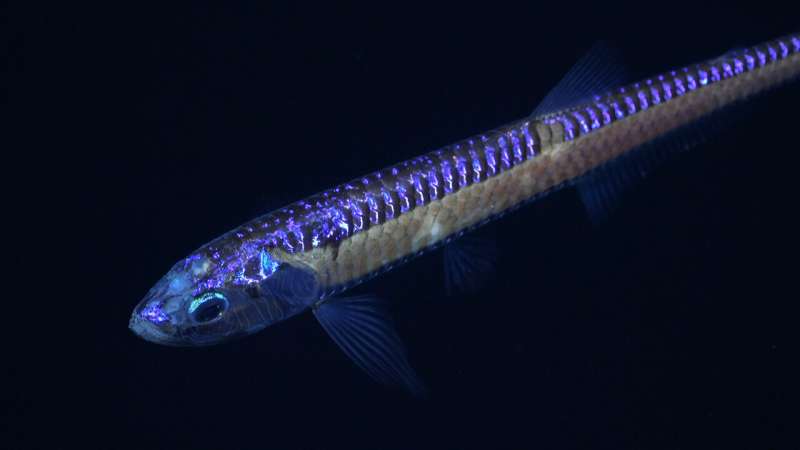
https://phys.org/news/2024-04-team-potentially-deep-sea-species.html

Instead of searching for aliens or extraterrestrial intelligence maybe we should learn more about the vast seas that nurture our lives. Unlike space, they are filled with life. We don’t have to go far to find amazing and exotic creatures and ecosystems that are far more interesting that we can imagine.

*”Research team discovers more than 50 potentially new deep-seas species in one of the most unexplored areas of the planet” (April 12, 2024 by Barcelona Supercomputing Center)
LLMs + SEO = LLMOs

Bruce Schneier over at Schneier on Security writes:

The web has become so interwoven with everyday life that it is easy to forget what an extraordinary accomplishment and treasure it is. In just a few decades, much of human knowledge has been collectively written up and made available to anyone with an internet connection.

But all of this is coming to an end. The advent of AI threatens to destroy the complex online ecosystem that allows writers, artists, and other creators to reach human audiences.

The internet let us all become creators. Writers. Artists. Publishers. You Name It. Content was no longer the province of gate-keeping institutions like book and music publishers, movie studios, art galleries, or libraries. Anyone and everyone had a voice. Naturally, it got a little loud.

So the folks at Google came up with SEO or Search Engine Optimization. These were things you could do to amplify your voice. The idea was that SEO would help the user to better find what they wanted. Of course the scammers were all over that and had counter-measures for everything else (like PageRank) that came their way. The result is that there is no way to know if the hits you get on your search are legit. I think we’ve all seen the shrinking range of search results over the years. And who hasn’t been frustrated by the long list of links that reference the same source? Cory Doctorow calls this degradation of quality enshittification and I think it’s a perfect word.

On the scene these days are ginormous computer programs called LLMs or Large Language Models. ChatGPT is an example of such a thing. All this stuff gets lumped under the umbrella term AI.

LLMs are fed all the data they can handle. ChatGPT is so voracious there’s talk it will run out of material to consume in a few years. Everything produced by all of us will some day be absorbed by these machines and reduced to impersonal bits.

I love a classic BLT. Bacon. Lettuce. Tomato. Toasted bread, some mustard and mayo. Yumm. But put it in a blender and turn it into a BLT Smoothie? Yeeucch.

That’s what our friends over at AI, Inc. want. They think chatbots will do a better job of managing all that information out there. And that is certainly possible if all we care about is INFORMATION. You add SEO, that, is “optimization” to LLMs, and you’ll get LLMOs. These unholy constructs will hoover up all the information in the world and customize it into any number of flavored potions. As Schneier says:

If you want to know about climate change, or immigration policy or any other contested issue, there are people, corporations, and lobby groups with strong vested interests in shaping what you believe. They’ll hire LLMOs to ensure that LLM outputs present their preferred slant, their handpicked facts, their favored conclusions.

The internet was like a flea market in the early days. Then it evolved to more like a suburban mall and soon it will be more like a cable-TV subscription. Lots of channels but not much choice. Search engines, in the early days, made it possible for people to connect with other people. Now we have AI-synthesized answers that cut people out of the equation.

That makes the internet a sterile place. Perhaps people will discover what they are missing and begin to demand (and create) an alternative.

A wee bite

The ancients were able to predict eclipses. That’s because they aren’t random. Rather, they are periodic. They occur in cycles.

The current eclipse is part of Saros Series 139. A saros is 6585.3 days long which is 18 years, 11 days, and 8 hours. Eclipses separated by one saros have a similar geometry. A series will typically last 12 to 13 centuries and contain 70 to 80 eclipses. This particular series began on May 17th in 1501 and will end on July 3rd in 2753. Saros Series 139 is 1262.11 years long.

Saros was a Greek word chosen by Edmund Halley to represent 222 lunar months (another way to express 6585.3 days).

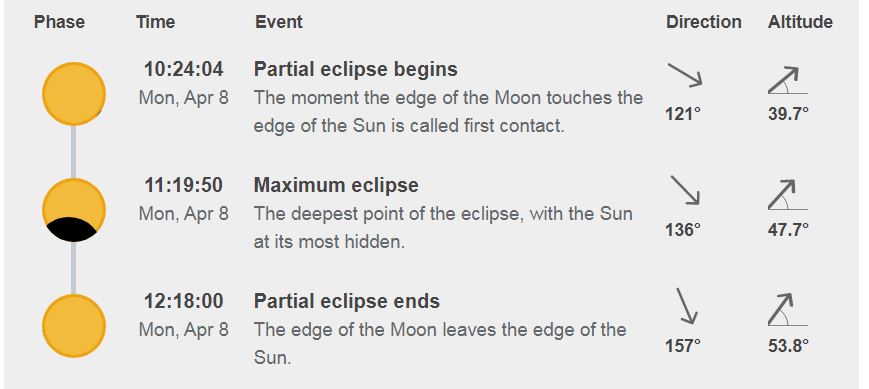
Here at home it was just a wee bite. You had to travel to see the total eclipse. I hope the eclipse-chasers got to experience totality, wherever they were.

https://www.timeanddate.com/eclipse/in/usa/yreka?iso=20240408