Europium, #63

Color TV broadcasts started in this country in the 1950s but really didn’t take off until the mid-60s. In 1972 half of the television sets in the US were color. I remember our family getting a color TV (and cable!) right about then. Very few all black-and-white TV stations remained by the end of that decade.

One of the barriers to color reception was red. Color is displayed on screens by means of phosphors. These are materials that emit light when exposed to radiant energy. In a TV, an electron beam activates the luminescent substance. Different chemicals give off different colors.

In the case of red, the key breakthrough was the use of the lanthanoid or rare-earth element Europium. Yttrium orthovanadate (YVO4) is “doped” with a small amount of europium oxide (Eu2O3) to produce a bright red glow. TV sets contain about a half a gram to a gram of Eu2O3.

The European Union takes advantage of europium oxide’s luminescent property by embedding it in fibers in their banknotes. This is an anti-counterfeiting measure. You can see the red stripe that emerges under UV light in the 100-euro bill:

Europium has no known biological role and is not toxic. Europium is one of the rarest of the lanthanoids. In the Mountain Pass Mine in California, our only domestic source of REEs (rare earth elements), europium is a tiny fraction (0.2%) of the ore.

A material world

One of the reasons that energy costs go up over time is that it gets harder to extract a resource as it gets depleted. The oil that was close to the surface or in easily accessible sites was pumped out first. These days we need deeper wells. Or wells in crazy places like the Arctic or the open ocean. And we have to employ new methods like hydraulic fracturing (“fracking”).

The low-hanging fruit has been picked.

This is an issue for any resource. Minerals are no exception. Here’s a bit from an Allianz Research trade report (Metals and Mining: Do we live in a material world?):

“Furthermore, as accessible high-grade deposits become rare, mining companies are increasingly targeting deeper or lower-grade deposits, which require more sophisticated, hazardous and costly extraction techniques.”

If you can’t grow it, you have to mine it. But it is getting harder, and it takes longer. The “green energy” transition will require enormous investments in mines and minerals. That’s going to require planning ahead as the lead times are significant. Take a look at the chart below. Mines are big, messy, complex things with a lot of impacts. And the industry hasn’t done much to win the public’s trust so you can understand the pushback in the form of increased regulations.

Of course we could always just get our minerals from mines in the third world, or places where there is little or no oversight. But miners don’t like to invest in sketchy places. They like law and order. They want to keep their properties and their profits. Here at home we have the regulations in place so that we can mine intelligently. And we have courts and rules and banks and everything else for businesses to prosper.

So, let’s get those shovels in the ground already!

Tellurium, #52

Tellurides are minerals formed with the telluride anion (Te2-). Both gold and silver form tellurides, the most common being a mineral called sylvanite [(Au,Ag)Te4]. Gold and silver were mined extensively around the town of Telluride in Colorado, but interestingly no gold telluride minerals have been found there! Seems like the Chamber of Commerce needs to get on that one. The local mines were rich in lead, zinc, and copper as well.

Tellurium (Te, #74) is a metalloid in Group 16 of the periodic table. Groups (or “families”) are the columns in the table—the rows are called periods. Tellurium is in the same family as oxygen, sulfur, and selenium. There are fungi that can substitute tellurium for either selenium or sulfur in metabolic processes but it otherwise has no biological function.

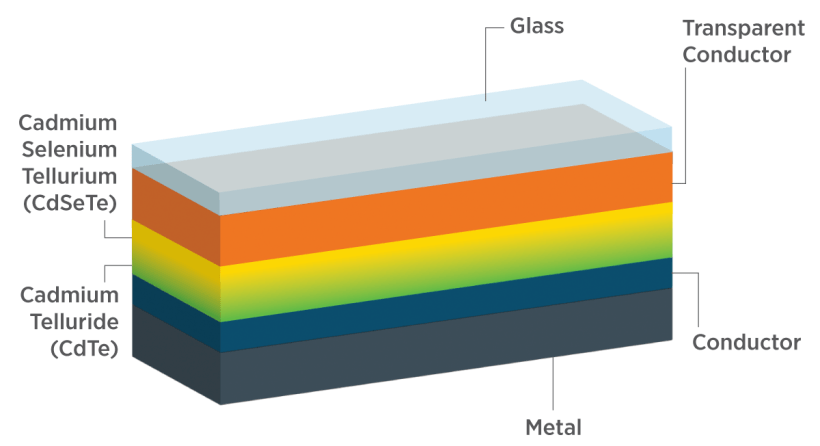
Tellurium is usually obtained as a by-product of copper refining. Its primary use is in solar cells. Cadmium telluride (CdTe) panels are more efficient than the more common crystalline silicon types so expect demand for this rare element to increase.