Cerium (Ce) is the most abundant of the lanthanoids. You find those in row (period) 6 of the periodic table. The two periods on the bottom of the chart (row 6 and row 7, the actinoids) make up the “rare-earth” elements. In our tech-sodden world demand for REEs (rare-earth elements) continues to grow. All of these elements were first isolated as oxides.
The oxide of cerium (CeO2), known as ceria, has a variety of uses. The one that interests me is in automobile catalytic converters. (When people were stealing these things they were going after the platinum and other precious metals, not the ceria. Rare-earths aren’t all that rare!)
The Environmental Protection Agency mandated automobile exhaust emissions control as a result of the 1970 Clean Air Act. By 1975 almost all cars were equipped with catalytic converters. The impact on air quality (and thus public health) was noticeable in every city but particularly in the LA basin. Smog in Los Angeles had been part of the landscape for so long people were astonished to see the mountains after decades of pollution-obscured vistas.
A lot of short-sighted people hollered about such government interventions (like banning lead in gasoline) back in those days. The same idiots are still screaming today even though we have proof that environmental regulations can, and do, improve life for everyone. I wish we could count on the Holy of Holies—the “marketplace”—to get clean air. But we can’t. We have to order the assholes who pollute the air to stop doing it.
And we have to look in the mirror, too. Our insatiable demand for more of everything comes at a cost.
Scientists in Ireland have synthesized ceria (they call it cerianite) in the laboratory. Although the element cerium has no known biological function the compound cerianite shows potential as an antioxidant and as an anti-inflammatory agent. Here’s a picture of some of the particle types they made:
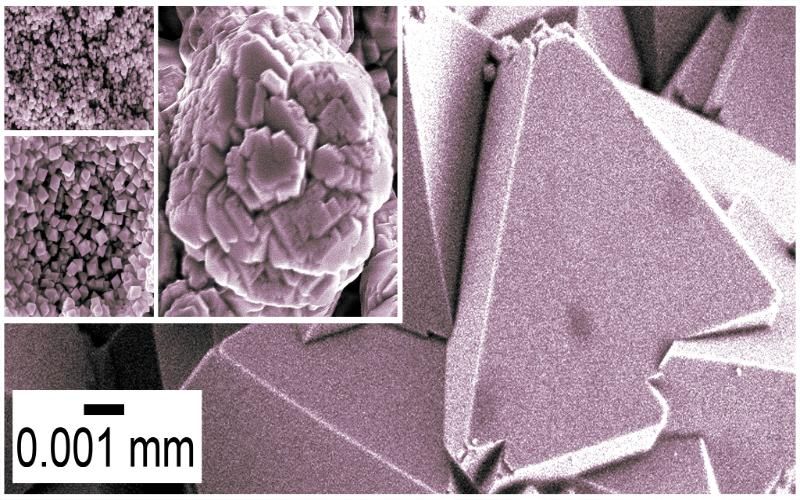
They range from nano-particles (1-100 nm in diameter) to micro-particles (100-2500 nm). A nano-meter (nm) is 10-9 or one-billionth of a meter. The scale on the photo shows 0.001 milli-meters which is 1000 nm.
A molecule of the simple sugar glucose is about one nanometer across in size. A bacterium would be on the order of one thousand nanometers. (Wolfram Alpha is a fun resource!)
 Mark C. O'Connor