I bought some “organic” asparagus at Raley’s last week.
The bunch had a tag on it from Gourmet Trading Company. They source their asparagus from Peru and it is available year-round.
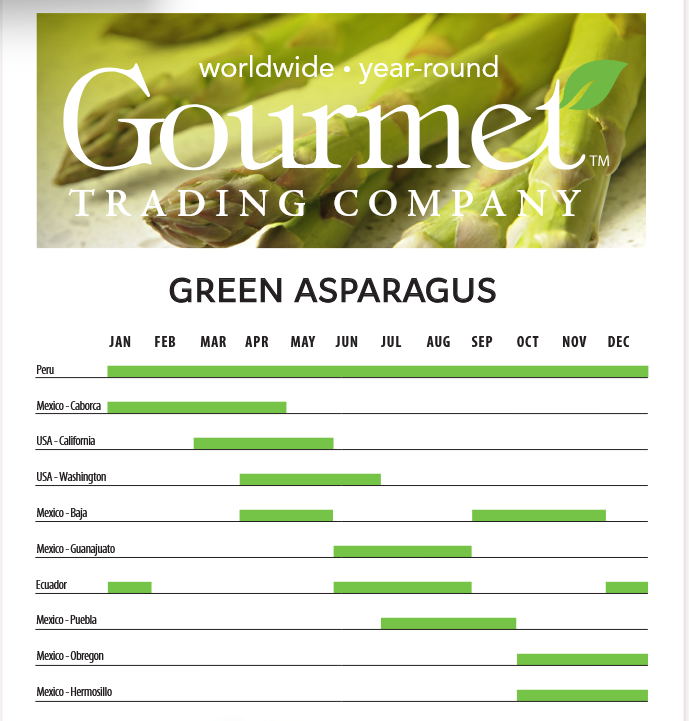
As you can see from the chart asparagus is a spring crop here in the Pacific Northwest. I bought my bunch in the middle of winter!
It takes about two weeks to ship a container from Lima or Callao in Peru to coastal ports like Los Angeles or Savannah. Obviously produce has to be refrigerated, but even carefully packaged and stored vegetables lose much of their nutritional value a few days after harvest. These folks say asparagus has a shelf-life of 5-7 days in your fridge. But what if it hasn’t gotten to my fridge yet?
To be fair, the asparagus from Raley’s was crisp and delicious. Obviously I cannot evaluate the nutritional content. And I’m not sure I would be able to distinguish the off-season Peruvian asparagus from local, seasonal asparagus. Perhaps in a side-by-side comparison I might be able to pick out the “fresher” alternative, but I don’t think so.
There is this idea that we should reduce our “food miles.” The energy/carbon footprint of global trade is massive. (Most foodstuffs, at least, are shipped and not flown.) At the same time, people in poorer countries and communities depend on the income from farm exports. Americans have the luxury of food surplus. We get to choose what we eat, when we eat, and how much we eat. Even in a small, nowheresville-town like Yreka I can get an astonishing variety of food from all over the world.
Economists want everything to be about efficiency and comparative advantage. Economists are analytical types and they like stuff to fit neatly into their definitions and equations. Most of them don’t “think outside the box” of their discipline. Agriculture is not an entirely economic activity! Farming is not just a business, it is much more fundamental to our existence and a deep and enduring part of our cultural inheritance. It’s not just about dollars-and-cents, but about how we live and our relationship to our planet.
Being a “locavore” may not always be practical. I like coffee, for example. And everyone I know (except me) likes bananas! But exceptions don’t undermine the big idea. The big idea is that we should have robust and healthy local agriculture to support robust and healthy communities. That’s a no-brainer.
What does it take to have robust and healthy communities? For one thing, don’t vote for assholes like the current one in White House. People like that care only about themselves, about getting richer, and about “getting one over” on their perceived opponents and enemies. The world doesn’t get better when people like that usurp and wield power.
I want a world where people work way less and have way more time to be with their families and take care of each other. I want a world where everyone has access to quality food and fresh water. Where no one is un-housed. Where people are free from tyranny and abuse. I don’t know how to make this world any more than you do. But we won’t get anywhere if we don’t make these our goals.
Think big. Think about the whole world. It’s not just a bunch of asparagus! It’s a chain of connections stretching across the globe and we are all part of it.
 Mark C. O'Connor
Sometimes it just comes down to the asparagus. That being said, I planted some last summer in my newly reconstructed garden and harvested the first dozen stalks a couple of weeks ago. Talk about fresh! Absolutely delicious.
I’ll do what I can to share it with friends and acquaintances and make the world surrounding me a bit better. Cheers!
LikeLiked by 1 person
Awesome!
LikeLike