When people invented the internal combustion engine they really didn’t consider the consequences. Turns out that these remarkable, revolutionary devices were noisy, smelly, and smoky.
And the smoke turned out to be not only poisonous to people but a serious global pollutant.
I live in a small town in a rural area. We don’t get urban (that is, automotive) air pollution. We are too few and too dispersed. So we don’t notice the issue. Most of the world lives in urban regions and air pollution is a serious thing. I haven’t included non-automotive (i.e. industrial) sources, but those are of course significant. In my home town, our biggest source of air pollution is home-heating wood stoves. Funny thing most residents here don’t view that (visible) smoke and those (invisible) particulates as pollution!
Those of us who remember the brown skies that covered the LA Basin the 1970s have reason to be thankful for the invention of the catalytic converter. By the 1980s the catalytic converter was in almost every car. It’s a standard item now. The country phased out leaded gas and phased in pollution control in those two decades. It’s been so long now that people have forgotten how well these schemes work. Just check out the air in LA. Fifty years later: more people, more cars, but cleaner air.
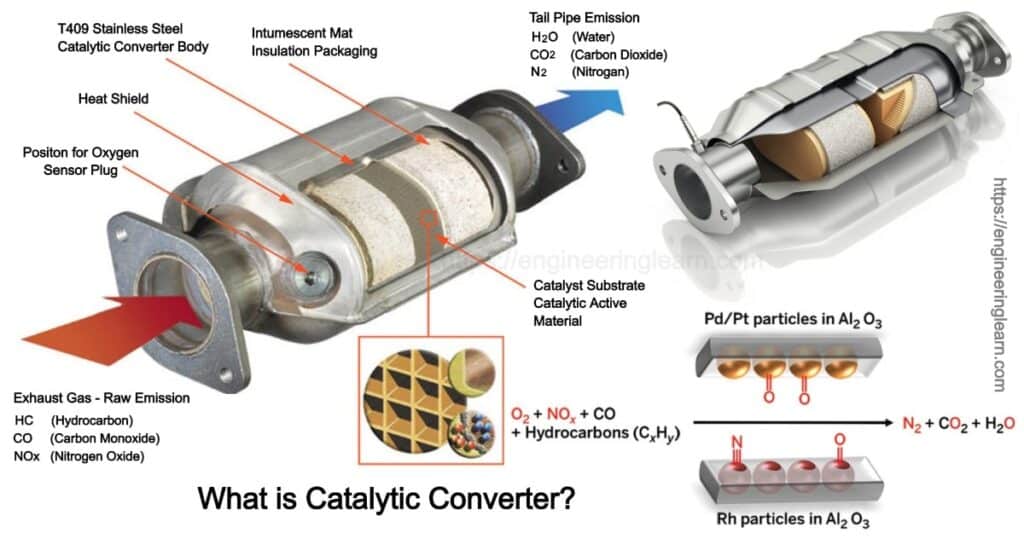
Catalytic converters, as the name implies, use a catalyst. The precious metals platinum, rhodium, and palladium (Pd, #46) are the most common. Your car probably has 3-7 grams of palladium in its converter. A US nickel weighs 5.00 grams for comparison.
Speaking of the US Mint, that’s another use for palladium—coinage. You can invest in palladium for a mere $1845 per troy ounce. The palladium coin below (it uses the same design as the old “Mercury” dime) has a face value of $25.

 Mark C. O'Connor