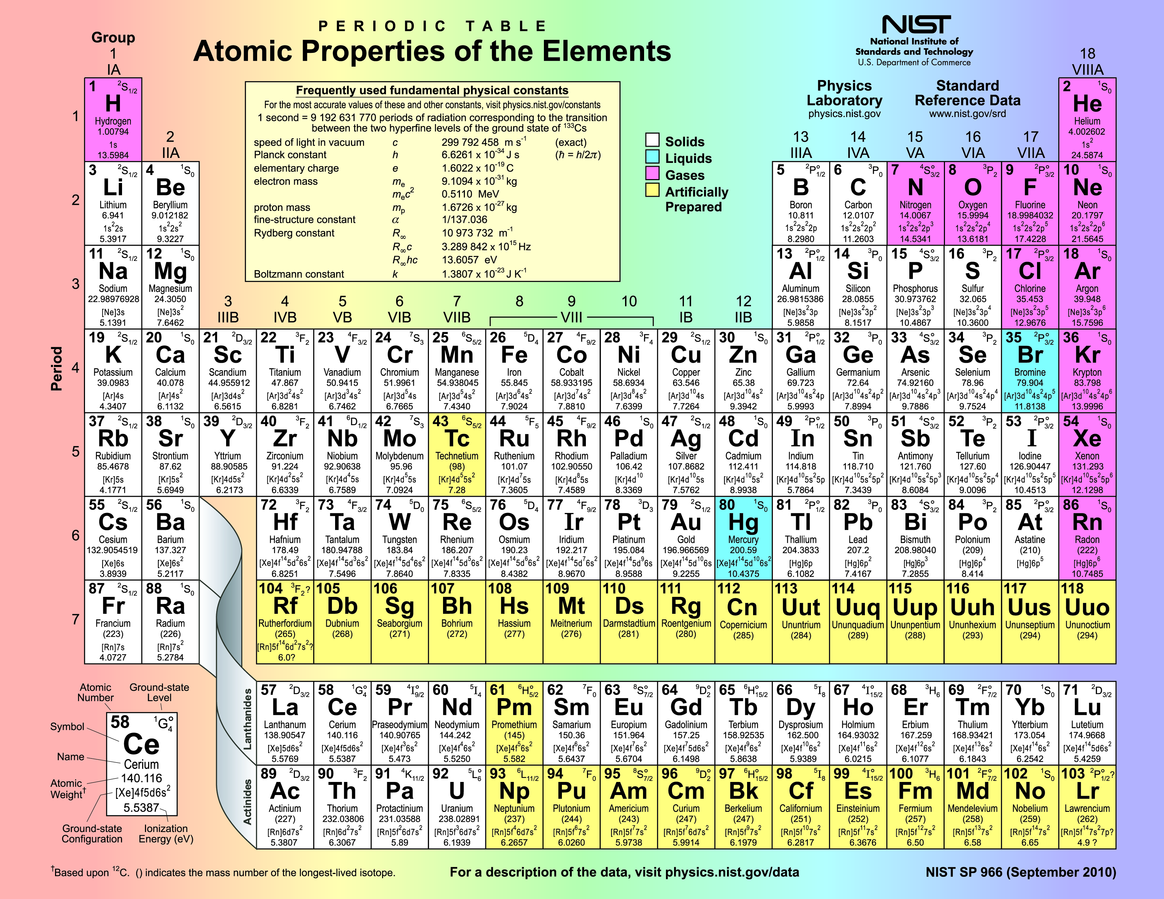
The so-called “alkali metals” form column one—the first period—of the periodic table. Some of these are familiar, like lithium (#3), sodium (#11), and potassium (#19). We know these things from compounds like lithium carbonate, the medical “lithium” that is used to treat mood disorders. Of course we need sodium chloride (table salt) in our daily diet for its essential role in our physiology. And we eat bananas (or drink OJ) to get potassium salts, another life-sustaining nutrient.
But the actual metals are rare. Outside of chemistry class most folks will never see these things as pure metals. They are typically stored under oil as they oxidize rapidly in the presence of air. I used to toss a chunk of sodium into a bucket of water (outdoors, of course!) for the lovely explosion it made. Lithium, sodium, and potassium are less dense than water and will float. But they will react violently with the water, releasing hydrogen gas which the heat of the reaction will then ignite. Very cool! And the pH of the water surges up, making it alkaline, hence the name “alkali” metals.
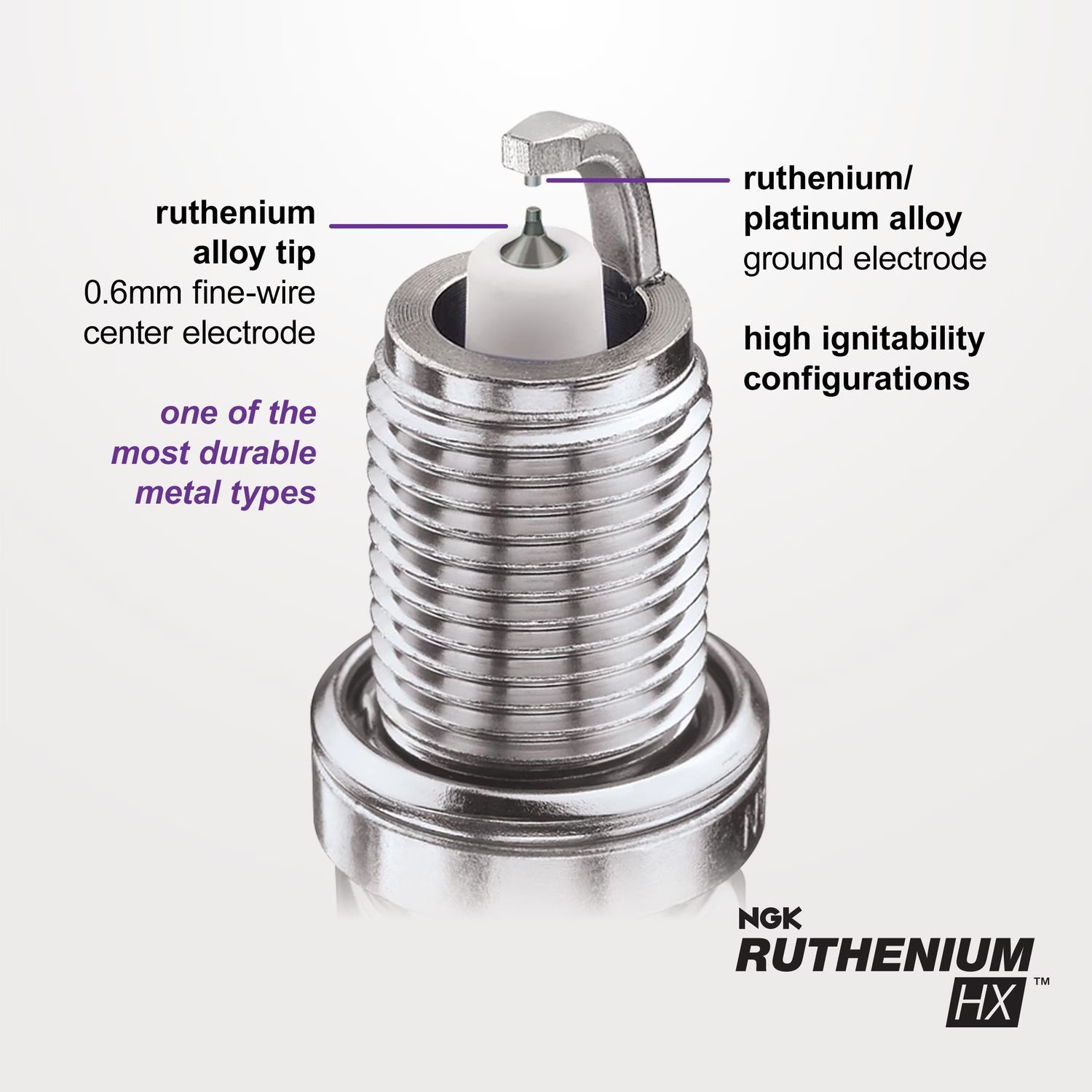
Rubidium, #37, has all the same properties as the above except it is denser than water. And it has no known biological function. But it is capable of replacing potassium in organisms and thus can be used as a biomarker.
Rubidium has few industrial uses but has many technical applications in research laboratories. It is used as a laser target, for example, and in atomic clocks. It is named for the ruby color the compounds emit when ignited, and some of the salts are used in fireworks.
I recently finished reading Charles Darwin’s The Origin of Species.
The full title is actually On the Origin of Species by Means of Natural Selection, or the Preservation of Favoured Races in the Struggle for Life.
It is an extraordinary work. Mostly because it is one of the few scientific pieces of great importance that is immediately accessible to the general reader. One is hard-pressed to read Newton’s epochal Principia, even though it has a helpful diagram on almost every page, because it is mostly a math book. You need scratch paper and a pencil by your side! The same can be said for Copernicus or Kepler. Albert Einstein’s papers from 1905 that established his reputation are short, but dense and obscure. And again the math is a barrier.
Perhaps something like Rachel Carson’s Silent Spring compares, although that is a very brief book and was clearly written for mainstream reception. Darwin was writing to his fellow naturalists. Her book, it could be argued, had a similar impact. Carson’s views have ultimately prevailed among the citizenry, few would argue with her claims today. Darwin, not so much. Anti-evolutionary sentiment is very strong in American education and politics despite its widespread acceptance throughout the world.
The discovery of genetics and the means of inheritance only strengthened Darwin’s (and Alfred Russel Wallace’s) evolutionary schemes. No scientist today questions the idea of the mutability of species. Darwin’s book actually addresses a simple question: does life change over time? Most authorities of Darwin’s time (the book was published in 1859) believed that all living species were specifically created. A species, by definition, was immutable.
The Origin demolishes that point of view. What makes it a great book is that Darwin does it with a scalpel and a smile. The book is not a polemic. It’s a careful, humble, and meticulous exposition of something that became obvious to Darwin over the course of his journeys and studies. He brings the reader along with a clear awareness of the arguments against his ideas and shows how the old ways of thinking just don’t work as well.
That’s the key. Darwin shows, chapter after chapter, how natural selection and variation account for what we actually see in the natural world. It becomes clear that the objections to an evolutionary outlook are grounded in philosophy and religion, not in observation of real things.
The Origin shows a powerful but patient intellect at work. Darwin does not like to leap to conclusions despite his passion for his theory. He takes great pains to support his claims and show how evolution, as a paradigm for the study of life, is more illuminating, more interesting, and more encompassing than the existing modes of thought.
He makes his case. By the end of the book you can see how the new theory supplants the old because it has better explaining power. Reading Darwin helps you understand the scientific method. He starts with the facts: his observations and the results of his experiments; and the mountains of evidence from the work of others. Then, and only then, does he postulate the unifying concepts.
Be suspicious of arguments that start with the principles first. The principles should emerge from the evidence. If you state the theory at the beginning, it will be easy to find examples that support your point of view. If you look first, and then examine what you find, you might have a chance to figure out the big ideas. The first method is biased. The second gives the truth an opening.
Earth is known as a watery planet. Problem is, despite all the water, most of it is salty. There’s really not all that much fresh water available.
You can live perhaps for a few days without water. That’s a simple fact of biology that cannot be transcended no matter how smart, rich, or technologically-enabled you are! Our Silicon Valley Tech Bro Overlords can die of thirst just as easily as the rest of us.
It would behoove the human race to take better care of its freshwater resources.
Hafnium (Hf) is found with zirconium and that’s how most of it is obtained. The two elements are very similar although zirconium is about half as dense as hafnium.
The ores of titanium (rutile and ilmenite) are the source for zirconium and thus for hafnium. Zirconium is used as cladding for fuel rods in nuclear reactors. It has to be pure and any hafnium has to be separated out. The hafnium thus obtained is used for nuclear reactor control rods as it is a good neutron absorber.
A control rod speeds up or slows down a nuclear chain reaction due to its ability to regulate the flow of neutrons. Those neutrons are supplied by the fuel rods (uranium, usually). A nuclear reactor is a collection of fuel rods and control rods. Their movement in and out of the reactor core regulates the rate of fission. The heat energy from nuclear fission (atom-splitting) is sent to a boiler that makes steam. The steam runs a turbine which ultimately drives an electrical generator.
Hafnium is used in alloys and its oxides are used in integrated circuits.
Much is being made about “critical minerals” these days. The energy transition—electric vehicles, solar and wind power—will make enormous demands on our supply chains. Big Tech’s obsession with AI and data centers will all also fuel more demand, and this industry is already insatiable. Everyday Americans use more energy and buy more stuff every year.
The usual response to the demand for more minerals (like copper, cobalt, nickel, rare earths, etc.) is to build more mines. The United States is rich in natural resources but the mining industry has left a legacy of pollution and degradation and thus it has engendered mistrust from the public. It’s hard to build a new mine these days. The response by our autocratic regime is a predictable one: cut oversight and regulations and “fast-track” new projects. And throw some money around.
But what if there is another way?
A mine is a big hole in the ground. A lot of material gets moved and has to be dumped on site. The ore gets processed and the “waste” rock gets dumped on site. Some of this material is underwater in ponds. The dams holding back these ponds can break and cause catastrophes, like this one in Brazil (Brumadinho) in 2019 that killed nearly 300 people:
There are tailings ponds all over the world, many with dams just waiting to fail. There are piles and piles of waste rock and tailings all over the world. The thing is, this stuff isn’t waste. It’s processed rock. It contains, albeit in lower concentrations, the very minerals that were being mined in the first place.
A new study from the Colorado School of Mines suggests that 90% of our country’s “critical minerals” needs could be met by mining tailings piles. This would be easy mining. No new holes to dig. The material you want to work is already on the surface and has already gone through a preliminary sorting.
We have the world’s most valuable garbage. When we ship our garbage overseas, poor people there go through it for valuable stuff so they can eke out a living. At some point, we have to stop thinking about waste, garbage, refuse, and trash. These things don’t really exist! They are just resources that have yet to be returned to the system.
Miners should be required to process their tailings and waste rock before they are allowed to dig new mines. Old mines should be rehabilitated before building new ones. Public policy (i.e. government investment) should be directed toward “enhanced recovery” and the exploitation of what we used to think of as leftovers.
The modern metal industry, particularly steel, copper, and aluminum, depends on recycling. Scrap is critical to the production cycle. There are incentives in place to recover used metal. This kind of thing needs to be ubiquitous. It is especially necessary in the tech sector with its toxic obsolescence/upgrade cycle. We throw away functional tech just because it gets “old” and not because it doesn’t work anymore. Silicon Valley depends on voracious consumer demand for fancier, shinier, and prettier stuff every year.
The US has sufficient geological endowment in active metal mines to reduce the nation’s dependence on critical mineral imports. Demand is increasing for cobalt, nickel, rare earth elements, tellurium, germanium, and other materials used in energy production, semiconductors, and defense. This study uses a statistical evaluation of new geochemical datasets to quantify the critical minerals that are mined annually in US ores but go unrecovered. Ninety percent recovery of by-products from existing domestic metal mining operations could meet nearly all US critical mineral needs; one percent recovery would substantially reduce import reliance for most elements evaluated. Policies and technological advancements can enable by-product recovery, which is a resource-efficient approach to critical mineral supply that reduces waste, impact, and geopolitical risk.
Sitting on the patio at twilight there were sleek, black birds overhead, dashing about erratically. In silhouette they resembled accipiters with their long, pointed wings These birds were more slender though, and they moved more like flycatchers or even butterflies. Accipiters like Cooper’s hawks fly in straight lines or in smooth, aerodynamic arcs. This handful of birds seemed like they were chasing insects.
And that’s what Common nighthawks (Cordeiles minor) eat! Flying insects. Lots of them. Nighthawks are classified with Whip-poor-will’s and other Nightjars in the avian family Caprimulgidae in the order Caprimulgiformes. The Latin root “capri-” means “goat” and these are the Goatsuckers.
Why are they called that? It seems they have rather large mouth openings and ancient people believed their nocturnal habits included sucking milk from she-goats. Modern people believe a lot of crazy shit, too.
The nighthawks danced around a bit, darting to-and-for in search of prey. By the time it got dark they were long gone. I guess they need light to see like the rest of us!
Edward Hopper was thinking of night-time predators when he painted his masterpiece:
Normally I am one to get excited about new technologies. But with AI the story is different. I am hostile to the entire field. I get sick to my stomach every time I hear or see “AI.”
. . . the backlash against artificial intelligence, especially within circles sensitive to economic inequality and corporate overreach, is not a random or irrational phenomenon. It is an entirely predictable consequence of a decade scarred by tech disappointments and malfeasance, amplified by the unsettling ideologies and political stances of AI’s leading figures. The industry’s penchant for reality-bending hyperbole, coupled with legitimate concerns about intellectual property, data privacy, and job security, has created an environment where distrust is and should be the default position.
Diehl is a computer scientist who writes a lot about public policy.
The sad part about all this is that large language models and neural networks are really cool tools with some very interesting and important applications. But they are kind of like table saws—only useful to a small number of people. The “average joe” is not going to benefit from most of this stuff.
Diehl adds:
. . . the core reasons for the backlash are deeply rooted in the industry’s own presentation and practices. By cultivating an image characterized by unlikeable leaders, bizarre eschatological pronouncements, anti-democratic leanings, and ethically questionable methods, the AI industry has largely engineered its own public relations problem. It should not wonder why it faces skepticism and hostility; it is, in many ways, a backlash of its own making.
I’m old enough to have lived through many boom-and-bust cycles and seen lots of hype and failure. Right now, our Tech Bro Overlords are still living on the spectacular success of the iPhone. That wave has crested, but everyone is still riding it. There is no new killer app or killer piece of tech that will have the impact of the iPhone. Silicon Valley peaked out with that one. They desperately want to get back to that place of cultural and economic hegemony that the smartphone market produced.
But it ain’t happening. These guys are high on their own supply and clinging to their mythology about the transformative nature of their products. But there is no there, there, and no amount of hype is going to change that.
Make America Dumb has succeeded. In another act of ideological madness the head of the HHS (I can hardly bring myself to type his name) has cancelled funding for mRNA vaccine research. This is MADness: another act of impossible stupidity and cruelty, founded entirely on deliberate ignorance, fear-mongering, and a callous dismissal of years of hard work by thousands of dedicated people.
The anti-vaccine crowd has never been known for any kind of consistency or coherence in their world-view. This is an unfortunate consequence of the pseudo-spiritual woo-woo that became mainstream in the 70s and soon replaced any sort of intellectual rigor when it came to health and disease, nutrition, and fitness.
Criticism of the medical establishment and Big Pharma is certainly warranted. Things could be a lot better. But substituting hippy bullshit for actual research is just plain stupid.
mRNA vaccines are part of the movement toward more targeted, more personalized medical interventions called immunotherapy. Even the crystal-gazers want a better immune system! Well, this is how you get there. Cutting off funding for life-saving science because you are pandering to the dumbest bloc of voters in the country is morally reprehensible. That man is scum, and his boss is the Scumbag-in-Chief.
Thank you, anti-vaxxers! Your mentally bankrupt “philosophy” is going to bite you (and the rest of us) in the ass! Once you start down the road of trashing legitimate intellectual endeavors—like cancer studies—and the places where they are done—like universities—you will find it hard to recover. The people who do this work will go somewhere else. The companies that partner with these institutions will lose intellectual capital and their businesses will suffer. And the people like us who might benefit someday from quality scientific work will never see those fruits because the trees will have been ripped out by the roots.
This is how you Make America Dumb. This is MADness.
When people invented the internal combustion engine they really didn’t consider the consequences. Turns out that these remarkable, revolutionary devices were noisy, smelly, and smoky.
And the smoke turned out to be not only poisonous to people but a serious global pollutant.
I live in a small town in a rural area. We don’t get urban (that is, automotive) air pollution. We are too few and too dispersed. So we don’t notice the issue. Most of the world lives in urban regions and air pollution is a serious thing. I haven’t included non-automotive (i.e. industrial) sources, but those are of course significant. In my home town, our biggest source of air pollution is home-heating wood stoves. Funny thing most residents here don’t view that (visible) smoke and those (invisible) particulates as pollution!
Those of us who remember the brown skies that covered the LA Basin the 1970s have reason to be thankful for the invention of the catalytic converter. By the 1980s the catalytic converter was in almost every car. It’s a standard item now. The country phased out leaded gas and phased in pollution control in those two decades. It’s been so long now that people have forgotten how well these schemes work. Just check out the air in LA. Fifty years later: more people, more cars, but cleaner air.
Catalytic converters, as the name implies, use a catalyst. The precious metals platinum, rhodium, and palladium (Pd, #46) are the most common. Your car probably has 3-7 grams of palladium in its converter. A US nickel weighs 5.00 grams for comparison.
Speaking of the US Mint, that’s another use for palladium—coinage. You can invest in palladium for a mere $1845 per troy ounce. The palladium coin below (it uses the same design as the old “Mercury” dime) has a face value of $25.
Yesterday afternoon about five o’clock the sky opened up and battered us with hailstones. Some were as big as marbles. The big ones sounded like gunshots on the patio overhang.
The rain followed, with swirling winds and thunder. Everything was drenched in half an hour. Our gutters overflowed. Sheets of water ran down the street.. Eddies formed in my driveway.
The storm ebbed and flowed in intensity for a couple of hours. By eight o’clock it was over. The sky still looked menacing, but that was it. I didn’t see a lot of lightning flashes despite hearing thunder throughout the event.
We are in a good location for summer thundershowers. This one was particularly ferocious. This morning, there’s plenty of evidence of a storm—leaves, twigs, and cones scattered about, plus mud, silt, and roof debris. But the ground is mostly dry and only small puddles are left.
In the desert, the rain comes all at once, and then it disappears. Maybe there’s more on the way this weekend: