Norway on my mind

I’ve been thinking a lot about Norway. I want to go there. It looks amazing. Here’s a photo from a travel site offering aurora cruises:

https://www.fjordtravel.no/tours-cruises-norway/aurora-borealis-cruises/

And then there’s fjords and glaciers and arctic fishing villages and all that. Sounds great—sign me up!

Norway has a lot of money in the bank. Their sovereign wealth fund is over 1.4 trillion dollars. That money comes from oil revenues. Norway is a global player in fossil fuels, exporting both oil and natural gas from their North Sea fields. Most of the country is run on hydro-power so local demand isn’t a problem. They have the most electric vehicles (per capita) of any nation. Also it’s a small country population-wise, only 5.5 million folks. The city of Saint Petersburg in Russia has about the same number of inhabitants.

Norway is now interested in another kind of resource and it’s found on the sea floor. Lumps of accreted minerals, rocks ranging in size from golf balls to bowling balls, are found on the continental shelf and deep ocean surrounding the country. A potentially vast new source of manganese, copper, cobalt, nickel, and other critical minerals, these polymetallic nodules are the mining industry’s hot new commodity. And that makes the ocean bottom the new frontier. Here’s the scope of Norway’s ambition:

https://news.mongabay.com/2023/04/norway-proposes-opening-germany-sized-area-of-its-continental-shelf-to-deep-sea-mining/

This is a completely new thing. It’s true that terrestrial mining is increasingly unpopular, but it is at least a well-understood thing. People know how to do it properly. Any failure by miners to contain their messes and clean up their act is a choice by them. They have the means and skill. Only the desire to cut corners, a consequence of profit-chasing, prevents them (or any business) from being a responsible corporate citizen.

We know nothing about the ocean. We know more about Mars, fer chrissakes. And we know enough about Mars to know it will never be home, that Elon’s grandiose adolescent fantasy is just that.

The ocean really is our home. It’s the source of life. It’s our planet’s heart and lungs. And our planet’s heater and air conditioner, too!

I think this decision to mine the ocean floor is a momentous one. We really need to learn a hell of a lot more about the ocean before we start sullying it with robots and mining waste. At least this stuff will be done remotely. People can’t go down that far and work. Machines (as we’ve learned with the Mars journeys) are much better in harsh environments than people.

There are no solutions, only trade-offs. (I first read that on John D. Cook’s blog but it’s attributed to Thomas Sowell.)

We want a green future but it will cost us. And I don’t mean just dollars. How much are we willing to pay? I don’t know the answer to that question. And I still want to go to Norway. Apparently a lot of other folks want to go there as well, it’s a very popular travel destination.

What I really want to do is travel by boat across the Atlantic. Halifax seems a good place to start. Or someplace on the St. Lawrence, like Montreal. A stop or two in Greenland or Iceland would be nice, as would the Shetlands, Orkneys, and Faroes, but the main goal would be the Norwegian coast, and northwards to the Arctic Circle.

I might just wind up staying home, of course. It would be better for the planet. I’m not going to bicycle to Halifax, for instance. There’s plenty of travel to do here, close by. Your mind can certainly take you on plenty of journeys. For most of human history people never ventured more than a few miles from where they were born. We live in an amazing time where we can actually contemplate round-the-world travel. Sailors, sea captains, and the merchant-princes who funded their vessels and journeys always had that option, but most of the world were land-lubbers. Now a remarkable portion of our population has flown in transcontinental airliners and on vessels that traverse vast seas safely and even luxuriously.

Check out this deal from Hurtigruten: only $1648 per person! Looks like a fabulous journey:

Praseodymium, #59

The name comes from Greek and means “green twin.” Rare-earth elements (lanthanoids) are similar chemically and are often hard to separate from one another. In the 1840s a recently discovered rare-earth oxide called didymia was reduced to form a metal called didymium. Later, in 1885, it was shown that didymium was actually a mixture of two different metals. After the elements were isolated one was called Neodymium (#60), the other Praseodymium.

Praseodymium is found in magnets and in alloys. The compounds are colorful and used in a variety of glasses. Sound familiar? Most of the elements in the lanthanide/lanthanoid series have similar applications. Our high-tech world demands a LOT of magnets (for electric motors especially) so we will be looking for stuff like praseodymium with great urgency. Familiarize yourself with that section of the periodic table (in red below) as you will be hearing more and more about these substances.

The chief ores are monazite minerals which are also the source of Cerium (#58), Samarium (#62) and other rare-earth elements. Monazites are dense and concentrate in alluvial deposits, forming placers. South Africa and Australia are the major mining regions.

https://www.askiitians.com/iit-jee-d-and-f-block-elements/Lanthanides.html

Thacker Pass, revisited

A few months ago I wrote about a new lithium mine at Thacker Pass which is in northern Nevada near the Oregon border. The geologically important area is called the McDermitt Caldera which is an ancient, collapsed volcano, much like Crater Lake (just not filled with water!). It turns out that some folks took another look at the area and decided it was richer in lithium than they thought. In fact, it might be the largest lithium deposit in the world.

Lithium is often extracted from subsurface brines. These fluids are pumped up out of the ground like oil. Unlike oil they are spread out into shallow ponds and the water allowed to evaporate (much like obtaining sea salt) leaving the minerals behind. The salts are processed to separate out the desired minerals. Lithium is usually marketed as lithium carbonate. Here’s a look at lithium distribution in the world:

https://www.science.org/doi/10.1126/sciadv.adh8183

This lithium deposit in the McDermitt Caldera is composed of clays on or near the surface. Specifically they are “clay-rich lacustrine sediments” (lacustra is Latin for lake) that were laid down in Miocene times (5-23 million years ago). Obviously the climate was much different, today it is a vast desert, then it was probably sub-tropical. Illite and smectite are the primary ores, both are sheet silicates. The mining will be done by open pit methods. You can see on the graphic below that the clay sediments are within tens of meters of the surface:

https://www.science.org/doi/10.1126/sciadv.adh8183

There is enough lithium in the world to supply automakers with this crucial EV battery material. But there isn’t much in the way of domestic supply, hence the excitement about this deposit in Nevada. It is potentially large enough so that American companies would not have to import any lithium.

During WWII there was not enough domestic uranium to supply the Manhattan Project. About two-thirds of the stuff came from a mine in the Belgian Congo. Thus there is always a strategic interest in local sources of critical minerals.

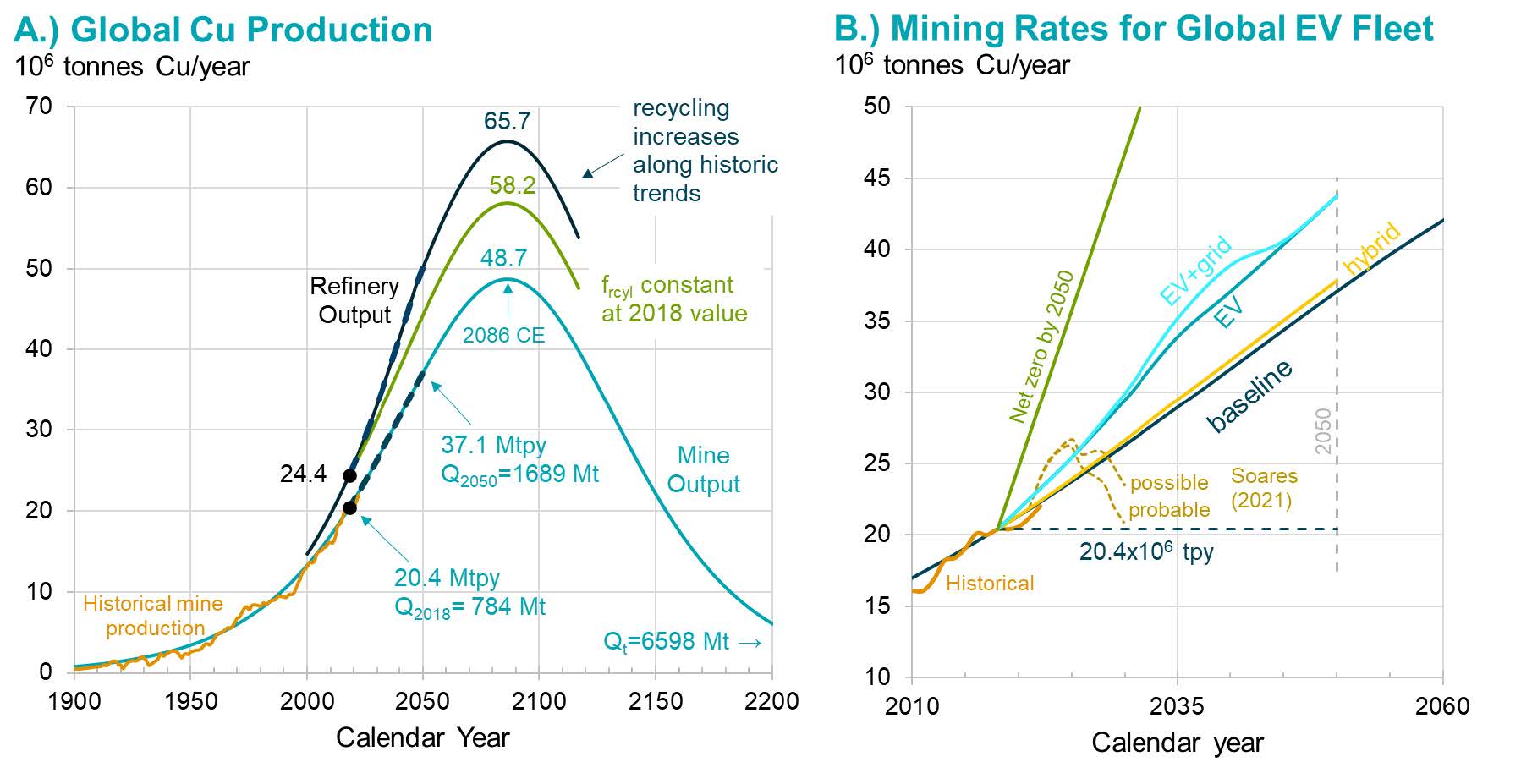
We are committed to electrifying our vehicle fleets. In the long run this will be a good thing. But EVs have created new demand for things like copper, zinc, and lithium and we’ll have to find new sources (mines!) for them. And there should be incentive to re-visit previously worked sites and to recover new minerals by recycling. And I think it is desirable to have domestic mines because we have, at least nominally, the rule of law here and thus environmental regulations actually have a chance of being enforced. If we are going to make big messes in the ground, let’s at least do it where we can keep an eye on it and clean up after it.

EVs are still vehicles. They still need roads. They still need steel, glass, aluminum, and plastic. And they still need parking lots! There will still be traffic snarls, and congestion, and long, soul-crushing commutes. A cleaner car or truck is better than a dirtier one, but it doesn’t address the real problems. Do we still want a future where cities are increasingly uninhabitable for pedestrians? Do we still want a future where you have to drive everywhere? Do we still want a future where other transit options continue to fade away? We are a car-centric culture, and that car-centrism has shaped the way we live, work, and play. Is it possible to imagine other ways to live, especially ways that don’t require each of us to own and maintain a 5000-pound metal behemoth?

Before we get too excited about future vehicles, maybe we should spend more time thinking about the kind of future we want to live in.

Seeking Cesium, #55

The metallic element Cesium (Cs) is found in the first column (or group) of the periodic table. It sits under the other alkali metals like Lithium (Li, #3), Sodium (Na, #11), Potassium (K, #19), and Rubidium (Rb, #37). If you toss a chunk of a pure alkali metal into a pot of water you’ll get an explosion. The reaction releases hydrogen gas, which is flammable, and a lot of heat, which ignites the gas. If your container isn’t blown apart you can test the pH of the water left behind. You’ll discover it is quite basic (or alkaline), hence the name for the group. (When you rip hydrogen atoms off water molecules you get hydroxide ions which will turn pH paper blue.) I did this reaction every year in science class. We used sodium. Cesium would be much more reactive and thus that much more dangerous (and expensive).

Metallic cesium, like the other metals listed above, oxidizes immediately on contact with air. Thus none of these elements are found in nature except in compounds. Our laboratory sodium was stored under oil, for example.

I should note that much of the world spells the stuff “caesium” not “cesium.” Caesium is the official IUPAC form (International Union of Pure and Applied Chemistry).

Cesium has a number of radioactive isotopes of which Cs-137 is of interest. It is a by-product of uranium fission and thus present in the biosphere. Besides the bomb tests, nuclear power accidents (like Chernobyl) are the culprit. Cs-137 is used in radiation therapy as well as in a variety of gauges, meters, and measuring devices.

By far the most common use for cesium today is in the oil and gas industry. Cesium formate makes a very dense brine which is used as a drilling lubricant. Interestingly the fluids are mostly recovered and recycled, and cesium formate is particularly desirable because it is non-reactive and of low toxicity.

Cesium is obtained from the mineral pollucite. A large source is in Manitoba, on Lake Bernic, called the Tanco Mine (pictured below).

https://tancomine.com/

The mine is owned by a Chinese company called Sinomine Resources Group. They have suggested they might drain the lake to extract more cesium! They aren’t winning any friends with that idea.

Blue sky blues

We haven’t seen much of the sky lately. I long for some clear, blue days! I know that sitting in a smoky cesspool is a lot better than evacuating or watching my community burn so I’m trying not to be too down. But, boy-howdy, it is foul out there:

https://map.purpleair.com/1/mAQI/a10/p604800/cC0#11/41.7282/-122.6439

If you aren’t tuned in to Purple Air, you should be. It is a network of air quality sensors that you can freely access via the internet or a mobile device. We can simply look outside and see that the air is horrible. But that’s the stuff you can see. There are lots of things we are breathing in that we cannot see. These are the really bad things. In fact, we often have days where the air quality looks fine but is actually not. Sometimes you see a slight “haze” which can be the result of high concentrations of really small particles.

The Purple Air sensors measure several things but the one of interest is abbreviated PM for “particulate matter.” In this case, size matters. The sensors measure particles less than 10 microns in diameter and particles less than 2.5 microns. (A micron is also called a micro-meter, which is 10-6 or 0.000001 meters, about 0.00004 inches.)

It’s the PM 2.5 number that’s displayed. You can see that this morning the Yreka sensors show the local air quality to be very bad with numbers approaching 300. That means 300 micrograms per cubic meter (µg/m3) of air. Anything over 100 is a health concern. Here’s the scale:

Small particles are inhaled and deposit themselves on the lungs and from there enter the bloodstream. It almost doesn’t matter what the source of the particles is, the size is what makes them a problem. Wildfire smoke is a good source of particulate matter. Power plants and vehicle exhaust are also primary sources. These particles can be made of hundreds of different chemicals, including things like metals, and they spread indiscriminately. We’ve all sat around campfires and breathed in the smoke and not thought much about it. But this is like having a campfire in your tent with you at night and then carrying it around with you all day long. No one does that! So please don’t think that just because forests are “natural” that means that forest fires are good for your lungs. (Here’s a good article about the health effects of particulates.)

The EPA website has a good primer about particulate pollution. If you have N95 masks you might consider wearing them if you are going to be outdoors. They can help block some of the small (1-3 micron) stuff. Here’s a graphic to give you a sense of scale:

https://www.epa.gov/sites/default/files/2016-09/pm2.5_scale_graphic-color_2.jpg

Stay safe out there and pray for rain, I suppose, or at least a good stiff wind to clean out the valley!

Ultima Thulium (#69)

Ancient Greek and Roman cartographers described a place called Thule, the most northerly location known to them. Today we think they might have meant Scandinavia, Iceland, or perhaps the island groups like the Shetlands, Orkneys, or Faroes. Later the term Ultima Thule emerged and it came to mean anyplace far beyond the known world. I used to read Hal Foster’s comic strip Prince Valiant when I was a kid. Val, if you know the story, is from Thule.

Thulium (Tm) is a lanthanoid and with the exception of radioactive Promethium (Pm, #59) is the rarest of the so-called rare-earths. A mere 50 metric tons of thulia (thulium oxide, Tm2O3) is produced worldwide each year. The main source is monazite sand, a reddish-brown phosphate mineral found in placer deposits. Thulium is used in lasers and semiconductors.

Thulia was first isolated in 1879 by a Swedish chemist named Per Teodor Cleve. A pure sample of thulium metal was not prepared until 1911.

Strontium (#38) is in your bones

But not in a good way. Strontium, in its pure metallic form, is soft and silvery-white but tarnishes readily. It’s not found in nature except in compounds. Like its neighbors in columns 1 and 2 on the periodic table strontium is quite reactive. Humphry Davy first isolated it in 1807.

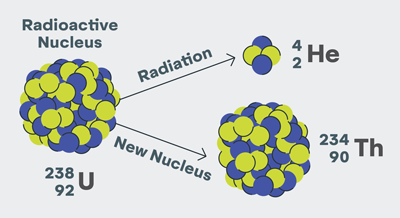
The primary isotope of strontium has 38 protons and 50 neutrons and thus an atomic mass of 88. A radioactive isotope of strontium, Sr-90 (52 protons), is a product of nuclear fission. Nuclear reactors are a source and the long half-life (29 years) makes it a serious high-level waste issue. Sr-90 is also in the fallout from atomic bombs.

Strontium sits right underneath calcium on the chart and is biochemically similar to this crucial, bone-building element. Sr-90 has a nasty habit of substituting itself for calcium in bones. Exposure to fallout can result in bone cancers and leukemia. Typically the Sr-90 is inhaled or ingested unknowingly. Fallout is composed of a large variety of particulate debris, much of which is too small to see. And soils and water tables can be contaminated miles from any blast as the fallout can be borne aloft by the winds.

Those of us born after the atomic testing of the 1950s and 1960s have radioactive isotopes in our bodies. Sr-90 would be a likely one. Fortunately the amounts of these materials are pretty small, and the major events since then (Three Mile Island, Chernobyl, Fukushima) were insignificant by comparison to the wanton and irresponsible testing after WWII.

Strontium was added to glass to block the X-rays produced by cathode-ray tubes. Those CRTs were common in the early computing days, but have since been replaced by newer technologies. Strontium compounds are used in fireworks, where they give off bright red colors. I remember well doing flame tests with my students and seeing the lovely scarlet hues produced by strontium chloride:

Boron (#5) is in California

San Bernardino is the largest of the Golden State’s 58 counties. It’s twice the size (~20,000 square miles) of second-place Inyo (~10,000 sq. mi.). Inyo County, by the way, is about the same size as Massachusetts. Kern County comes in third place, roughly 8,000 square miles.

At the southeast edge of Kern county, abutting the San Bernardino County line, is the town of Boron. It sits on the western edge of the vast Mojave Desert. It’s about 85 miles east of the San Joaquin Valley metropolis of Bakersfield. SR-58 climbs from there over Tehachapi Pass to get to Boron. Continuing eastward you’ll cross the junction of US-395. Barstow and I-15 are forty miles away. South of Boron is Edwards Air Force Base and its massive dry lake bed landing strip.

Two thousand folks live in Boron. Once it was nowhere, and then it was somewhere. Prospectors discovered borax in the early part of the 20th century and that changed everything. A mining town was born. Today the open pit mine (owned by Rio Tinto) is the largest in California and supplies half the world’s borates.

You can visit the mine.

Sodium borate (Na2H20B4O17) aka “borax” is the primary ore. It was made famous by the 20 Mule Team brand of detergent additive. You’ve seen the iconic images of the wagon trains that hauled borax from mines in Death Valley to the railroad in Mojave:

https://www.20muleteamlaundry.com/history/

Boron compounds have a huge number of applications. They are used in glasses, ceramics, flame retardants, fluxes, alloys, insecticides, adhesives, wood preservatives, lubricants, fertilizers, and much more. Elemental boron, a metalloid, is a neutron absorber and is used in nuclear reactor control rods. It is also an electron acceptor (or “p-type dopant”) and added to silicon-based semiconductors. Boron is also an essential nutrient for plants but it is not clear if boron is necessary in animal physiology.

About four million tonnes of boron minerals are produced annually.

Cook’s dictum

I found this bit of wisdom at the end of today’s post on The Endeavour, a blog by John D. Cook:

There are no solutions, only trade-offs.

Cook is an applied mathematician and he was writing about scripting languages (a kind of computer programming language). Most of the stuff on Cook’s blog is way over my head but every once in a while I learn something. Ultimately he was discussing using tools to solve problems. One scripting language was small and specialized, the other was more “expressive” (his term), that is, it had more features and thus more power. But that also meant he had to make more choices, and that created more chances to make mistakes. It’s a trade-off—productivity vs. expressiveness.

The solution depends on the problem, or as Cook says, it’s a “matter of tasks and circumstances.” He’s writing about his work, and his little saying up there should best be understood in that context. But it seems to be much more general than that. I suspect we could apply Cook’s dictum to lots of things.

But as I like to say, all generalizations are untrue. Rules-of-thumb like “there are no solutions, only trade-offs” are useful. Handy, even. They can help steer our thinking. If we recognized that a non-trivial problem (something worth solving) might not be solvable that might make us more humble. Less rigid in our thinking. More open to listening, and trying things out. Just because a problem isn’t solvable doesn’t mean things can’t be made better.

In search of Antimony (#51, Sb)

The sulfide of the metalloid Antimony (Sb2S3) is called stibnite. It is also the primary ore. The word comes from Latin—stibium—and that’s the source of the elemental symbol. Antimony is mined with other sulfides like cinnabar (mercury sulfide, HgS) and is found with gold, silver, lead, copper, arsenic, tungsten and many other minerals.

There was a domestic source of antimony: the Stibnite Mining Area near the town of Yellow Pine, Idaho. It’s part of the East Fork South Fork Salmon River (EFSFSR) watershed. It’s now a Superfund site. The USGS had this map:

https://www.usgs.gov/media/images/upper-east-fork-south-fork-salmon-river-watershed-map

It’s hard to get a sense of where this place is so here’s another map:

https://commons.wikimedia.org/wiki/File:Salmon_River_Idaho_Map.png

The town of Yellow Pine and the Stibnite Mining Area are near the “Mid” of the map label “Mid Fk Salmon R.” or about 80 miles west of Salmon. It is rugged, mountainous country and hard to get to but it is a popular area for rafting, fishing, and other recreation. Not to mention its forests and wilderness areas help protect a vast watershed.

Here’s a quote from the an EPA report on the site:

Past mining activities have deposited metals, spent and neutralized ore, waste rock, and mine tailings over half of the site. Mining-related source areas of potential contaminants include the Bradley tailings (the main deposition area), the smelter process area and its waste piles, process ponds, five heap-leach pads, unmaintained mine tunnel adits, and an open-pit mine. Contaminants associated with mining operations include heavy metals (e.g., arsenic and antimony) and cyanide in area soil, groundwater, surface water, seeps/springs, and sediments.

Mining is a messy business. Antimony is used in alloys, particularly in lead-acid batteries which are manufactured by the millions. It is also used in semiconductors. So, we need the stuff. And we need to figure out how to get the minerals we use without making a toxic waste dump that needs Superfund status!

Perpetua Resources (formerly Midas Gold, stock symbol PPTA) is an Idaho company and it has a plan to resume gold mining in the Yellow Pine/Stibnite Region. They also want to start producing antimony again.

The forks of the Salmon River eventually merge and then dump into the Snake River which is ultimately swallowed by the Columbia River. That runs all the way to the Pacific Ocean. I started my search for antimony and wound up with watersheds. All of us depend on the health of our watershed. If we poison our water upstream then that poison will show up downstream.

What watershed do you live in? Where does your water come from? Where does it go?

Do you know?