What’s the best website? That’s easy. It’s Astronomy Picture of the Day, known to its fans as APOD. They have something new every morning and I never fail to be amazed, inspired, or overwhelmed.
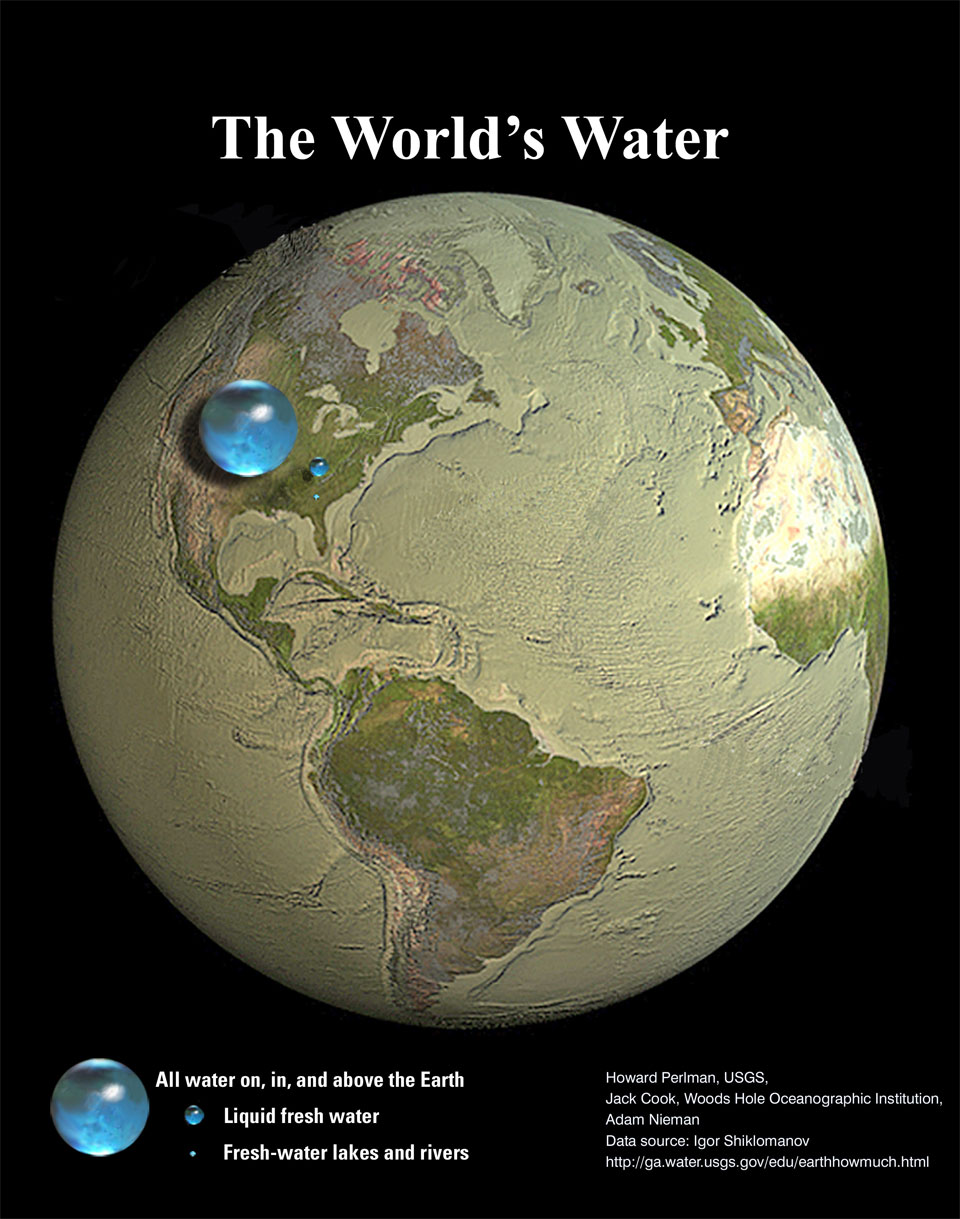
The above image was yesterday’s post. The source was Woods Hole Oceanographic Institute, a private, non-profit research facility located in Cape Cod, Massachusetts.
There isn’t much water on earth. And there is even less fresh water! Now, there may be incalculable amounts of water trapped in the rocks of the earth’s interior, but that’s not really helpful. At least not right now. (Check out Stephen Baxter’s novels Flood and Ark for more on that topic.)
Right now we need to view our water supply as fixed. We aren’t going to get any more “new” water into the system. What we got is what we got so we oughta take better care of it!
This metallic element gives its name to a whole series of similar substances—the lanthanoids or rare-earths. That name is a bit of a misnomer as lanthanum is three times more abundant than lead in the earth’s crust. The lanthanoids are noted for their many similar chemical properties and thus were not isolated and identified until the 19th and 20th centuries.
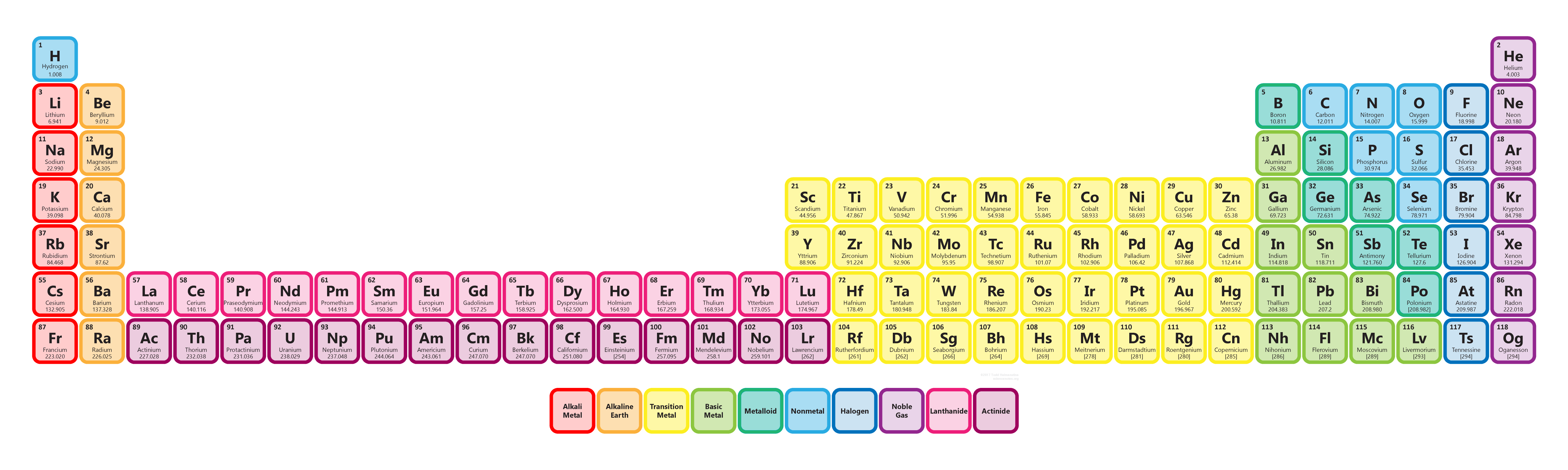
Most periodic tables show the lanthanoids below the main body of elements. This is due to the tyranny of 8-1/2 by 11 inch paper. They had to squeeze the damn table into a chart that would fit in a chem student’s binder! Here’s what I mean:
The lanthanoids are the numbers 57-71, La through Lu (Lutetium). It’s the brownish row, the top one of the bottom two. Lanthanum ought to fall in column 3, nestled between Barium (Ba, #56) and Hafnium (Hf, #72) and underneath Yttrium (Y, #39) and Scandium (Sc, #21). In fact both Y and Sc are often included with the rare-earths because of their similarity to La and the other lanthanoids. You can see the arrow from that empty spot in column 3 where they plucked out La and pasted it to the end of a the new row (Ce-Lu).
But the periodic table really ought to look like this:
You can see that this form would be a pain-in-the-ass. In the old days we would have folded the thing to make it fit. Nowadays you can just turn your phone sideways, I suppose. It’s not that important, mostly a matter of aesthetics. The lanthanoids are “f-block” elements (they fill the 4f electron shell) and this wide chart illustrates that a little better. Note the row below the lanthanoids: these are the actinoids and they are also f-block (they fill the 5f shell).
Lanthanum is used in alloys, particularly nickel-metal hydride (NiMH) batteries. It’s also used to make specialized types of glass. Interest in all the lanthanoids has exploded in recent years due to their usefulness in a wide variety of high-tech applications. Rare-earth mining has been in the news because the current world supply is dominated by China. There is a push to develop domestic mines and ore processing plants to meet the country’s growing needs and reduce reliance on a sketchy foreign power.
Mountain Pass Mine in the Mojave Desert is the largest known US deposit of rare-earth ore. There is also a new rare-earth mining venture in Texas called Round Top which aims to produce lithium as well. If it can’t be farmed, it has to be mined. There is no “green” future without some big holes in the ground!
OK so 30% plus 60% plus 70% is OVER 100% so that means IT WILL RAIN FOR SURE!!
Get ready to be wet by Tuesday. That’s not me, that’s math.
I used to tell my students that a 30% chance of rain meant that if 10 of them went outside 3 of them would get wet. Fortunately they didn’t buy it.
We had some rain already and that’s great but I really hope we get some more. It sure was nice to see new snow on Mt Shasta today. Even better is the air quality—we are finally free of smoke. Of course if the weather continues to cool the wood stoves will get fired up all over town and we’ll be inhaling the stuff again! Actually the forecast suggests we’ll be back to our more familiar warm and dry September experience once this autumnal interlude ends.
This Friday the 23rd at 01:03 UTC is the equinox. If you subtract seven hours* for PDT you get Thursday the 22nd at 6:03 p.m. Happy Fall!
*rewrite 01:03 as 25:03, subtract 7 hours to get 18:03
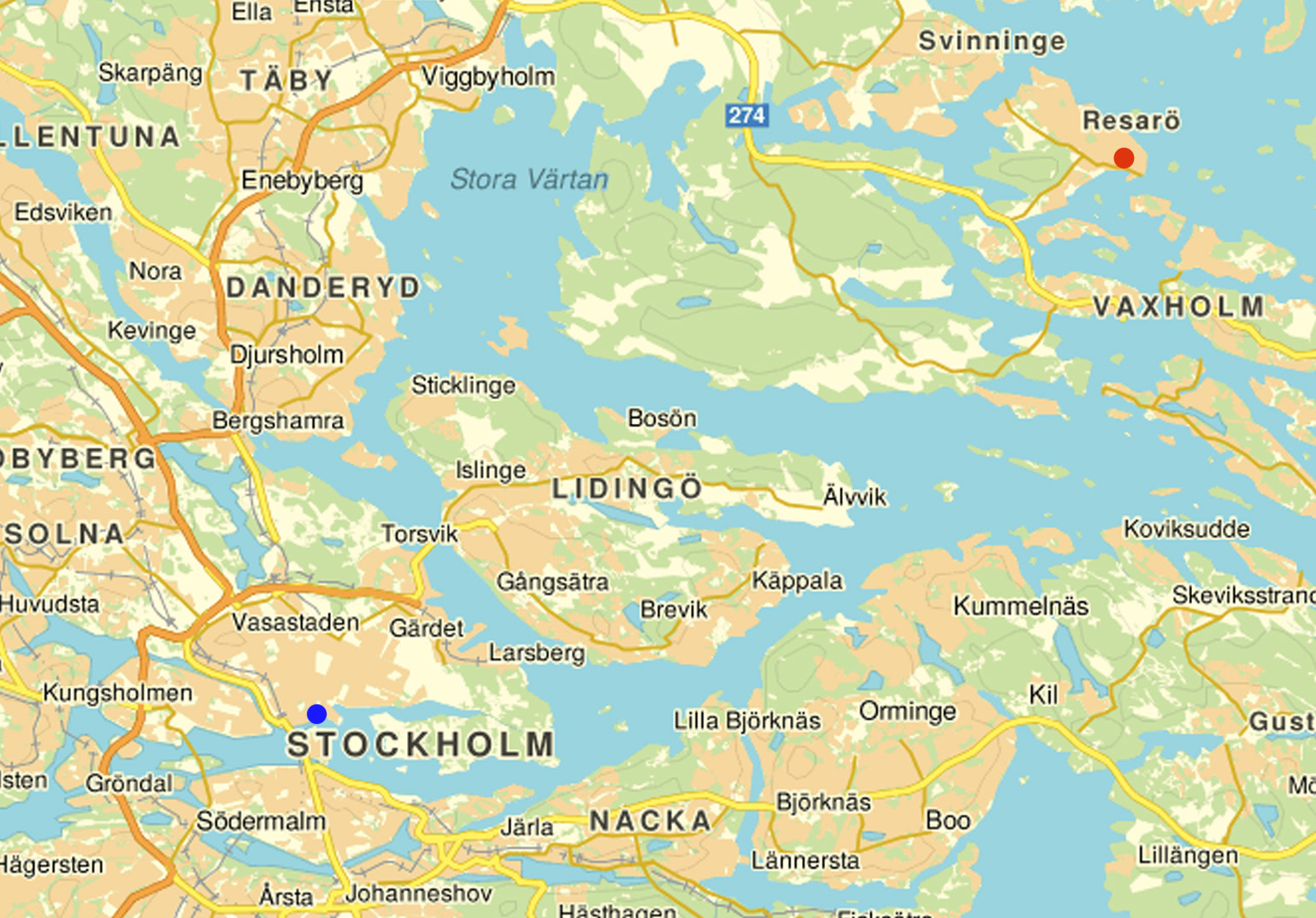
The village of Ytterby, Sweden is on the island of Resarö which is part of the Stockholm archipelago. It is immortalized on the periodic table. Yttrium (#39), Terbium (#65), Erbium (#68), and Ytterbium (#70) are all named for Ytterby. A centuries-old local quartz and feldspar mine produced an unusual black rock that was later found to be the source of the four eponymous elements. Four more elements—Scandium (#21), Gadolinium (#64), Holmium (#67), and Thulium (#69)—were also discovered there.
Erbium makes a Er3+ ion that is pink-colored and used in certain lasers. The lasers have applications in dental surgery and in optical communications. Erbium is also used in nickel and vanadium alloys and in control rods for nuclear reactors. Erbium is one of the so-called “rare earths” or lanthanoid elements.
My next post will be element #57, Lanthanum, which lends its name to the entire group!
U.S. Route 50 across the State of Nevada is called “The Loneliest Road in America” and it’s a reasonable description. There’s a whole lotta nuthin’ out there. But I would like to nominate State Route 140 for consideration. In Nevada SR 140 emerges from US-95 just north of Winnemucca. It travels west to the Oregon state line (but retains the 140 designation) and continues to the isolated burg of Lakeview, on to Klamath Falls, and ultimately terminates near Medford in the Rogue Valley. The highway in effect connects I-80 to I-5.
The stretch of 140 from Denio Junction in Nevada to Adel in Oregon (just east of Lakeview) could be the far side of the moon. It’s as bleak and desolate as any stretch of road here in the rural West. Do not attempt the drive in an unreliable vehicle—the only creatures that will find you if you break down are the vultures.
This lonely place could soon be a lot busier. A Canada-based multinational corporation called Lithium Americas wants to build a mine near Thacker Pass. Here’s a map:
Nevada is a mining state. Gold, silver, and copper are produced in large quantities and the industry is crucial to the economy. In fact The Silver State is considered by many as the top mining area in the world. This is not just due to the abundant resources. It is a reflection of the social and political stability as well as the excellent infrastructure. The rule of law still works in the US of A, a fact miners are well aware of. Investments in unstable and volatile regions of the world are much riskier. Even a modern, civilized country like Chile, the world’s largest copper producer, presents formidable political barriers to economic development. Codelco is a state-owned company, for example, that was formed in the 1970s by nationalizing the foreign holdings in the country. Our southern neighbor, Mexico, just announced the formation of a state-run company to exploit that country’s lithium resources.
Enter Lithium Americas and their Thacker Pass project. This is the kind of thing international mining outfits are interested in. It’s a private venture (but a public company, it trades on the NYSE) and obviously subject to local, state, and federal oversight, but it’s in a (mostly) free-market economy. This means the company and its investors can make money.
Lithium is a key battery material and thus critical to electric vehicles. Demand for lithium is surging and expected to keep growing. Most of the world’s lithium comes from less desirable jurisdictions so there is a lot of excitement about a large-scale domestic lithium mine.
Naturally there is opposition. Mines are messy. The industry has a poor track record. It’s legacy of boom-and-bust, toxic waste, and colossal traffic impacts is well known. Air and water quality both suffer in mined regions and mines can make some places uninhabitable when they are finally closed.
Modern mining companies like Lithium Americas say they can do things better. There is a much bigger industry effort toward so-called ESG concerns—environmental, social, and governance. Corporations don’t have a lot of credibility in these matters, I think that is safe to say, but I’m not sure we have a choice. Wouldn’t we rather have a domestic mine where we have at least a chance of public oversight than import our commodities from some half-assed third-world despotic regime? I think the answer is a resounding “yes.”
Humans make a big impact on the earth. Citizens in comfortable and wealthy first-world societies like to push their environmental problems overseas. Don’t want to see the local forests cut? No problem, just import logs, or worse, finished lumber, from some other place. Don’t want to see oil wells or offshore drilling platforms? Then buy oil from the Saudis. Don’t like mines in the wild, wide-open spaces? Just buy what you need on the international market and don’t worry if kids are digging the stuff out of the ground and poisoning themselves and their communities in the process.
I say “bullshit.” We are big boys and girls. If we need lithium we should dig it up ourselves and clean up our goddamn messes. And we should employ local people and see that profits find their way to local communities impacted by the mining. This is what economic development is supposed to do! So I say let’s make it work. And if we fail it will be our failure, and we will have to work to make it right. Do we really think we will be better served by pushing such problems away?
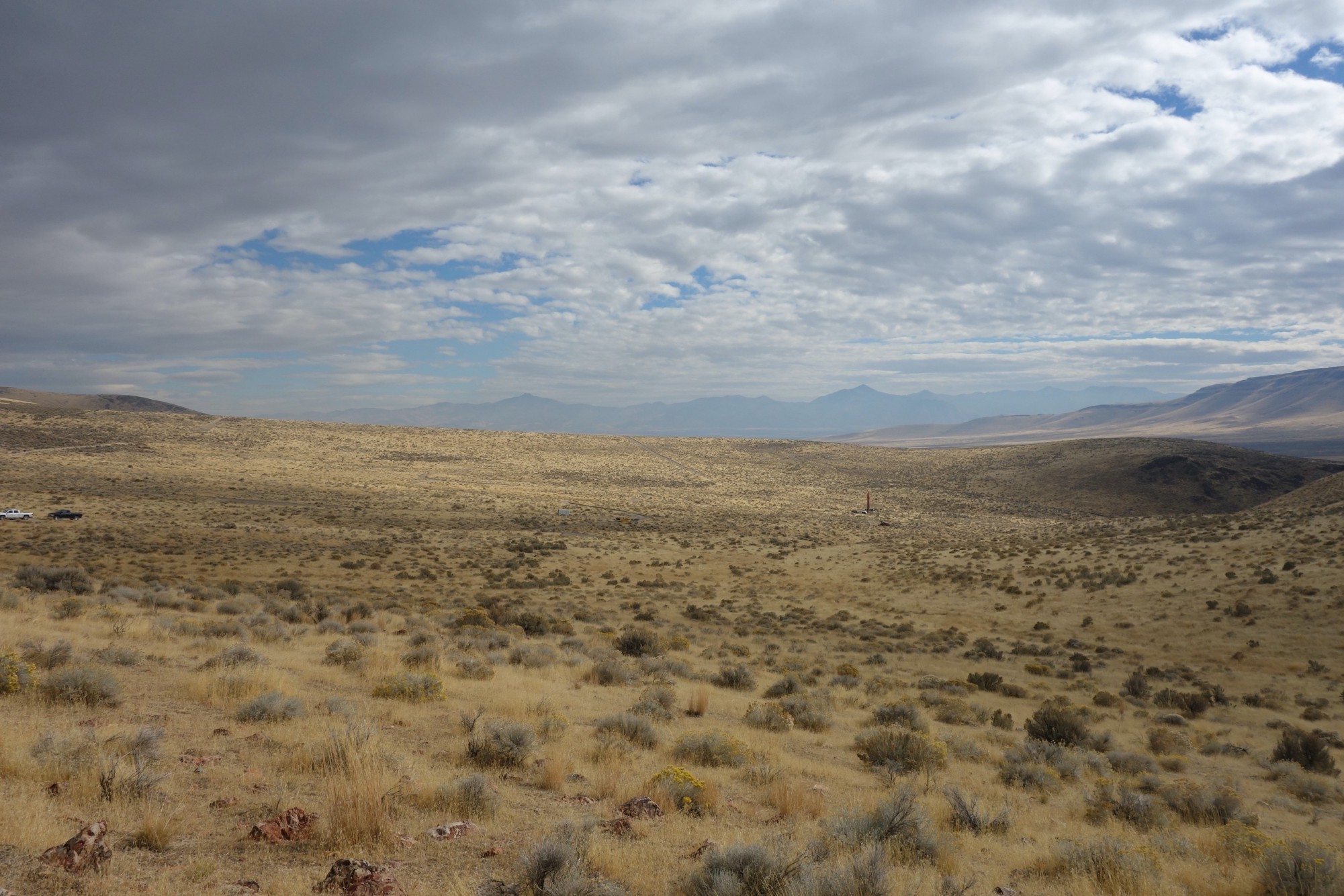
They say a picture is worth a thousand words so I’ll leave you with a photo of the Thacker Pass area where they hope to be mining lithium soon:
We recently experienced a scary forest fire within just a few miles of where I sit right now. The so-called McKinney Fire burned some 65,000 acres or about 100 square miles. Think about that—one hundred square miles is a square ten miles on a side. Ten times ten is a hundred.
A useful fact of North American geographical history is that one square mile of surveyed land is equal to 640 acres. Multiply that by one hundred. You can see now that a 65,000 acre fire is a little bit more than 100 square miles.
Try to imagine a quadrilateral of open land ten miles in length and ten miles in width. Ten miles is a real hike. Over flat ground and at a relaxed walking pace of two miles per hour that’s a five-hour excursion. To walk the entire boundary of the parcel is a forty-mile expedition. That’s a lot of ground.
Now imagine those one hundred square miles are not flat but steep, and even worse, rocky, and cut with numerous gulches and canyons. Add a covering of timber and heavy brush and you have the setting for the McKinney Fire.
The firefighters did an amazing job and with help from the weather gods they got the big blaze under control. Later they sent in the post-fire teams and called it over and went on to the next assignment. The professionalism and skill of the entire firefighting apparatus was a thing to behold. They are getting scarily good at this stuff. Lately they’ve had more than enough practice and it looks like that’s going to continue. That’s what happens when summers are hotter and winters are drier.
I can see remnants of the McKinney Fire out my window as I type. Big, new bulldozer tracks have been carved into the scrubby woodlands that cover the flanks of the ridge. They’ve been cleaned up nicely and look like real roads. They will be excellent firebreaks if anything ever comes down that hillside, and they will serve as access and escape routes.
These bare-dirt swaths mark up the wildland with a fierce urgency. They aren’t put in for looks but for emergency utility. They radiate a no-nonsense vibe.
But I have come to appreciate their artistry. Every town should have these moats around them. Fire season is year-round now. Every wildland interface needs at least a nip and a tuck if not full-on plastic surgery. We need a new aesthetic. One that adapts to a new vision for natural landscapes. These landscapes need open stretches of bare ground. They need trees removed. They need brush cleared. They need the obvious hand of humankind managing them.
We have a great love of wildness. And we like to see unspoiled nature. But that is an increasingly impractical notion. We are too vulnerable to fire. We have to re-imagine where we live to include stuff that says, loud and clear, “this is for the next big one.” I really like those ribbons of new road criss-crossing in my viewshed. It makes me feel like the folks who put them in were indeed thinking about “next time.”
Two more fires, the Mill Fire and the Mountain Fire, have hit nearby since McKinney. They are both still active incidents. Ash and cinders from both fires were blown into our yard. It has been a painful summer around here. Let’s hope it gets better soon. And let’s hope we can be more resilient in the future.
One of the most polluting and most energy-intensive things we do is to drive our cars and trucks. Gasoline-fueled internal combustion engines are at best about 35% efficient. Most of the time the car is even less efficient, as low as 10-15%, and commonly 25-30%. That means at least two-thirds of the energy in the fuel tank of a car is wasted. Diesels are a little better, but those vehicles suffer from the same inefficiencies: engine heat loss, wind and rolling resistance, braking, friction, idling, etc. You can only get so much useful energy out of an explosion! I should note that Nissan engineers claim they can get 50% thermal efficiency in a gas motor. Right on, I hope it works.
Why should you care about thermal efficiency? The goal of any energy transformation is to make it as clean as possible. To get the most out the resource with the least pain to society. To conserve in the true sense of the word, that of wise use.
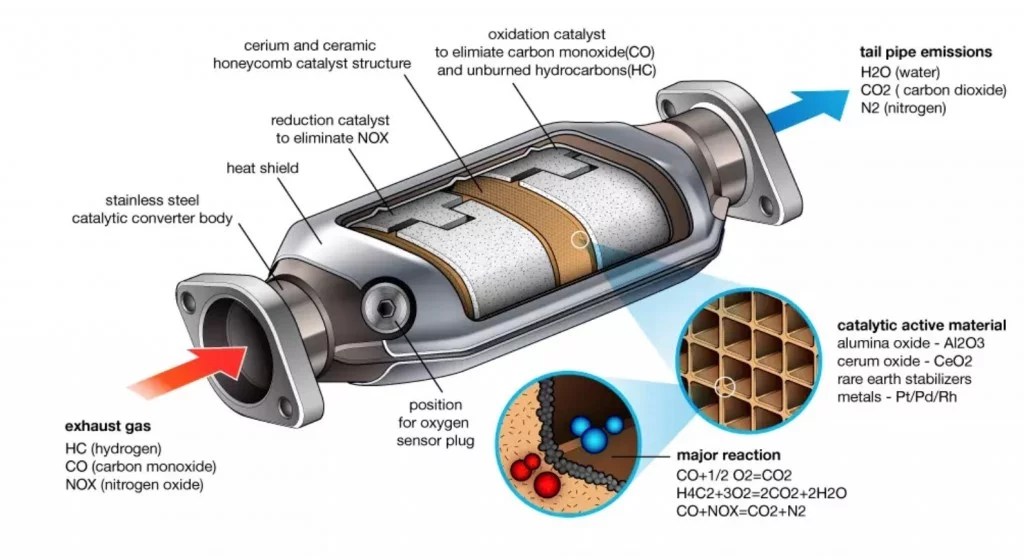
Rhodium is the rarest of all non-radioactive metals It is similar to platinum. Ruthenium, palladium, osmium, and iridium are all grouped with platinum because they are all hard and corrosion-resistant. They work well as precious metals and in jewelry, in electronics, dentistry, and most important of all, as catalysts.
80% of the world’s rhodium —this extremely rare precious metal, mind you—is used in catalytic converters.
These devices are great. They really, seriously clean up vehicle exhaust. All of us benefit from this technology. And we should appreciate that there are laws requiring such devices on our vehicles. This stuff makes the air better. We would make the air even better if we drove less, but that it seems is harder to do.
I don’t exactly eat an apple every day, but it’s close. I love apples. I eat them year-round. We don’t think much about year-round food, but we should. After all, apples are harvested in the fall in North America. Even with the high-tech storage the apple industry uses which can keep freshly-picked apples marketable for months, there will be gaps in the supply.
Enter South America. Chile, specifically. Since their seasons are the opposite of ours—their winter is our summer—they can supply us with apples in the lean times. Not just apples of course but a huge variety of other fruits like berries and grapes.
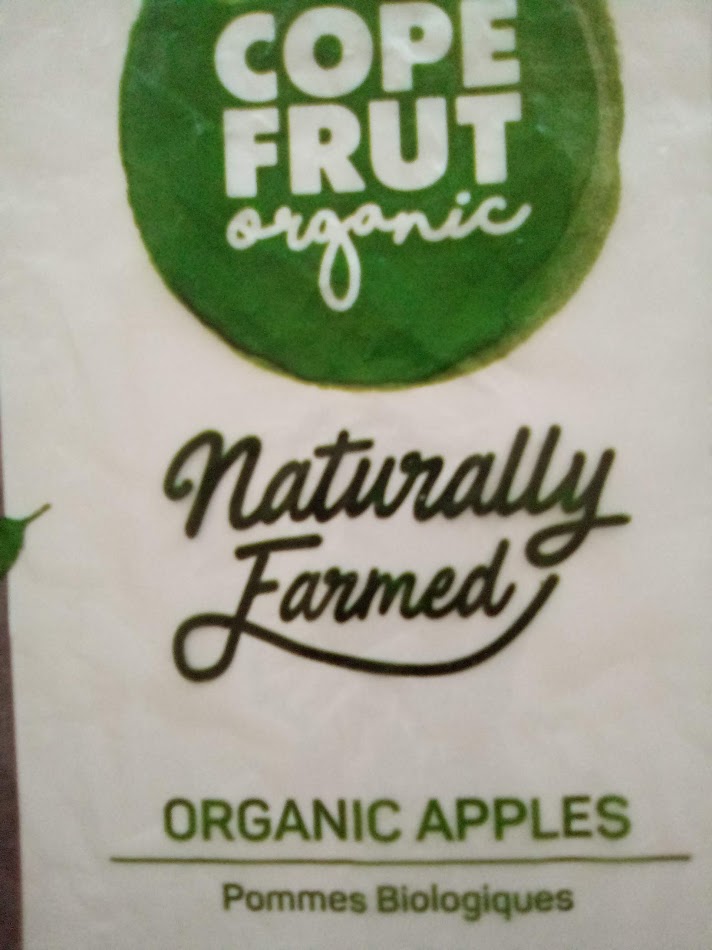
Here’s the label on the apple bag, the last batch from Raley’s I just finished:
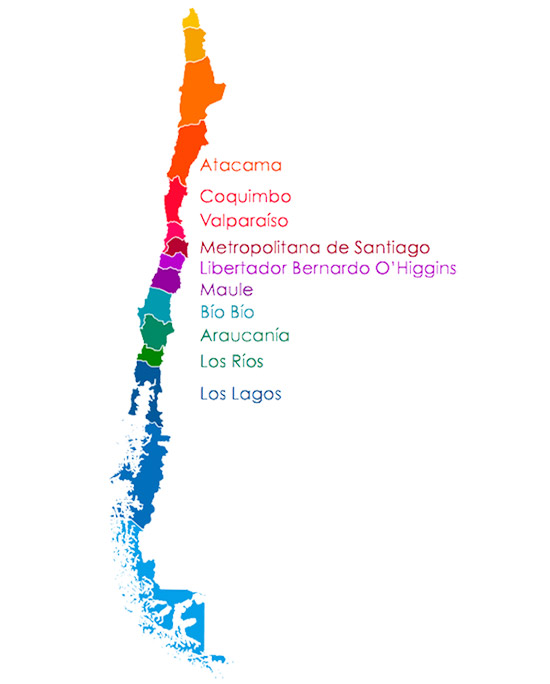
I checked out COPEFRUT. They are an agricultural cooperative based in Curicó, Chile, which is in the country’s central valley, a large depression west of the Andes and bounded by the coastal mountains. It has a Mediterranean climate similar to our own Central Valley here in California and thus is a great place to grow things. The organic apples come from the Maule and Araucanía Regions:
Apples are typically exported via refrigerated containers on ships. The trip to LA or another western port from the Chilean coast takes about two weeks. And as I mentioned earlier, the apple industry has sophisticated atmosphere-controlled storage options that allow wholesalers to supply multiple markets over a span of several weeks. That way I can have fresh, delicious apples year-round at my local supermarket.
Maritime transport is the most energy-efficient way to move things between continents. Air transport has a much, much larger carbon footprint. There’s a lot of interest these days in local, farm-fresh foods. Those of course are seasonal supplies. Most people I know want their coffee and bananas year-round. And once I could get the kind of apples I like every single week of the year in the produce section of my local store I got hooked. I would definitely miss my “apple a day” if the Chileans decided to sell their stuff elsewhere!
Farm-to-table is great. Support your local growers. But that’s just part of the picture. Our food supply is a complex web of global traffic. That’s why a war in Ukraine can effect grain prices. We are all connected together even if we don’t want to be. If we want to keep eating, and eat well, we should hope that all the ways we get our food are part of healthy, robust systems. These systems require huge inputs of both human and material energy. A hell of a lot of people have to work together to make sure these things get done. And that’s OK by me, after all getting a bunch of people to work together is a good thing, right?
Tin is a metal from antiquity. Copper is most likely the first metal people ever worked. And they probably discovered that mixing in a little tin really helped. Bronze is an alloy of copper and tin, with tin making up about 1/8 (~12%) of the mixture. You’ve heard of the Bronze Age, I’m sure, so you can imagine how important tin was to early societies.
Tin is not nearly as abundant as copper but the ore of tin, cassiterite (SnO2), is easy to smelt. That made it available to ancient peoples who probably used wood charcoal for the task. The Latin word stannum is the source of the symbol (Sn) for tin. Our English word is of German origin. Tin mining in Cornwall, the southwest edge of the isle of Britain, dates from two thousand years before Christ.
If you ever fooled around with electronics you probably did some soldering. Most of the tin in the world goes into making solders. And much of the rest of the tin goes into making cans. We still call them “tin cans” and they simply call them “tins” in England and Australia. The cans are made of steel but they have a thin layer of tin on them. The material is actually called “tinplate” and has been used for decades to store food and other substances. The tin is corrosion-resistant so the cans (and the food) have a longer shelf life.
Steel cans get lined with plastic films these days. That way acidic foods like tomato sauce won’t eat away at the metals. Unfortunately some of the plastics aren’t the best and there have been concerns about BPA (Bisphenol-A) contamination. Tin itself is not biologically active. Tin poisoning is very rare, particularly from metallic tin and its inorganic compounds. Organic tin compounds, called stannanes, can be toxic, however.
Tin is the traditional gift for a tenth anniversary. It is supposed to be a symbol of durability. Being that we depend on tinned steel cans for our food and tin solder in our electronic devices I’d say element #50 will certainly endure.
We have to go to Redding on Thursday. It’s going to be hot. Look at those “Low” temperatures: 75 and 77 ºF!
My world is warming, that much I know.
This creates a feedback loop. As temperatures rise, people need more indoor climate control. In today’s world that means “air conditioning.” An air conditioner is just a refrigerator. A fridge though only has to cool a small box. An air conditioner has to cool a room. Or a whole house. Or an entire building.
More demand for air conditioning means more demand for electricity. And that means more primary energy. Coal and gas plants have to burn more coal and more natural gas. More wind and solar farms have to be built. Construction projects need building materials and the energy to power the machinery. (Even nuclear plants have to replace the fuel rods now and then.) All of that requires more ore to be dug, more minerals extracted, more products manufactured, and more fossil fuels to be consumed. All of those processes also produce waste heat, and the more we do them, the more waste heat we make.
So, the hotter it gets, the hotter it gets. We have to heat up the world to cool down our little corner of it.
Much of the electricity in the West comes from hydroelectric projects. Dams. You need full reservoirs to get the most out of a hydroelectric system. Warmer weather means faster evaporation from those big, flat, bodies of water. And drier winters means less snowpack, and thus a lot less spring meltwater to fill the streams that fill the reservoirs behind the dams. The dams need falling water to spin turbines that make our electricity. The electricity we need more of because it is getting hotter!
That’s the feedback loop. We’re hot, so we run our A/C more, so we heat up the planet more, so we get hotter, and run the A/C even more, ad infinitum. Well, it won’t last forever. There’s no infinity here. Eventually the system will break down. Either the A/C will quit or the electricity will go out or both. Or civilization will collapse. Entropy will ensue, that’s for sure, and that means we’ll be scrambling to keep up.
Civilization doesn’t have to collapse, of course. That’s just a worst-case scenario. But we’ve certainly got plenty of scrambling to do to keep things working. The investments in energy, technology, and manufacturing necessary to maintain and improve our infrastructure in a changing world are enormous. Here in California, a modern place, most of the homes already built have no A/C and have to be retro-fitted. My house is 100 years old! It’s not nearly insulated enough. If it were built today it would be sealed up as tight as a zip-lock baggie. That would reduce my energy consumption.
That’s the kind of feedback loop we want. If we insulate our homes better, we cut down on our demand for electricity. We should all be living in half-buried foam igloos if we really wanted to be energy-efficient, but that’s not going to be a popular choice. In the meantime, bust out the weather-stripping and save the world.





 Mark C. O'Connor