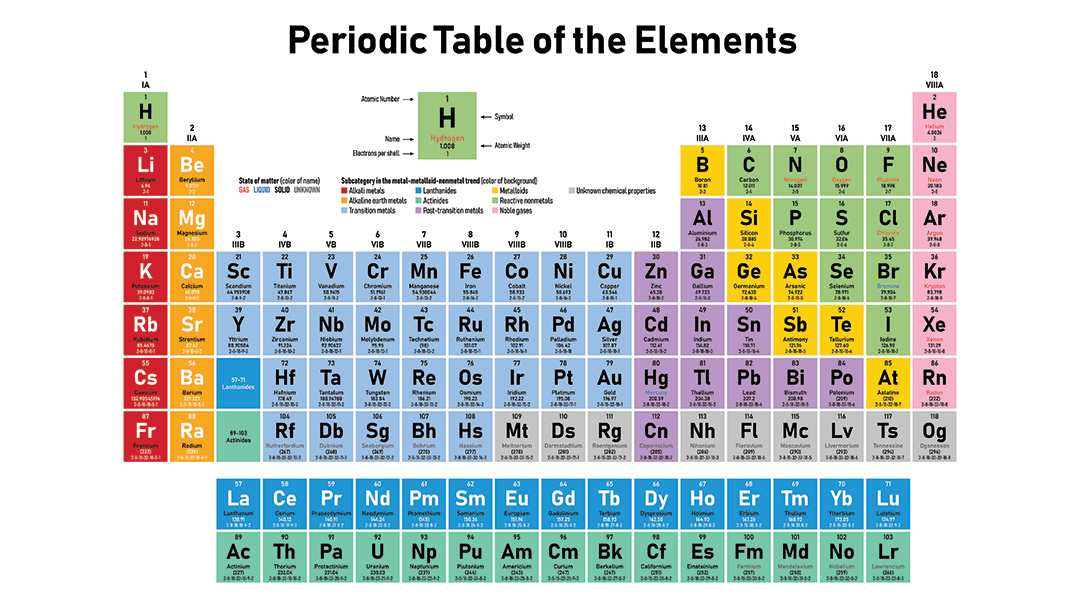
You will find Yttrium (symbol “Y”) just below Scandium (#21, Sc) in column three. Beneath that you see the box for the lanthanides, elements 57 through 71. You have to imagine that row of blue (La to Lu) squeezed into the space between Barium (Ba, #56) and Hafnium (Hf, #72). I’ve even seen it represented in 3-D with the blue row of lanthanides popping out of the page toward the reader.
Columns on the periodic table are called “groups.” Elements in the same group have similar properties. This is due to their electron arrangement. All the elements in group one, for example, have one electron in their outer shell and this makes them highly reactive. They readily form positive ions. All the way to the right, in group eighteen, the elements have filled outermost electron shells and are thus inert. They don’t readily ionize.
You’ll see that the element yttrium is in the same column as the element lanthanum, #57, the “head” of the group called lanthanides. We talked about this group in a previous post. These materials, for historical reasons, are called “rare earths.” Yttrium and lanthanum have the same outer shell electron configuration and thus have similar properties. Although it is not technically a “rare earth” like lanthanum and the rest of that row (57-71) it is close enough to be classified with them.
Yttrium is more abundant than silver, being found in the earth’s crust at 31 parts per million. Silver checks in at significantly less than 0.1 ppm. Yttrium, like all the lanthanides, is never found in nature as a pure metal. It is mined from the same sources as the rest of the rare earths.
Yttrium is used in video displays to make red colors. It is used to make synthetic garnets and as an alloying agent for magnesium and aluminum. It is also used in lasers. Yttrium, like erbium, terbium, and ytterbium, is named for the village of Ytterby in Sweden.
The United States consumes about 700 metric tons of yttrium annually.
Sodium’s symbol Na is from the Latin word natrium. The Romans did not know about free sodium metal as it does not exist in nature. Humphry Davy first isolated pure sodium metal in 1807. Natrium probably referred to one or more of the common salts of sodium metal, like table salt (sodium chloride, NaCl), or perhaps soda ash (sodium carbonate Na2CO3), baking soda (sodium bicarbonate, NaHCO3), or caustic soda (sodium hydroxide, NaOH). All of those chemicals are of immense importance in modern manufacturing and have also been used domestically for millenia.
Sodium metal is not much in demand. It is too hard to store as it reacts quickly with air to form an oxide and reacts explosively with water. Sodium is bound up in crustal rocks in a dizzying variety of minerals and is among the most abundant of all the terrestrial elements. It is the compounds of sodium that matter, particularly sodium chloride, as sodium ions (Na+) are essential to metabolism. The free sodium ions play a role in regulating blood volume, blood pressure, and blood pH.
When you discuss dietary sodium with your doctor you are really talking about your salt intake. Adult humans need about 500 mg per day. Dietary recommendations are for 1-2 grams per day but most Americans consume twice that. Salt is present in packaged foods and common preservatives include sodium benzoate, sodium nitrite, and monosodium glutamate. If you need to limit sodium you need to avoid prepared foods! Take a look at the sodium content of your groceries the next time you go shopping—you will find it an eye-opening experience. Too much sodium in the diet can lead to cardiovascular complications.
One interesting use of salt is in nuclear reactors. Molten sodium chloride can be used as a coolant. Its high temperature (700 Celsius) means it can more efficiently transfer heat from the reactor core to the boiler. Some reactors actually include the nuclear fuel as part of the molten salt mix! The technology is well-studied and has proven to work but has not been widely adopted. Interest in nuclear power as an alternative to carbon-based energy is increasing. Perhaps we’ll see a nuclear renaissance in the coming decades.
Sodium finds a use in sodium-vapor lamps. You’ve seen them in every parking lot and along every freeway. Like fluorescent lights they are efficient (about 100 lumens per watt) and long-lasting. Sodium light has a distinctive yellow color. A flame test with table salt or other sodium compounds will also give a yellow result.
You’ve probably never heard of Jean Potts. I hadn’t before I stumbled upon Stark House Press. I suppose I didn’t really stumble upon them, I found them in the Ziesings catalog. I get a lot of books from Zeisings and I encourage you to do the same. They are a true Mom & Pop (on-line) bookshop in the hinterlands of Northern California. They have all the best books and will also get you whatever you want.
But back to Stark House and Jean Potts. Stark House is in Eureka, California and they specialize in reprints. Jean Potts was a successful novelist and short story writer from the 1940s until the 1970s. She wrote mostly mysteries that are perhaps best described as psychological suspense tales. Get a group of people together who are all a little neurotic and unlikable and drop a body into their midst and see how it plays out.
Stark House has a double with Footsteps on the Stairs (1966) and The Troublemaker (1972) that I just finished. Both are “whodunits” in the sense that someone is murdered and you spend the entire time trying to figure out which one of the group is the killer. All the characters could be guilty, of course, they are all weird and suspicious in some way. In both books the “reveal” is handled deftly (I guessed the second one correctly) but that’s not what makes them work. The angst Potts creates among the characters and the conflicts that emerge, the shifting alliances and such, have tension and a sense of urgency. I like action in a novel but sometimes the best action is the fear, anger, and hostility that break out when people get challenged or cornered. And have something to hide even if it isn’t murder.
Both stories are taut and engaging and handle themes like sexual politics, race, and class that don’t suffer from being dated (the stories are set in the 60s). I think it’s because the characters are clearly drawn and we understand why they do what they do. In writer’s parlance the characters have “agency” and are not simply props or mouthpieces to move the story along.
There are a lot of really excellent crime novels from the post-war era and I love discovering new ones. I’ve several more from Stark House that I’ll post about later.
Ytterbium is not very important. Only about 50 metric tons of the stuff is produced each year. That being said, element number 70 is part of a group of important, high-demand elements. They were once called “rare earths” but it turns out these substances are neither rare, nor “earths” (the old name for metal oxides).
Although the old term “rare earths” is still widely used, chemists call these elements lanthanides after element #57, lanthanum. There are 15 lanthanides, from #57 to #71, lutetium. They occupy the 4f-block of the transition metals. It is more correct to say lanthanoids as the “-ide” suffix is normally used for negative ions, but the usage of lanthanide is so pervasive that it will likely stay.
The word means “to lie hidden.” Many of these elements were unknown until modern times because they are so chemically similar they are hard to separate and distinguish. Ytterbium is named for Ytterby, Sweden, which is where it was first isolated. The elements terbium (Tb, #65) and erbium (Er, #68) are named for the same place.
Ytterbium is used in atomic clocks and in fact is part of the world’s most accurate time piece. Some ytterbium is used as a moderator in nuclear reactors. Otherwise its sister elements in the lanthanoid series are the ones getting the headlines. They are used as catalysts in glass-making and in optical devices like lasers. Mostly they are used in magnets and electric motors. Right now the US has only one rare earth mine and one processing facility. China is the world’s leading producer.
Britain was once a Roman province. A few centuries passed and it was no longer a Roman province. The problem is that no one was around to write down what happened. Or if there were such scribes their works have mostly been lost.
A fellow named Gildas wrote, in Latin, a treatise called De Excidio et Conquestu Britanniae which means “On the Ruin and Conquest of Britain.” It was composed, most likely, in the early 6th century, perhaps about AD 510-530. This is one of the only written sources about the decline and fall of Roman rule in Britain.
Hadrian’s Wall was built in the second century. The start date is usually given as 122 AD. Early in the fifth century, around 410, there is evidence of Britons seeking help from the Emperor but being denied. By the end of the century the Roman province of Britannia would cease to be. What happened? And why? There is a lot of scholarship but not a lot of answers. It’s an interesting time precisely because we know so little. The legend of King Arthur emerged from this era and those stories still generate debate about their historicity.
The folks at GMT Games have stepped into this morass and offered their own take:
This is a game. It’s a very complicated game with a 72-page rulebook. It attempts to model the conflicts between the Romans, Romanized Britons, and the barbarians (Saxons and Celts) who raided and invaded the province of Britannia.
This game appealed to me precisely because it’s a time in history where most of the information has been lost. There are plenty of wargames out there that model famous battles where the movement of every battalion is well known. Think about the Battle of Waterloo, for example. You can play lots of games where you are Napoleon or Wellington or whatnot and you can re-create famous moments in history.
But that’s no fun. We know how those turn out. Pendragon is interesting because we know how things turned out, but not how they got there.
I bought this game when it came out several years ago and have struggled with it. It’s got a lot going on. I boxed it back up and put it away after several frustrating attempts to learn to play properly. I’ve decided to give it another try so I set it up again and I’m going to run through the practice scenario. Then I’ll play against the “bots” which are mostly just flowcharts. There are four factions (Dux, Civitates, Saxons, Scotti) and you pick one to face off against the other three. Or you play “barbarians” (Saxons and Scotti) against “Britons” (Dux and Civitates). At some point in the game the alliance between the Dux (Imperial troops) and the Briton landlords (Civitates) breaks down and the factions enter into open conflict. The Celtic raiders (Scotti) and their Continental counterparts (Saxons) don’t work together, and are hostile to each other, but they do have the same goals—gaining plunder and ultimately creating settlements on the island.
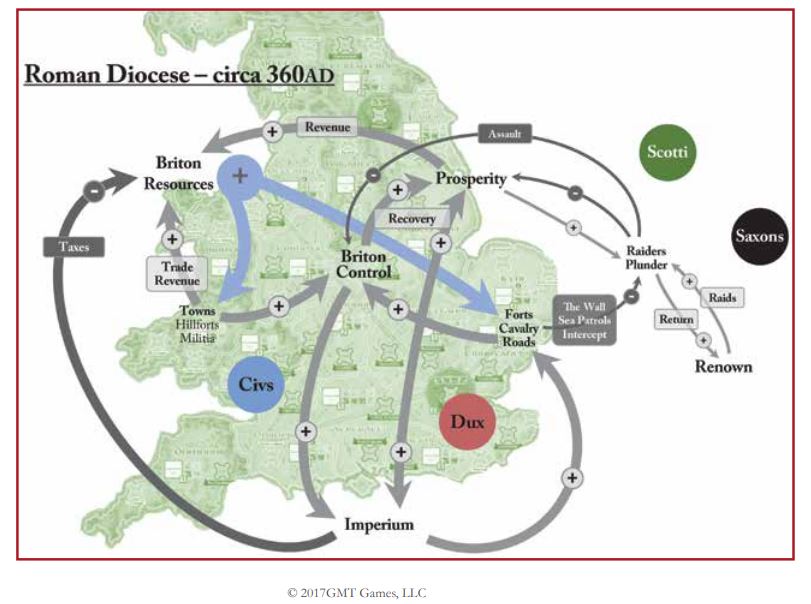
The game designers provide a lot of background and discussion about how they modeled the historical situation. Here’s a sample of some of their stuff:
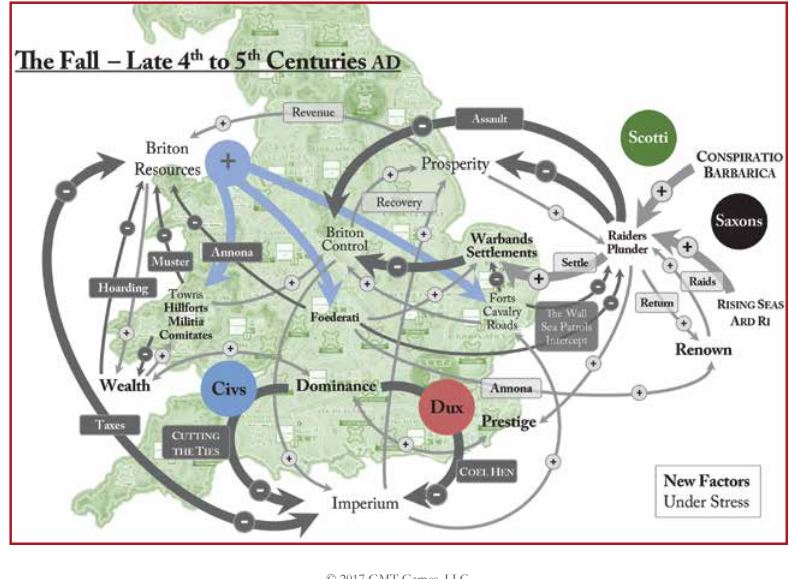
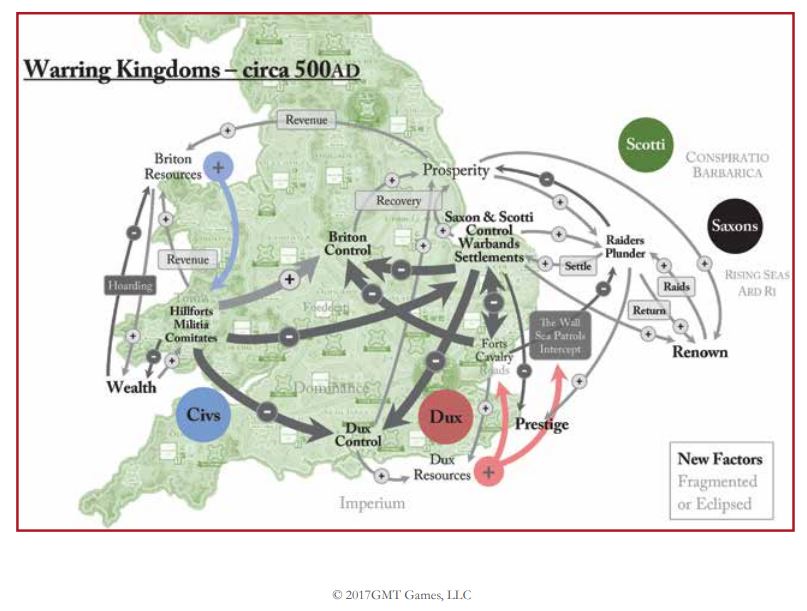
I like this sort of thing. I’m wondering if more students would like history if it was presented dynamically and could be modeled with a game. This diagram suggest movement and flow, not the static collection of facts which (unfortunately) history class is often seen as.
Here’s more:
Wargaming is part of all professional military schools. The US Navy wargamed, in advance, every scenario they encountered in WWII against Japan. Except for the kamikazes, that is. Otherwise they had worked out “if they do this, we’ll do that” or “if we do this, they’ll do that” for dozens of possibilities and so were prepared, strategically, for the war’s challenges.
This kind of wargaming is not that, of course. Pendragon is about conflict. And conflict between peoples, states, and institutions is part of life. Perhaps if we learn about previous conflicts, and how to model them, we can understand contemporary conflicts better. And if we understand something we might improve on it.
Lithium (Li) is not a stable substance. The pure metal has to be stored under oil because it will oxidize immediately on contact with air. It will react explosively to water. One does not find pure lithium metal in a natural setting.
The main ore of lithium is spodumene. It’s a silicate mineral, LiAl(SiO3)2, and it is extracted via hard rock mining. The largest spodumene deposit in the world is in the Congo (DRC). The ore is roasted to a very high temperature (900 C) and the lithium is extracted with various reagents. Much of the mined lithium is marketed as lithium hydroxide, LiOH. This material is used in the ceramics industry and of course in the manufacture of lithium-ion batteries.
Lithium is present in brines, typically as lithium carbonate (LiCO3). Chile is a major source. The brines are pumped to the surface and evaporated from large pans. The remaining salts are processed to obtain the lithium. Lithium carbonate is an important medicine in treating mental illness. And of course this stuff is needed for the manufacture of lithium-ion batteries.
Electric vehicles (EVs) need these batteries. Li-ion batteries can hold enough charge to power the motors for a long enough time, they can be recharged over and over again, and they are light enough to lug around in the trunk mile after mile. But light they are not. An EV’s batteries can be 1000 pounds! EVs are heavier than gas-guzzlers because those big Li-ion battery packs weigh a lot.
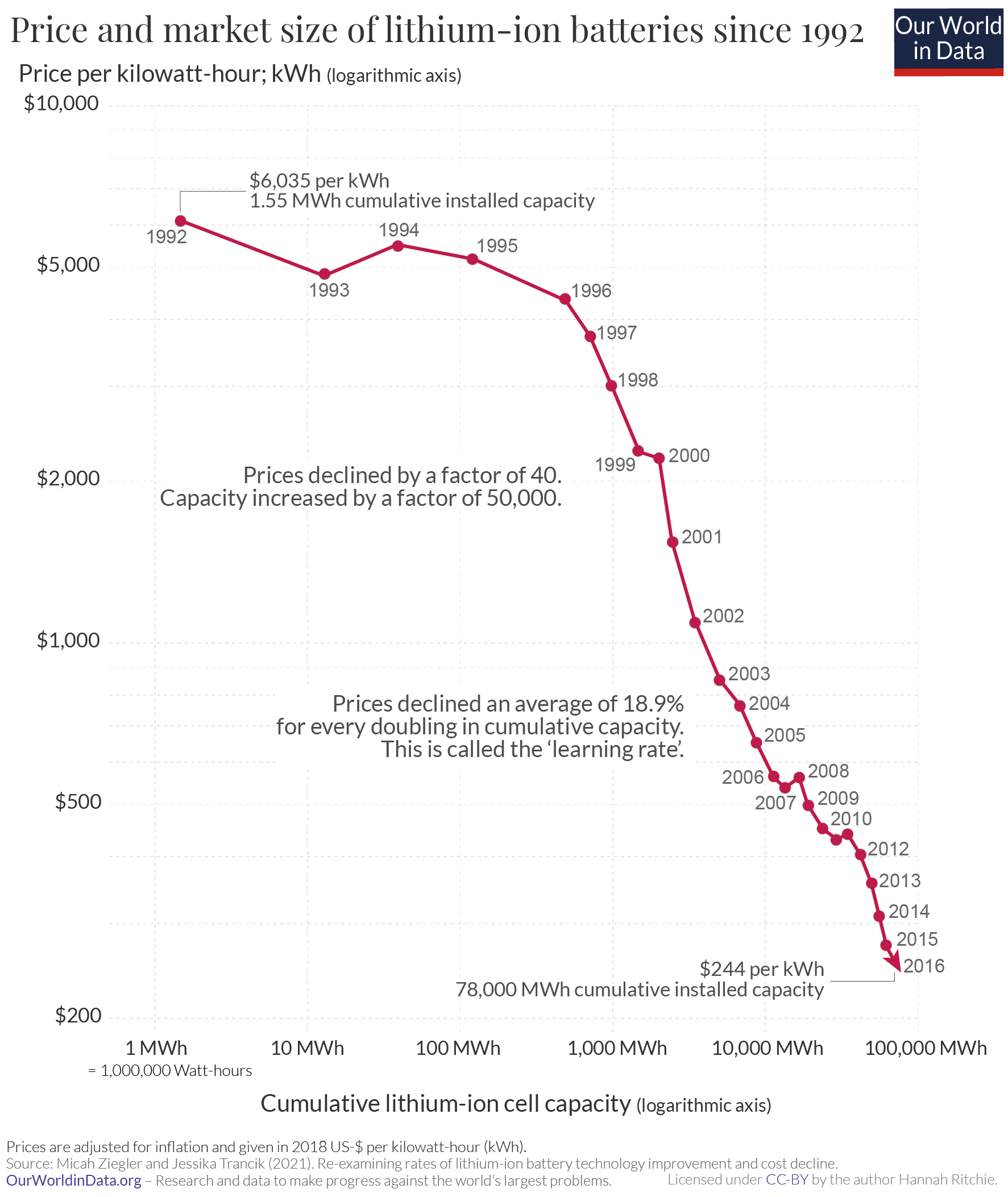
We’ve all used Li-ion batteries and battery packs in rechargeable and cordless products. They are everywhere. And their use will continue to grow. Wood Mackenzie says we’ll use five times more than we use now by 2030. Those folks are in the forecasting business so maybe they know something. It certainly isn’t hard to imagine our society wanting more of something! A look at the graph below will show you the impact of all that demand for Li-ion batteries—capitalism in action.
That means more mining, of course. The greening of the economy will require the largest investment in resource extraction in history. Lithium compounds are just one piece of the puzzle.
The folks at random.org care about randomness. An honest set of dice will generate random numbers. There is a fixed range, and the outcomes are predictable by the laws of probability (you’ll get more sevens than threes), but each individual roll has an unpredictable outcome. Something is random if you can’t predict it.
If a computer generates random numbers they are not truly random. A computer has to follow an instruction set and if a number is created in response to a programming command then it is not random but deterministic. A computer can create a list of pseudo-random numbers, that is, numbers that show enough variety that they appear to be random. This works well for many purposes but not always for cryptography. Modern encryption techniques involve doing math with randomly-generated number sequences. Such pseudo-random numbers are not necessarily good enough. If a computer program created a list of such numbers in theory that method could then be re-created and thus the entire encryption scheme compromised.
True randomness requires nature, that is, a physical phenomenon. Radioactivity is truly random. A pile of radioactive material will decay at a predictable rate, but which individual atoms will decay and when they will decay are not predictable. Those are random events.
At random.org they use atmospheric noise. Tune your radio to a frequency between stations. You get “hash” or radio noise from all the electromagnetic activity in the atmosphere. That’s random.
Here’s one of the tools you can use at random.org:
I chose the numbers 1-92 because that’s how many elements there are. At least, elements that occur in nature. The “trans-uranium” elements (beyond 92) are synthetic—they are created in the lab.
So I’m going to get a randomly-generated list containing the numerals 1 through 92 and each represents a chemical element. It would be like putting the names on cards and tossing them in a hat and then pulling them out one-by-one.
The list is my next writing project. I’m going to do a post about each of the 92 elements. My new randomly-generated list will give me the sequence! I could have used a simple pseudo-random list, but I was intrigued by the random.org website. And I could have decided to do them alphabetically, or in the order they appear on the periodic table, or whatnot. But I went with random, so that’s what you’ll get.
My first element is #3, Lithium. I’ve posted about lithium before but it never hurts to review. Lithium is very fashionable these days so we should all be up-to-speed.
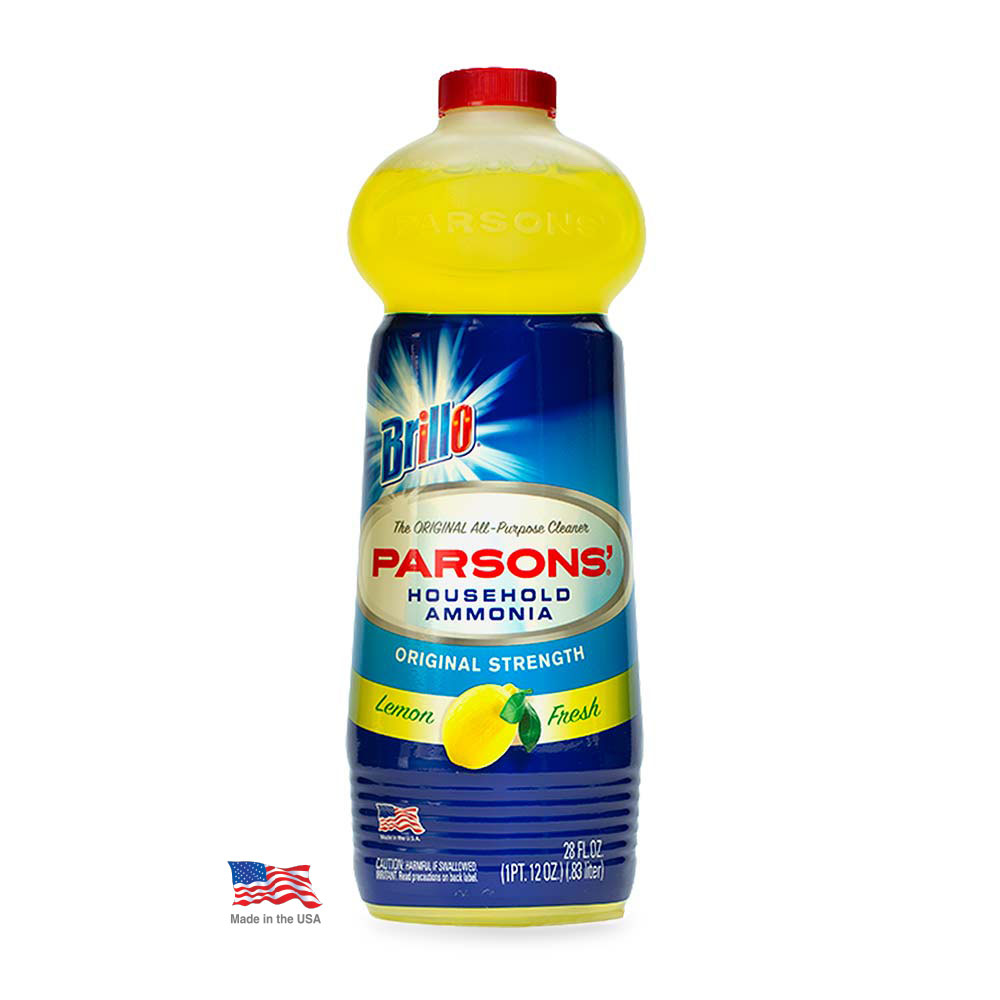
That kind of ammonia (“household” ammonia) isn’t used for cleaning around the house much these days. People switched to bleach or one of the many other cleaning products out there that don’t smell so bad.
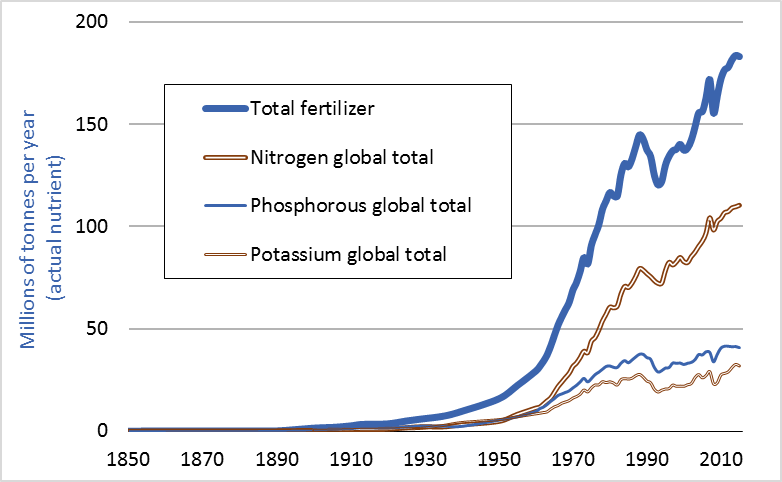
Household ammonia is a dilute solution of ammonium hydroxide, made by bubbling ammonia gas into water. Ammonia gas (NH3) is synthesized from hydrogen and nitrogen. That process, called Haber-Bosch, was invented in the early 20th century and revolutionized world agriculture. No longer did farms have to depend on an increasingly variable supply of biological materials like manure, guano, kelp, fish meal, etc. Now ammonia-based nitrogen fertilizers could be manufactured to meet demand.
In some cases ammonia gas is injected directly into fields. In other cases the nitrogen is made available in a different compound, synthesized from ammonia. Regardless, ammonia production is crucial to feeding the human race. And ammonia production is costly, energy-wise. It is estimated that 1% of all the world’s energy is used to make nitrogen-based fertilizers. Right now most of the hydrogen used in ammonia synthesis comes from natural gas, and the high-pressure steam heating required is supplied by fossil fuels. There are greener pathways for making ammonia, but none currently compete with existing technologies.
The “organic” farming movement has gained a lot of traction in the US. We are wealthy enough and have an abundant food supply so consumers can be picky about what they eat and where it comes from. Much of the world does not have that luxury. But the organic farmers have a point: industrial agriculture is not sustainable. Right now we are eating our oil! The energy requirements of the modern farm are immense and as the world population grows the demand for food will increase and thus more and more energy will be required.
Advances in herbicides, pesticides, fertilizers and soil amendments, tractors and farm machinery, crop breeding, and genetics have enabled fewer and fewer people to grow more and more food. Before WWII American farmers could get, if they were lucky, two tonnes* of corn (maize) per hectare**. Now they routinely get ten! But that five-fold increase is not going to happen again. We aren’t going to get some magic technological bullet that will suddenly double our yields. Growing enough food to feed the world will continue to require very large inputs of energy.
Innovations will be needed of course, this is why people are excited about biotechnology. GMOs are here to stay and we’ll need more of them in the future. But we also have to face our choices and our consumption patterns. There is a belief that advances in science will be sufficient to take care of our environmental problems. This is not so. Most of our problems are social, economic, and political. Solving those kinds of problems is much trickier than inventing new stuff. We have to work together and you know how hard that is! The whole world wants to eat as well as we do. It’s a fair thing to want. What’s it going to take to get there?
Mr. McGuire: I want to say one word to you. Just one word.
Benjamin: Yes, sir.
Mr. McGuire: Are you listening?
Benjamin: Yes, I am.
Mr. McGuire: Plastics.
It’s from The Graduate, a very popular Mike Nichols film from 1967, just in case you don’t already know that. The screenplay is from Buck Henry and Calder Willingham and the movie made Dustin Hoffman a star.
Plastics are everywhere. The modern world is a plastic one. Plastics are made from hydrocarbons. They don’t have to be. You can make plastics from cellulose—rayon is a good example. You can make plastics from bio-molecules like starches and proteins. There are potato plastics and corn plastics and soybean plastics and whatnot.
But what we mean when we say “plastic” is the stuff made from oil and gas. In chemistry things that have a carbon-atom backbone are called “organic.” It was assumed for a long time that certain types of compounds—amino acids are a good example—could only be created by living things. Then a fellow named Wohler synthesized urea (a byproduct of protein metabolism in mammals, secreted in the urine) from “inorganic” compounds. Crushed rocks. Stuff not made of dead things. And people realized that a molecule was a molecule and its origin was not so important. Thus synthetic chemistry was born. People starting making their own molecules that mimicked “natural” ones. Plastics were born.
Plastics are polymers, just like starches. The most famous of all polymers is DNA. But it is the hydrocarbon polymers, mostly made with ethylene, that make up our plastic world. If you take “organic” chemistry in college you don’t learn about herbicide-free farming. You learn about polymers (and other stuff) and it matters not if they occur in nature or are made in a factory. Chemistry is chemistry is chemistry.
The plastics we make from petroleum have made our cars lighter and thus improved the gas mileage. That’s an environmental good. But most of the plastics are “one-use” and then they become garbage. That’s an environmental bad. All technologies are like this. There is no free lunch. Every decision we make about how to use a natural resource will come with consequences. It’s not about a consequence-free invention or innovation: that’s a fantasy. It’s about understanding and appreciating the consequences of our choices. It’s about making informed choices, and choices that value the future, and the well-being of all over short-term gains.
Spend your day looking around you. Think about all the different plastics you encounter. How many of them could you replace with something better? Chemists will continue to innovate and create new plastics. What do we want from these materials? And how do we get there?
Historians used to tell us that the growth of human civilization was broken into three stages: the Stone Age, the Bronze Age, and and Iron Age. Nowadays we know these distinctions to be over-simplified. Nonetheless the emergence of iron and steel in human history was a major turning point.
Bronze is an alloy of copper and tin. Both of these metals have been known since antiquity. The natural ores for both copper and tin are easy to smelt. Temperatures in the 250 to 350 Celsius range (600 Fahrenheit) can be obtained in fireplaces and thus early peoples could work these materials.
Iron is another story. The separation of iron from its ore requires a lot of heat energy. Charcoal is needed to smelt iron ore and more specialized furnaces are required. Temperatures have to be in the 1250 Celsius (2300 Fahrenheit) range. Thus it is reasonable that iron (and steel) emerged later in human history.
One of the key moments in the so-called Industrial Revolution was the invention of the modern blast furnace. Steel is iron that contains small amounts of carbon. Controlling the carbon content changes the brittle pig iron and wrought iron into the tougher and more malleable steel. The blast furnace made the conversion of iron to steel cheaper and more efficient and gave more control over the quality of the final product.
Today steel is made with coke which is a charcoal made from coal, not wood. The demand for “met” (metallurgical) or coking coal is growing even as the demand for thermal coal is declining. The production of virgin steel needs a lot of coke. Recycled scrap steel is worked in an electric arc furnace which does not need coke. Most electric arc furnaces are powered by natural gas which provides the energy for the electric current generation. Steel melts at about 1500 Celsius (2700 Fahrenheit) so you can see that the energy needs are still very high. Recycling of scrap steel is a well-established industry and the energy savings from virgin steel production are significant. Most manufactured steel is recycled as scrap when its lifespan is reached. Think of all the auto junkyards—those are scrap metal stockpiles.
World demand for steel is of course on the increase. As countries like China and India, the two most populous in the world, improve their standards of living they will build more modern-style buildings and consume more modern devices like vehicles and tools. Energy consumption is the true measure of wealth. Americans consume more energy per capita than everyone else. It is only natural that poorer nations will seek to emulate American economic gains and attempt to deliver a better life for their citizens. That means they will consume greater quantities of primary energy sources (coal, oil, natural gas, nuclear fuel) and seek to build more energy generating technologies (solar panels, hydroelectric dams, wind turbines). Demand for all the natural resources will accelerate in the coming decades. This is an inescapable fact of economic growth! Economic growth is the Holy Grail of Western societies and the obvious benefits are plain to all. The rest of the world wants what we take for granted.
But economic growth comes with environmental costs. This is another inescapable fact of modern life. Can we get there without polluting our world to the point of making it un-inhabitable? Yes, but it will take a lot of creative people working together. And we will have to revisit our notions of wealth and freedom and reevaluate our needs regarding comfort, leisure, and consumer goods.
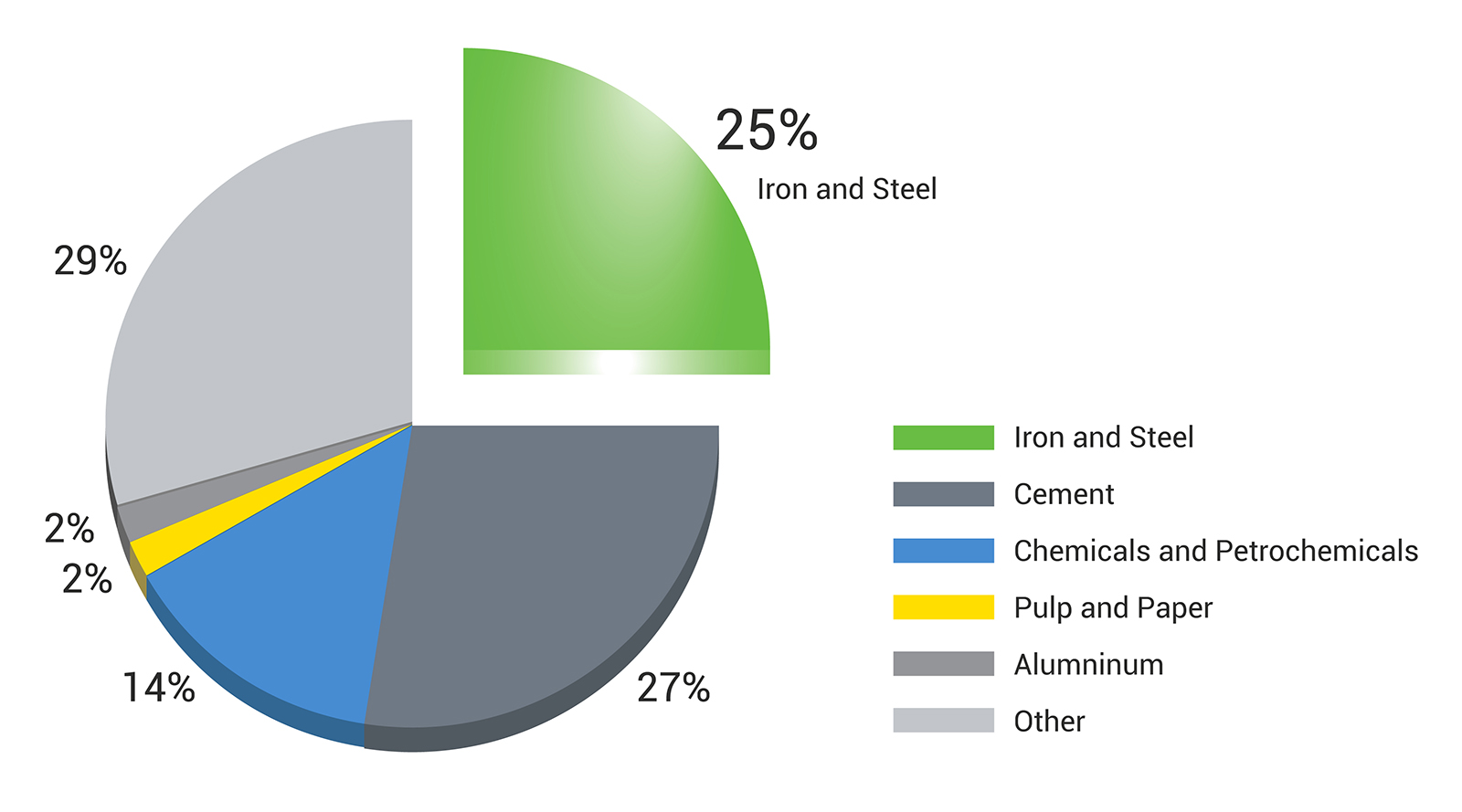
Here’s a graph that shows the significance of iron processing and steel manufacturing in the overall industrial sector:


 Mark C. O'Connor