John le Carré

The great master of the spy novel died yesterday at the age of 89. His real name was David Cornwell and he spent a few of his younger years working for both MI5 and MI6, the British domestic and foreign spy agencies. Much was made of le Carré’s time in the espionage racket. His fans assumed that his experiences informed his books and made them more authentic. His critics—including government service insiders—complained that the pictures he painted of the spy trade were fantastical rubbish.

I’m sure he loved the hubbub. What writer doesn’t like people fussing over his stuff?

The Spy Who Came In From the Cold (his third novel) was published in 1963 and was successful enough that le Carré could quit his job and devote himself to writing full-time. He followed that with another twenty or so novels covering everything from the Cold War to the War on Terror. Mostly he emphasized character over action and moral quandaries over shootouts but that does him a bit of an injustice. His books are usually gripping reads with long stretches of anguished tension, as taut as any hard boiled crime novel and as fast-paced as any thriller. While le Carré created a more erudite and literary version of the suspense novel he managed to keep them, well, suspenseful.

As far as realism and authenticity go, that sort of debate misses the point. We are talking about fiction. Fiction is stuff people make up. This idea that fiction has to be realistic is silly. Good fiction has to seem real. It has to feel real. It doesn’t have to be real. Whether le Carré’s spies used actual, real-life fieldcraft on their missions or instead used entirely made up stuff is not important. What’s important is the reader’s immersion into the fictional world. If the reader buys it, it is as good as real.

When I said le Carré was a master of the spy novel, this is what I meant. He drew you in and enveloped you completely in his imaginary universe. That imaginary universe corresponded to the real world in the sense that Russia was Russia and China was China and all that. There weren’t any elves or aliens. Gravity worked, as did guns. But it was still make-believe despite its verisimilitude.

As he got older le Carré’s books got more weary and cynical. He was always more interested in the dark side, focusing on the lies, hypocrisies, and betrayals instead of the triumphs, but his books usually had a little light at the end of the tunnel. The tunnel got a little longer and the exit a little smaller over the six decades of his writing.

I suppose we are all susceptible to weariness and cynicism as we age. One of the reasons I like to read noir fiction is that it makes me feel better. It’s sort of like playing blues music when you are sad, it tends to lift you up. At least that’s the way it works for me.

If you are interested in le Carré, I really liked The Little Drummer Girl (1983) and A Perfect Spy (1986) but even his more recent books like A Most Wanted Man (2008) and A Delicate Truth (2013) are still great.

No place like home

In 1990 the population of California was thirty million. Thirty years later it is forty million.

That’s a thirty-three percent increase. (30M + 10M = 40M and 10M/30M = 0.33 = 33%)

In 1990 the population of Yreka was seven thousand. Thirty years later it is seven thousand, six hundred.

That’s just under a nine percent increase. (7K + 0.6K = 7.6K and 0.6K/7K = 0.086 = 8.6%)

While the State has averaged a little over one-percent annual growth the City has managed just three-tenths of that. I think most would say the State has grown too much and the City has not grown enough. In the same time span Siskiyou County has grown by only 100 souls, from 43,500 in 1990 to 43,600 in 2020 (with a peak of 45,000 ten years ago). That’s only (100/43500) 0.2% growth! I think most would not call that growth but instead call it stagnation.

In capitalism you have to grow. Growing slowly is almost the same as not growing. There’s no such thing as a steady-state. The growth curve must trend upward—it cannot be flat. The entire edifice of the free market system is built on growth. Lack of growth means not simply diminished expectations for the citizen-consumer but collapse of their way of life.

Most folks think, with apparent logic and good intentions, that there is a growth-number sweet spot, a sort of Goldilocks “just-right” percentage that will allow a city, county, state, or country to grow and prosper without sacrificing the quality of life. There may be such a number. I don’t know, but I have my doubts.

Here’s where you need math. Don’t run away. This is easy, and I’ll put the nerd stuff in the “optional reading” section. It is called The Rule of 72. If you want to know how fast something will grow think of it in terms of doubling time. If you have a hundred bucks invested in something, how long will it take at that interest rate to get to two hundred bucks?

If you are making 1% interest, it will take 72 years because 72/1 = 72.

If you are making 2% interest, it will take 36 years because 72/2 = 36.

If you are making 3% interest, it will take 24 years because 72/3 = 24.

That’s the Rule of 72. Take 72 and divide by the interest rate. 72/4 = 18, so it will take 18 years for $100 to become $200 at 4% growth.

So if you live in a lovely town of 5,000 people and the city council wants to spur job creation and growth and they pick a target of 3% per year you can tell them that means the town will have 10,000 people in twenty-four years (72/3 =24). Ask them if this is their intention—to double the size of the town in one generation.

The Rule of 72 works for any kind of percent growth: people, bacteria, dollars, etc.

Yreka is a quiet place and lots of people have to leave because there just aren’t enough jobs. It is tough to make a living in a place where economic growth is slow-paced. In fast-growing places people often have to leave because housing and transportation costs outpace incomes. This is why we are always on the lookout for that sweet spot, where the growth is enough to sustain communities but not so much it prices people out. California is well-known for its high cost of living.

I don’t know the answer. Growth is one of those things we talk about every election cycle but we talk about it in vague terms. We equate growth with “good” but we don’t really know how much is good and how much is too much. We usually find out the hard way, after things have happened. We don’t really know how to plan for growth, or if we do, how to make it work. I think people in famous resort areas like Lake Tahoe would say they wished they’d planned for growth a little better. A weekend drive there can turn into car-maggedon in a hurry.

I do know that until we can quantify growth, and translate that into quality-of-life metrics that reflect the impact of growth on communities, we’ll just be trotting out the same B.S. and having the same arguments. I don’t think folks are willing to question the basic growth assumptions that underlie our capitalist society. I don’t think an austerity message will resonate with Americans. Capitalism is optimistic in its outlook. There’s always another market just around the corner, all it will take is a little innovation and elbow grease and we’ll all get rich. It’s hard to argue with that. Only later, when the ravenous maw of free enterprise has consumed your small town and left behind a strip mall, will you wish you’d done the math.

++++optional reading++++

The Rule of 72 works because of the natural logarithm of 2, which is approximately 0.693 and is often rounded off to 0.7 for quick estimates. Dealing with percentages means we have to multiply by 100 so you get 70, and it is sometimes called the Rule of 70. The Rule of 72 works as a convenient approximation because 72 is divisible by 36, 24, 18, 12, 9, 8, 6, 4, 3, and 2 and is thus handier for mental math.

Why the natural logarithm of two (ln 2)? Since we are talking about doubling time, we need a solution to the exponential growth formula that is twice as big as what you start with.

Growth is calculated with the base e raised to the product of the rate and the time:

e^rt or ert (they mean the same thing, one is easier to type).

If you start with amount A you need to find the rt (rate x time) to get to 2A, or double the original amount.

2A = Aert

2 = ert

ln 2 = rt

r is expressed as a percent, thus r/100, so you get

100 ln 2 = t

t is time in years and ln 2 is about 0.7 so

70 = t

Tumblin’ tumbleweeds

We’ve been getting these cute little tumbleweeds around here lately:

That’s a 12-inch ruler for scale. It took a while for me to identify this plant but it has to be Panicum capillare also known as witchgrass.

The part of the plant you see is the inflorescence, that is, the flower head, and this type of inflorescence is called a panicle. If you like goofy words, you should check out botany.

Here’s a bit from the entry in Munz & Keck’s A California Flora, p. 1546:

. . . papillose-hispid to subglabrous . . . attentuate at tip, subsessile along the ultimate branchlets . . .

Botany books go on like this for days. You need a specialized glossary to make sense of the stuff—a little book to de-code the big book!

What made this one tough is that the dry panicles become tumbleweeds and they float around on the lightest of breezes and attach themselves to other plants. I finally had to pull some of the bunchgrass out by its roots before I could be sure which inflorescence went along with which plant.

There are places in the world, mostly deserts, where the tumbleweeds can be so bad that cars and houses get buried after a windstorm. Out in the dry valleys east of here there are several species of plants that dry up at the end of the summer and turn into tumbleweeds and become a potential nuisance. Here in town the open fields are small and broken up by neighborhoods with their cultivated lawns and gardens. There’s not much chance of a tumbleweed problem. As you can see the witchgrass tumbleweed made by Panicum capillare is a light and delicate thing, and absent of thorns or sharp edges.

Of course, any talk of tumbleweeds leads naturally to The Sons of the Pioneers:

See them tumblin’ down

Pledging their love to the ground!

Lonely but free I’ll be found

Drifting along with the tumbling tumbleweeds

Songwriter: Bob Nolan

Stay safe out there on the trail, pardner!

That’s a lot!

I remember the arrival of the transistor radio. Suddenly everyone could afford a little box from Japan with a dial and an antenna and listen to their favorite stations. About the same time the solid-state TV was replacing the old tube-type sets, much like flat screens today pushing aside those clunky CRTs.

The transistor was conceived in the 1920s, invented in the 1940s, and mass-produced by the 1960s. The transistor is an electronic component made from semiconducting materials. It gradually replaced the vacuum tube and thus radios and whatnot could be made more portable. Eventually the transistor could be microscopically etched into a circuit board and complex devices like computers could be shrunk to desktop size.

These days we carry our devices in our pockets. A cell phone has billions of transistors in its circuitry. The transistor count used to be a measure of complexity but is mostly irrelevant now. All of today’s modern chips are packed with almost unimaginable numbers of tiny circuit elements. How well your device works with networks and other devices is what matters. A cell phone, even if it happens to have the most sophisticated architecture, is useless by itself.

The most common kind of transistor today is called MOS and that means “metal-oxide semiconductor.” A sandwich made from a layer of pure silicon and a layer of its oxide is the basis of the MOS transistor, hence the name. The computer I’m typing this post on has billions of MOS transistors in its chipsets.

Let’s multiply those billions by the many, many millions of users. Let’s not forget the cell phones, too, and all the devices in our homes, cars, and workplaces. Not to mention all the technology that launches satellites, flies planes, and pilots ships. And all the computers and whatnot needed for banking, trading, manufacturing, health care, law enforcement, and all the rest of the things that make up a society. Plus we have to add all the dead tech—the heaping piles of old Macs and PCs and flip phones and other obsolete stuff.

The MOS transistor is a good candidate for the single most manufactured thing of all time. According the the Computer History Museum blog something like 13 sextillion (1.3 x 10²²) MOS transistors have been made!

That’s an absurd number. It looks like this:

13,000,000,000,000,000,000,000.

Here’s the number of people on earth (7 x 10⁹):

7,000,000,000.

That’s nearly two trillion (2 x 10¹²) MOS transistors for each of us!

They think there might be a trillion stars (1012) in the Milky Way galaxy and that looks like this:

1,000,000,000,000.

So that’s 130 billion (1.3 x 10¹⁰) MOS transistors for each star!

In a tablespoon of water (15 grams), there are 500 septillion (5 x 10²³) H2O molecules. That means they’ll have to share. A few dozen water molecules will have to fight over one measly MOS transistor.

I was staggered by the number of those little bitty things we humans have managed to make in the course of my lifetime. But then I think about the scale of the atom, and realize that even 13 sextillion isn’t that much. If a tablespoon of water can dwarf that number, imagine how many molecules of H2O are in Lake Tahoe, or the Pacific Ocean!

I’m certainly thankful for all those little bits of computer stuff. Our communication technology has enabled us to weather this pandemic storm. We can’t get together, but we can still stay in touch, and that’s made all the difference.

Zero, corrected

My lovely bride pointed out to me yesterday that I was wrong. This is not news around here. She keeps records of things like low temperatures and she showed me at least two instances where we were well below the ten degrees Fahrenheit I mentioned.

In December of 2013 we had back-to-back nights of -5 ºF and in January of 2017 we bottomed out at -10 ºF.

A negative ten degrees, or ten degrees below zero, would be -23 on the Celsius scale!

Our Founding Fathers did not know about negative numbers, or if they did, they considered them nonsensical. Negative numbers had been around for a thousand years and had been used by Indian and Arabic mathematicians for centuries but did not really gain much traction in the West until the 18th century.

Numbers are more than just quantities. When you put them on a number line you now have something more than just size or magnitude, you now have direction.

A negative number has the same magnitude but it is the opposite of a positive number. On a temperature scale the change in direction is up or down and on a number line it is left or right but the concept is the same.

Beyond that, negative numbers occur in algebraic solutions (remember the quadratic formula?) and along with imaginary (complex) numbers are essential in engineering and science. You just can’t do enough stuff if you only have positive, real numbers.

The obvious use of negatives to represent debts, losses, and outflows in accounting did not become a common practice until modern times.

My sister-in-law pointed out to me that the new vaccine from Pfizer for COVID-19 has to be stored at -80 ºC (-112 ºF). Brrr! Imagine if we could not talk about such things like eighty degrees below the freezing point of water or that such notions were not a commonplace part of a child’s education. That’s weird to think about. Many of the profoundest minds in our history would have been bewildered by something we teach in elementary school! As a race, humanity is a hell of a lot smarter now than we were in the past. That’s not to say we’ll always act smart, just that we are smarter.

Zero

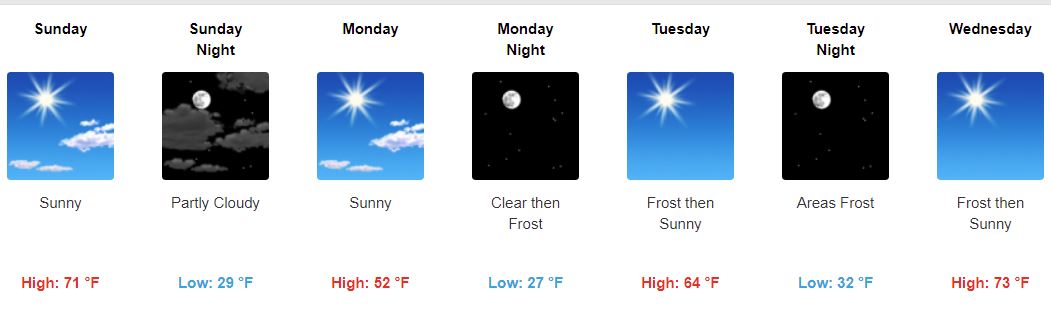
It is just past one o’clock here and the thermometer says zero. That’s Celsius, of course, and it sounds worse than it is. In our more familiar Fahrenheit system the air temperature is a balmy thirty-two degrees on the plus side of zero.

The centi-grade system is based on one hundred degrees as you would expect. Water freezes at zero and boils at one hundred.

Fahrenheit’s scale uses one hundred-eighty degrees for the same span: water freezes at thirty-two and boils at two hundred-twelve.

Both are arbitrary. The thing I like about Fahrenheit is when the temperature climbs into triple digits, from the 90s to the 100s, you know it is really hot. The Celsius scale has you going from the mid 30s to the low 40s and it just isn’t the same. Our body temperature of 98.6º F translates to 37 ºC and so a jump to 100 ºF, which is dramatic, seems less so when it is only a jump to 38 ºC.

Other than that you can get used to the Celsius scale easily enough. I like to remember a couple of key points like room temperature which at 68 ºF is 20 ºC. That’s a good point to start. Every five Celsius degrees is equal to nine Fahrenheit degrees so you can just count by fives on one side and add nine on the other.

25 ºC is (68+9) 77 ºF and 30 ºC is (77+9) 86 ºF and so on. You can go down as well. Remembering that 20 ºC equals 68 ºF means that 15 ºC is (68-9) 59 ºF and 10 ºC is (59-9) 50 ºF and so on.

I suppose that is only handy if you are travelling in England or whatnot and they give the weather forecast in Celsius. By the way if you use my subtraction method above all the way down to -40 on the Celsius side you will find that it will equal -40 on the Fahrenheit side! Just a little quirk in the two systems—they are offset by thirty-two degrees and a Celsius degree is 1.8 (9/5) times bigger than a Fahrenheit degree. If the two temperature scales are plotted on a graph the slopes of the lines will be different and that means they have to intersect somewhere.

Thirty-two degrees Fahrenheit (zero Celsius) isn’t all that inviting for a walk around the block but is pretty mild overall. We can get days that are below freezing, in the teens and 20s, which puts you into negative numbers in Celsius (-5 ºC = 23 ºF and -10 ºC = 14 ºF).

It seems like negative numbers should be reserved for the really cold days and the Fahrenheit scale works like that. Anything below zero Fahrenheit (-18 ºC) is really cold, something on the scale of winters in North Dakota. The coldest temperature we have recorded living here thirty-plus years is 10 ºF (or -12 ºC). People in Nebraska get that kind of stuff all the time which makes me happy I live here and not there.

Speaking of variation, you probably know from experience that water boils at different temperatures depending on the altitude (elevation above sea level). That kind of thing, plus the arbitrary nature of the temperature scales, has scientists in search of a more absolute way to measure temperature. The Kelvin scale is based on the idea of absolute zero, when molecular motion is so insignificant it cannot be measured as heat. This scale zeroes out at about -459 ºF (-273 ºC).

If I convert today’s 32 ºF (that is, 0 ºC) to the Kelvin scale I get, interestingly, 273 Kelvins (you don’t say “degrees Kelvin”, just “Kelvins”). A Kelvin, it turns out, is the same size as a Celsius degree, but the scale starts at a different place, absolute zero.

Rain!

The Weather Service says we might get up to a quarter-inch of rain today. It got me thinking: how much is that?

An inch of rain is just what it says, enough water on the ground to make a depth of one inch. But that’s just one axis of the problem. How much water is that, really?

Let’s imagine a square yard of land, three feet long and three feet wide. Rain falls to some depth, like a quarter-inch or half-inch. If we have to put everything in inches that’s a 36-inch by 36-inch plot, or 362 or 1296 square inches.

If our precipitation is one inch, that’s 1296 x 1 or 1296 cubic inches of water.

If our precipitation is a half-inch, that’s 1296 x (1/2) or 648 cubic inches of water. Thus a quarter-inch of rain would be 324 cubic inches.

But that’s no help. No one thinks about water in cubic inches. We need pints and quarts and gallons! A quick trip to Wolfram Alpha reveals that a gallon of water is 231 cubic inches.

So an inch of rain on a square yard (1296/231) is 5.6 gallons, or five gallons plus five pints. And a half inch is 2.8 gallons and a quarter-inch is 1.4 gallons, or one gallon plus one quart plus one pint.

Let’s translate that to an acre. An acre is 660 feet by 66 feet (do you know why?*) or 43,560 square feet. That’s 220 yards (one furlong) by 22 yards or 4840 square yards.

4840 multiplied by 1.4 gallons gives me 6776 or almost 7000 gallons of water. I live on about one-third of an acre here in town and that means we should get well over two thousand gallons today! The water trucks you see at construction sites carry anywhere from 2000 to 4000 gallons, so that’s a way to visualize the amount.

It has been raining steadily since before sunrise so I think we might get more than is forecast, or at least be closer to the upper end.

California is perpetually short of water. The notion of seasonal drought is a quaint anachronism—supply will always fail to meet demand and that means drought is a permanent condition, just temporarily (and locally) relieved by precipitation.

Some of this water will make its way to the streams and some of it will fill lakes and ponds and some of it will recharge aquifers and some of it will be taken up by plants (even this late in the year) but most of it will evaporate and/or find its way back to the ocean. And the cycle will start all over again.

And some time around May the rains will stop and we’ll have to make do with what’s left over to get us through October and back to the wet season. I remember telling my Irish cousin that we could go six months without rain in California and she was literally open-mouthed with astonishment. She kept shaking her head and saying “can you imagine that?” to her kids. They get over 100 inches of rain per year in Galway which means they average well over a quarter-inch per day.

Now THAT’S a lot of rain!

*An acre is 10 square chains, that is, a piece of land 10 chains long by one chain wide. A chain is 66 feet so 10 x 1 is 660 x 66 and thus 43560. A square mile is 640 acres. Can you see why? (Hint: a mile is 80 chains long.)

SNOW . . . and a president

This morning we were treated to our first-of-the-season snowfall:

It’s wasn’t much, but in the water-starved State of Jefferson it is a thing of beauty. Let’s hope it is a harbinger of colder and wetter times!

It wasn’t until yesterday that everyone agreed to call the election. The Founding Fathers did not want the people to select the president, they wanted the states to select the president. That means we have to sit around and wait for razor-thin margins in places like Pennsylvania or Georgia or Arizona to get settled before we get a result. The popular vote was a clear win for Biden, but like 2016, a few thousand votes in a few dozen counties in a handful of states decided the outcome. Trump was able to eke out an electoral win last time with that math, despite losing the popular vote, but this time the coin flipped the other way.

And I don’t know about you, but I think a coin flip is a lousy way to decide things. I suppose, in a politically divided country, close national elections will be the new norm.

Biden’s lead over Trump is a little over four million votes, which is about the difference in the California vote alone. Californians cast about fourteen million votes in total, roughly one-tenth of the national total.

I’m not sure whether to be embarrassed by the painfully antiquated voting systems in our country or charmed by their rustic quaintness. I suppose a slick, new system where everyone could vote from their phone, laptop, or a computer at the public library would come with its own set of problems, so let’s just do the best job we can with what we have. Everyone does banking and other personal stuff via the world wide web these days, I suspect at some point we’ll vote that way too, but that’s probably farther away than I think.

I was in the 8th grade in 1972 and that was the first national election I paid any real attention to. I was too young to vote in 1976 and cast my first ballot in the 1978 gubernatorial contest (for Jerry Brown!). I’ve voted for a president eleven times (’80, ’84, ’88, ’92, ’96, ’00, ’04, ’08, ’12, ’16, ’20) since then, with my candidate winning five of those contests. What was it I was saying about coin flips? I like those odds better.

Meanwhile, with the race decided we can get back to other things. Like watching the weather and hoping for lots more snow!

Uncertainty

The first of Mr. O’Connor’s Three Rules of Science™ is:

all measurements are uncertain.

It’s the size of the uncertainty that matters. How much uncertainty can you live with?

Some phenomena can be measured quite precisely. Others, not so much.

Measuring people’s feelings, for example, or their intentions, is difficult. Even when faced with a binary choice like Trump v. Biden people equivocate when asked about their decisions.

This creates uncertainties in polling. We all KNOW there are such uncertainties but we don’t talk about them. We look at a poll or a survey and it says “47% of people support . . .” and we don’t think “oh that means it could be 42% or even 52%” or somesuch. We get stuck on the number as a fixed thing.

It’s not. It’s just a stop on a continuum. The polls all have ranges attached to their numbers like “+/- 3%” and that means that’s the most likely set of outcomes in their model.

Polling and pollsters are going to get a lot of heat in this election, much like the last one, but it is misplaced. Consumers of polling information should focus on the uncertainties in the polling results and the biases in the polling methods and not assume the models are predictive. They are just models after all, and even good models need to be continuously tweaked.

A “surprise” in an election is often just dissonance with the polls. An expectation of an election result is formed by the pre-election information presented by the polls. If you did not have that information in the first place you might not consider the outcome a surprise!

We expect a lot from these polls. We expect them to give us knowledge about the future when they can only guess at a cluster of possibilities. It’s the process of making those predictions that’s exciting, not the predictions themselves. Building robust, powerful models is foundational work in science. That can only be done with continuous trial-and-error. If the pollsters get it “wrong” then they have a new challenge to work on for the next go-round.

It stinks to have this much uncertainty in our national election. It’s hard to live with. What matters at this point, of course, is not what anyone said beforehand, but reducing, as much as possible, the uncertainly in the final vote counts. Even something as apparently simple as counting and tallying has uncertainty, and I’m not sure any of us knows how much of that there is, and I’m also not sure we really want to find out.

Wood, fire, heat, and smoke

Summers here in the arid West are punctuated by smoky stretches that can last days or even weeks. No one likes the smoky skies and no one wants to breathe the polluted air.

And yes, wildfire smoke is a pollutant. Perhaps I should say it contains many long-recognized polluting chemicals. You’ve heard of them: carbon monoxide, benzene, sulfur and nitrogen oxides, dioxins, formaldehyde, etc. Add in the particulates, especially the small ones (less than 2.5 microns), and weird stuff like mold spores, and you have a nasty brew that is NOT good to breathe.

Now that autumnal weather is here and winter is approaching temperatures are dropping and the heaters are coming on.

That means more wood smoke. It’s almost de rigueur in the rural West to heat your home with wood. It’s a rite of passage to, at the very least, split and stack firewood every fall. Some folks go out and get their own from the vast quantities available in our nearby National Forests. But the majority of people with wood stoves get their fuel delivered. Split, seasoned firewood is sold by the cord (a stack four feet wide, four feet high, and eight feet long) in various lengths (usually 12 to 18 inches). A good quality cord of hardwood like oak can set you back well over two hundred dollars.

There’s nothing quite as satisfying on a cold winter day than a roaring wood fire. The radiant, penetrating heat put out by a wood stove cannot be replicated by more modern heat sources.

But it comes at a cost. Wood is messy. It takes a lot of time and energy to maintain a fire and keep a home heated. The fuel quality varies greatly, as does availability. Wood piles are sources of insect infestations and potential fire hazards. Creosotes, which are by-products of wood combustion, build up in chimneys which require frequent cleaning to reduce the additional hazard of flue fires.

In our home we have both electric heat (via heat exchangers) and a fuel oil furnace. We don’t have natural gas here in Siskiyou County because the pipeline is too far to the east of us and thus we don’t enjoy the benefits of that energy source. We do have town gas (a propane mixture) that runs on an antiquated underground system, but we un-installed that in our home due to its high cost. Bottled gas like propane can run heaters but can’t compete with kerosene-type fuels for efficiency.

As a result we almost never use the wood stove to heat the house any more. We are glad to have it in case there is a power outage (very rare here) in the depths of winter. But the time, effort, and mess associated with a wood fire can’t compete with the ease and convenience of a modern system that one can “set and forget.”

One of the problems with wood heat is that it is almost impossible to regulate. Wood should be burned hot, and completely, in order to reduce emissions. But folks who want a fire in the morning “damp down” their stoves at night, that is, reduce the air intake so that the logs smolder and burn slowly. That keeps them from being consumed and keeps the fire from going out which makes it easier to re-start. This of course is terribly polluting. And it is a matter of guesswork as it depends on how well-seasoned the logs are, the type of wood, the size of the stove, the drop in night-time temperature, even the relative humidity and the outside barometric pressure. Everyone with a wood stove knows the particular quirks of their situation. I’ve been in wood-heated homes when the output of the stove was so ferocious that doors and windows were left open so the heat could escape! That happens sometimes when you get a big fire going—it heats the stove up so much that the box will continue to radiate even as the fire wanes in intensity.

Like all things, wood heat is a trade-off. Many folks appreciate that wood is abundant locally and can be a cost-effective (if you don’t consider the labor costs) alternative to fuel oil and/or electric heat. Many older houses don’t have another heat source. Lots of mountain municipalities regulate wood-burning due to the pollution but have exemptions for low-income people and homes without other options. Wintertime atmospheric inversions are very common in alpine regions and the valleys and basins which hold the bulk of the population can get as polluted from wood smoke as any diesel truck- and passenger car-choked urban area.

And there’s the rub. Because wood smoke, be it from wildfires or hearth fires, is natural, it is not always perceived as a hazard.

That’s nonsense, of course. A poison, be it made by the Hand of God or the Hand of Man, is still a poison. Our ancestors harnessed the fire from wood. Then they harnessed the fire from peat and coal. Then oil and gas. And now we harness fire from the atom.

All of those fires are both good and bad. There is no pure, perfect, “natural” fire. They all come with costs along with the benefits.

I’m looking forward to winter, I always do. I like the cold weather and the opportunities to go skiing and even perhaps do some snow-shoeing. But I can’t say I’m going to enjoy all the seasonal wood smoke. It was easier when the summers weren’t so bad. Now we breathe that stuff all year!

Lots of active weather patterns with frequent storms will be good. Those will keep the air moving and well-mixed and help the pollutants disperse. The crisp, clean mountain air, especially on a brisk January day, is one the best things about living here. Let’s hope we get lots of days like that.