Athabasca is a word from Cree, one of many languages in the Algonquian family that are native to North America.
The confluence of the Peace and Athabasca Rivers in northern Alberta forms one of the largest freshwater deltas in the world. These rivers converge on Lake Athabasca which spreads into Saskatchewan. South of the Lake are the Athabasca Sand Dunes. There’s a town called Athabasca in Alberta, it’s in Athabasca county, and there you’ll find Athabasca University. Jasper National Park has Mount Athabasca, Athabasca Pass, and Athabasca Glacier.
Those are just a few of the things called Athabasca. The word could mean something grand like “the meeting place of many waters” or merely “where there are reeds.” It’s an old, aboriginal word that’s been translated, transliterated, and anglicized and its earliest meaning is lost to us.
Here’s the first piece of my late mother-in-law’s triptych Athabasca, called simply Athabasca I:
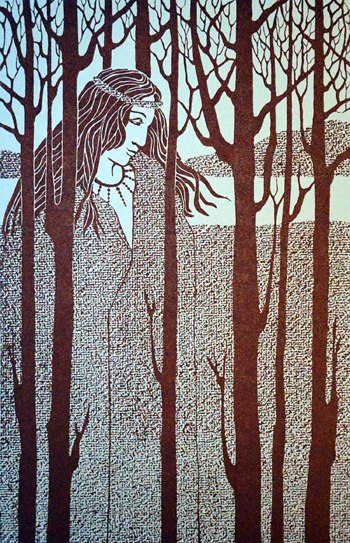
The artist, E.B. Rothwell, included Athabasca in her Spiritus Loci (“spirit of the place”) series. She could trace her ancestry to French fur trappers and an indigenous great-great-grandmother named Marie Caribou. Caribou is an Algonquian word as are moose, raccoon, chipmunk, skunk, moccasin, hickory, toboggan, succotash, squash and many more.
That same area of Canada is also home to the Athabasca oil sands. Petroleum extraction started in 1967 and continues, controversially, to this day. Canada is the world’s fourth-largest producer and exporter of crude oil. Most of that comes from oil sands. The biggest customer is the U.S.
In 1957 a paper* by oceanographer Roger Revelle and physical chemist Hans Suess discussed the connection between mass fossil fuel consumption and atmospheric carbon dioxide, offering this sobering thought:
“Thus human beings are now carrying out a large-scale geophysical experiment of a kind that could not have happened in the past nor be reproduced in the future. Within a few centuries we are returning to the atmosphere and oceans the concentrated organic carbon stored in sedimentary rocks over hundreds of millions of years.”
Think of the time scales Athabasca evokes. You can count the decades, even a few centuries, of my mother-in-law and her ancestors. Those centuries add up to millenia when you think of the native peoples and their tongues. But the fossil carbon of the oil sands requires a real mind-stretch. Geologists say that stuff is from the Middle Cretaceous period—115 million years ago!
It’s easy to think of the spirits that inhabit a place, but it’s hard to imagine what came before. Those carbon atoms that make up the tar sands at one time inhabited a living thing. Probably marine algae, not a dinosaur, and not what we imagine as a sentient being, but alive nonetheless? Do they leave behind ghosts when we dig them up and burn them?
*https://www.tandfonline.com/doi/abs/10.3402/tellusa.v9i1.9075
 Mark C. O'Connor
Ghosts from the sand, sounds like a good book title
LikeLiked by 1 person