The Greeks called it “water-silver” or ΰδραργυρος which the Romans converted to hydrargyrum and thus the source of its symbol, Hg.
Mercury, or quicksilver, is weird stuff. It’s a liquid at room temperature, the only such metal with that property. The only other element that is a liquid at room temperature is the non-metal halogen Bromine (Br, #35) . Its lighter sister elements Fluorine (Fl, #9) and Chlorine (Cl, #17) are gases while the heavier Iodine (I, #53) is a solid.
Mercury was of course known to ancient peoples. The Almadén Mine in Spain is at least 2500 years old and mercury was part of Chinese medicine for at least a thousand years before that. There’s evidence of long-ago mercury and cinnabar (mercury sulfide, HgS, the chief ore) use in the New World as well. Here’s cinnabar:
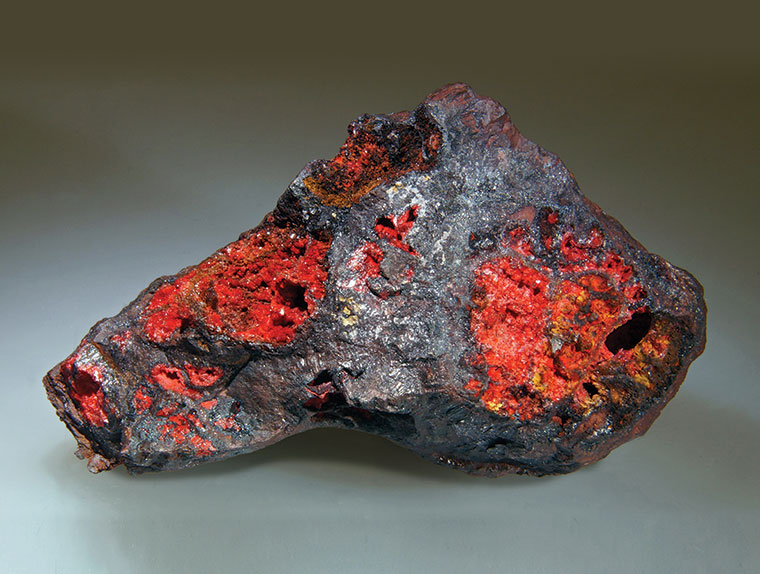
Cinnabar was mined extensively in California. Gold and silver readily combine with mercury to form amalgams and so it is used to extract these metals from their ores. Mercury can be quite a significant toxin and you can imagine the exposures these early miners were subjected too. I had a chance to tour a modern, open-pit gold mine (McLaughline Mine in Lake County) many years ago. Mercury was a major by-product. Mercury does not react with iron and so it is stored in iron flasks. These are standardized to hold 76 pounds of the liquid and that is the international unit by which mercury is bought and sold.
In our day we’ve been warned about mercury contamination of seafood. Industrial waste dumped into our waterways ultimately finds its way to the ocean and into the fatty tissues of fish. This is a serious concern for people who depend on a fish and shellfish diet. The infamous Minamata Bay poisoning in the 1950s that decimated Japanese fishing communities was due to methlymercury, a particularly nasty organo-mercury compound. It wasn’t until several years had passed that the source of the contamination was pinned down—a nearby chemical plant run by Chisso Corporation.
It is possible for a metal to exist in different compounds that have entirely different metabolic effects! Tin is a good example. The metal and its oxides are non-toxic but the stannanes, organo-tin compounds, are quite poisonous.
Most mercury pollution is due to the burning of coal in power plants. In fact, we get more radioactive material dumped into our atmosphere from coal-burning than we do from all the nuclear plants and nuclear facilities in the world combined. Coal is a critical fuel for electricity generation but it comes with an enormous environmental cost.
Many of the uses of mercury compounds, like batteries and fluorescent lights, are being phased out. I still have a mercury thermometer but you don’t see them much any more. The main industrial use these days is as a catalyst for processes like making polyvinyl chlorides (PVCs). About 40 million tons of PVCs are made each year which is the third-most of any plastic polymer. Polyethylene (100 million tons) and polypropylene (80 million tons) are the leaders.
Mercury compounds have been used in various medicinal formulations for millenia. Some of those practices have been thankfully discontinued as they were of dubious value and most likely harmful. Preparations containing micro-doses of mercuric substances have a longer history, especially in Asia, and some of these treatments are still used and have garnered modern medical interest. As Paracelsus famously quipped “it’s the dose that makes the poison.” Funny thing, a mercury preservative (thimerosal) is used in many vaccines at a rate of about 0.003 to 0.01%. For the larger number, that’s 25 micrograms of mercury per 0.5 milliliter dose. Thimerosal is a big sticking point for the celebrity-fueled anti-vaxx crowd. I suppose it’s OK to chase after “traditional” and “holistic” Chinese cures that contain mercury but god forbid you put it in our vaccines!
Mercury is the god of commerce and financial gain. Partridge says that his name comes from mercor (-ari, -atus) the Latin verb meaning “to trade.” He is also the god of thieves and tricksters. Does anyone else find it interesting that merchants and liars are grouped together? Maybe the Romans were on to something.
 Mark C. O'Connor
Enjoyable read! Thank you, Mark.
LikeLike