You don’t have to be a tobacco smoker to get lung cancer. Exposure to such hazardous materials as asbestos and radon gas can also lead to a malignant tumor (carcinoma) in the lungs. We associate lung cancer with behavior, but you can just be unlucky, as is the case with radon gas exposure.
Do you live here? These are the places in the US with lots of radon:
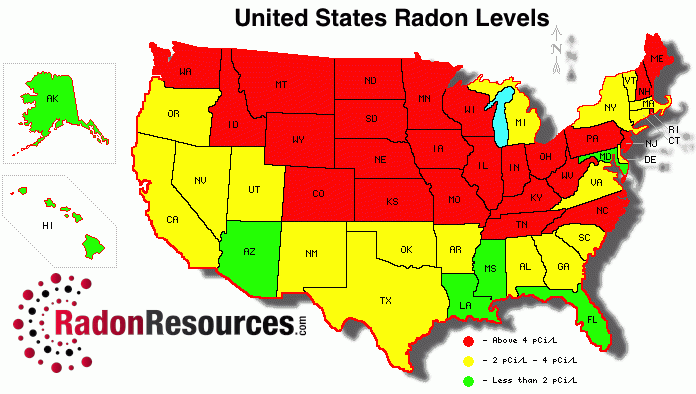
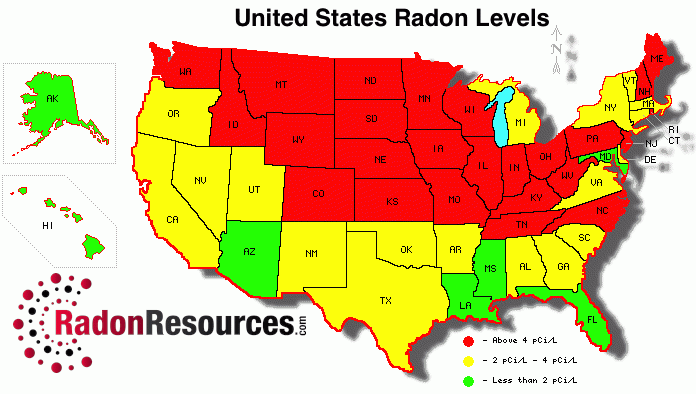
The key is hard to read but the red states in this case are those with over 4.0 pCi/L of radiation exposure. The unit is called a Curie (Ci) and this particular measurement is in picoCuries (or 10-12) and that’s per Liter (L). No one knows what a safe level of radon exposure is. Outside, you get about 0.4 pCi/L so the EPA decided the indoor action level should be 4.0 pCi/L, or ten times that. On the map the yellow states range from 2.0-4.0 pCi/L and the green states come in at less than 2.0 pCi/L. The average level of indoor radon exposure across the US is 1.3 pCi/L.
If you want to get more granular, the EPA has a county-level map here. California has its own indoor radon program.
Radon (Rn, #86) is the heaviest of the noble gases. It hardly exists at all. All the isotopes are radioactive and have short half-lives. Radon is a daughter product from the decay of radium-226, which is itself part of the decay chain of uranium-238. All the radon on the earth’s surface comes via this process. Uranium and radium are naturally occurring metals that are found in rocks all over the world. Mostly radon gas escapes from the soil and dissipates into the atmosphere. But we trap the stuff in our buildings and thus we get exposed.
This hazard—radon gas exposure—is entirely natural. The very ground we stand upon oozes the stuff. It is invisible: colorless, odorless, and tasteless. It’s is also measurable, and thus can be dealt with.
While we rely on private companies to do radon mitigation in buildings, the rest of our radon apparatus is run by the government. Public health agencies and environmental and regulatory bodies at all levels, local, state, and federal, are responsible for radon education and abatement.
The EPA estimates that 21,000 Americans die each year from radon-induced lung cancer.
 Mark C. O'Connor
Actually, Oganesson (Ununoctium) is the heaviest noble gas, but it’s so unstable that it has a half-life of like much less than a split-second.
LikeLike