If there’s one thing everyone knows about now it is the notion of a “choke point” or geographic bottleneck. Our cruel and stupid war with Iran has brought the Strait of Hormuz into everyone’s daily vocabulary.
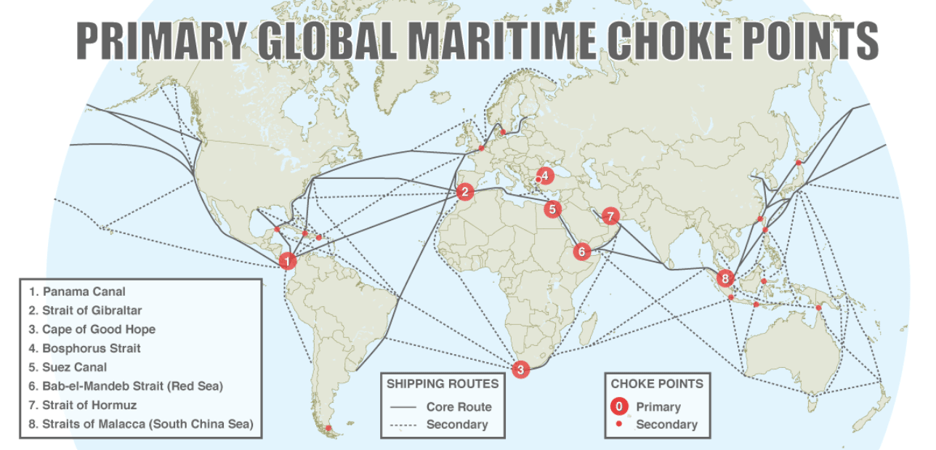
There are several places in the world where a determined actor could concentrate a military force and disrupt regional economies and global trade. Here are a few naval opportunities:
Choke points exist on land as well. Perhaps the most famous is the pass at Thermopylae and its role in the Greek-Persian wars of antiquity. (Ignore all that stuff about Spartans and Leonidas and “The 300” as that’s just a side story.) The famed Khyber Pass in the Hindu Kush between Afghanistan and Pakistan also figures prominently in military history.
But we live in an era of global shipping and maritime choke points are the real players. (Take a look at the Ukraine-Russia war if you want to see the effectiveness of ground armies in the drone-combat era.)
Choke points can be “closed” simply by the threat of attack. Iran cannot possibly interdict all the shipping in the Strait so they attack a few vessels here and there and that is mostly enough to discourage the rest. The modern, well-armed US Navy cannot “open” the Strait as the effort it would take to escort vessels would be too costly in munitions and materiél (and put sailors at risk).
Even a small-time outfit like the Houthis can threaten global trade by shooting at ships passing through the narrow Bab-el-Mandeb between Africa and Arabia at the southern end of the Red Sea (see #6 above). They aren’t even a real country and yet they can command the attention of global movers-and-shakers.
The US Navy was founded on the principle of freedom of the seas. Literally. Our navy was created to protect merchant ships! We got around to fighting other navies later. The current regime seems not to give a shit about the vital freedom of navigation that has made our global economy possible. They seem to think an insular, command-type economy will be better, despite all current and historical evidence to the contrary.
One of the consequences of global warming is the opening of the northern sea lanes in the Arctic. The ice cover is shrinking and new year-round routes are emerging. The Bering Sea between Alaska and Siberia will become increasingly important, as will the GIUK (Greenland-Iceland-UK) Gap. This is the passage between the Norwegian Sea and the North Atlantic (where the Faroe Islands lie) and includes the Denmark Strait separating Iceland and Greenland.

