Uncertainty

The first of Mr. O’Connor’s Three Rules of Science™ is:

all measurements are uncertain.

It’s the size of the uncertainty that matters. How much uncertainty can you live with?

Some phenomena can be measured quite precisely. Others, not so much.

Measuring people’s feelings, for example, or their intentions, is difficult. Even when faced with a binary choice like Trump v. Biden people equivocate when asked about their decisions.

This creates uncertainties in polling. We all KNOW there are such uncertainties but we don’t talk about them. We look at a poll or a survey and it says “47% of people support . . .” and we don’t think “oh that means it could be 42% or even 52%” or somesuch. We get stuck on the number as a fixed thing.

It’s not. It’s just a stop on a continuum. The polls all have ranges attached to their numbers like “+/- 3%” and that means that’s the most likely set of outcomes in their model.

Polling and pollsters are going to get a lot of heat in this election, much like the last one, but it is misplaced. Consumers of polling information should focus on the uncertainties in the polling results and the biases in the polling methods and not assume the models are predictive. They are just models after all, and even good models need to be continuously tweaked.

A “surprise” in an election is often just dissonance with the polls. An expectation of an election result is formed by the pre-election information presented by the polls. If you did not have that information in the first place you might not consider the outcome a surprise!

We expect a lot from these polls. We expect them to give us knowledge about the future when they can only guess at a cluster of possibilities. It’s the process of making those predictions that’s exciting, not the predictions themselves. Building robust, powerful models is foundational work in science. That can only be done with continuous trial-and-error. If the pollsters get it “wrong” then they have a new challenge to work on for the next go-round.

It stinks to have this much uncertainty in our national election. It’s hard to live with. What matters at this point, of course, is not what anyone said beforehand, but reducing, as much as possible, the uncertainly in the final vote counts. Even something as apparently simple as counting and tallying has uncertainty, and I’m not sure any of us knows how much of that there is, and I’m also not sure we really want to find out.

Wood, fire, heat, and smoke

Summers here in the arid West are punctuated by smoky stretches that can last days or even weeks. No one likes the smoky skies and no one wants to breathe the polluted air.

And yes, wildfire smoke is a pollutant. Perhaps I should say it contains many long-recognized polluting chemicals. You’ve heard of them: carbon monoxide, benzene, sulfur and nitrogen oxides, dioxins, formaldehyde, etc. Add in the particulates, especially the small ones (less than 2.5 microns), and weird stuff like mold spores, and you have a nasty brew that is NOT good to breathe.

Now that autumnal weather is here and winter is approaching temperatures are dropping and the heaters are coming on.

That means more wood smoke. It’s almost de rigueur in the rural West to heat your home with wood. It’s a rite of passage to, at the very least, split and stack firewood every fall. Some folks go out and get their own from the vast quantities available in our nearby National Forests. But the majority of people with wood stoves get their fuel delivered. Split, seasoned firewood is sold by the cord (a stack four feet wide, four feet high, and eight feet long) in various lengths (usually 12 to 18 inches). A good quality cord of hardwood like oak can set you back well over two hundred dollars.

There’s nothing quite as satisfying on a cold winter day than a roaring wood fire. The radiant, penetrating heat put out by a wood stove cannot be replicated by more modern heat sources.

But it comes at a cost. Wood is messy. It takes a lot of time and energy to maintain a fire and keep a home heated. The fuel quality varies greatly, as does availability. Wood piles are sources of insect infestations and potential fire hazards. Creosotes, which are by-products of wood combustion, build up in chimneys which require frequent cleaning to reduce the additional hazard of flue fires.

In our home we have both electric heat (via heat exchangers) and a fuel oil furnace. We don’t have natural gas here in Siskiyou County because the pipeline is too far to the east of us and thus we don’t enjoy the benefits of that energy source. We do have town gas (a propane mixture) that runs on an antiquated underground system, but we un-installed that in our home due to its high cost. Bottled gas like propane can run heaters but can’t compete with kerosene-type fuels for efficiency.

As a result we almost never use the wood stove to heat the house any more. We are glad to have it in case there is a power outage (very rare here) in the depths of winter. But the time, effort, and mess associated with a wood fire can’t compete with the ease and convenience of a modern system that one can “set and forget.”

One of the problems with wood heat is that it is almost impossible to regulate. Wood should be burned hot, and completely, in order to reduce emissions. But folks who want a fire in the morning “damp down” their stoves at night, that is, reduce the air intake so that the logs smolder and burn slowly. That keeps them from being consumed and keeps the fire from going out which makes it easier to re-start. This of course is terribly polluting. And it is a matter of guesswork as it depends on how well-seasoned the logs are, the type of wood, the size of the stove, the drop in night-time temperature, even the relative humidity and the outside barometric pressure. Everyone with a wood stove knows the particular quirks of their situation. I’ve been in wood-heated homes when the output of the stove was so ferocious that doors and windows were left open so the heat could escape! That happens sometimes when you get a big fire going—it heats the stove up so much that the box will continue to radiate even as the fire wanes in intensity.

Like all things, wood heat is a trade-off. Many folks appreciate that wood is abundant locally and can be a cost-effective (if you don’t consider the labor costs) alternative to fuel oil and/or electric heat. Many older houses don’t have another heat source. Lots of mountain municipalities regulate wood-burning due to the pollution but have exemptions for low-income people and homes without other options. Wintertime atmospheric inversions are very common in alpine regions and the valleys and basins which hold the bulk of the population can get as polluted from wood smoke as any diesel truck- and passenger car-choked urban area.

And there’s the rub. Because wood smoke, be it from wildfires or hearth fires, is natural, it is not always perceived as a hazard.

That’s nonsense, of course. A poison, be it made by the Hand of God or the Hand of Man, is still a poison. Our ancestors harnessed the fire from wood. Then they harnessed the fire from peat and coal. Then oil and gas. And now we harness fire from the atom.

All of those fires are both good and bad. There is no pure, perfect, “natural” fire. They all come with costs along with the benefits.

I’m looking forward to winter, I always do. I like the cold weather and the opportunities to go skiing and even perhaps do some snow-shoeing. But I can’t say I’m going to enjoy all the seasonal wood smoke. It was easier when the summers weren’t so bad. Now we breathe that stuff all year!

Lots of active weather patterns with frequent storms will be good. Those will keep the air moving and well-mixed and help the pollutants disperse. The crisp, clean mountain air, especially on a brisk January day, is one the best things about living here. Let’s hope we get lots of days like that.

Cedars of Yreka

A few days ago we were sitting at the patio table and watching the trees in the backyard swaying gently in the breeze. We noticed puffs of what looked like yellow smoke coming off the Deodar cedar.

It was pollen, of course.

Here’s what the estimable Sunset Western Garden Book had to say under the entry for Cedrus (true cedars including C. deodara):

Male catkins produce prodigious amounts of pollen that may cover you with yellow dust on windy day

3rd printing May 1989, p. 272

I’ve had to hose off the table twice more since then!

According to botanists there are only four true cedars. One is this species, C. deodara, also known as the Himalayan cedar (its native range). The famous Cedars of Lebanon (C. libani), mentioned in the Bible, are also in the genus Cedrus. The other two are also Mediterranean, the Atlas cedar (C. atlantica) and the Cyprus cedar (C. brevifolia). True cedars are members of the pine family (Pinaceae).

European naturalists encountering new plants in the Americas named them with systems imported from overseas. There are no true cedars in the Western Hemisphere but there are cedar-like trees that were tagged with the name. Ubiquitous in California forests is the incense-cedar or Calocedrus decurrens, a member of the cypress family (Cupressaceae). We have one in our yard. Heading north into Oregon, Washington, British Columbia, and Alaska you find the widespread Western red cedar (Thuja plicata), also in the cypress family. If, like us, you have an arborvitae among your plantings, that’s a relative—Thuja occidentalis.

Back here at home we moved the patio table from outside to under the overhang to keep it free of pollen. Tree pollens are particularly fine and dry compared to flower pollens and are thus easily spread far and wide. Although Deodar cedar pollen is not classified as an allergen, I’m convinced that my runny nose, itchy eyes, and hacking cough last week had something to do with all that yellow stuff floating around my back yard.

Lately the days have been beautiful and smoke-free, so I’m not complaining!

Cold, Rain, and Snow

It’s not bad to be wrong. Sometimes being wrong is the only way to find out how to be right.

Or at least get closer.

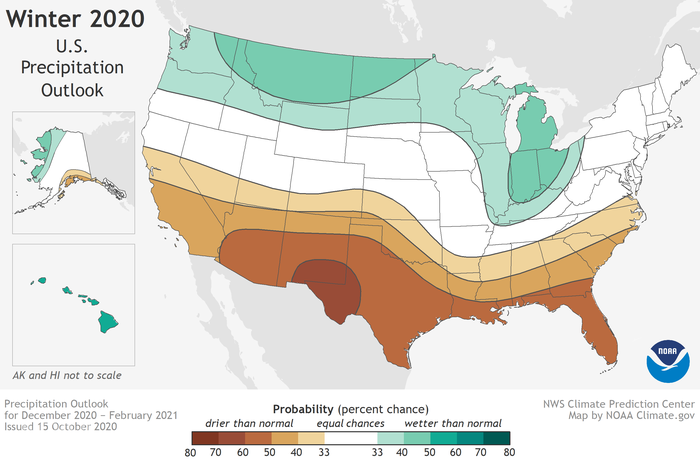
The forecasts for the upcoming winter here in the West are not encouraging:

There is literally a “sliver of hope” in the map above for us here: the tan-colored triangle in northwest California along the Oregon border just might include Yreka!

This is a little less depressing. We may get our usual precipitation, which of course isn’t much, but it doesn’t look like a banner year.

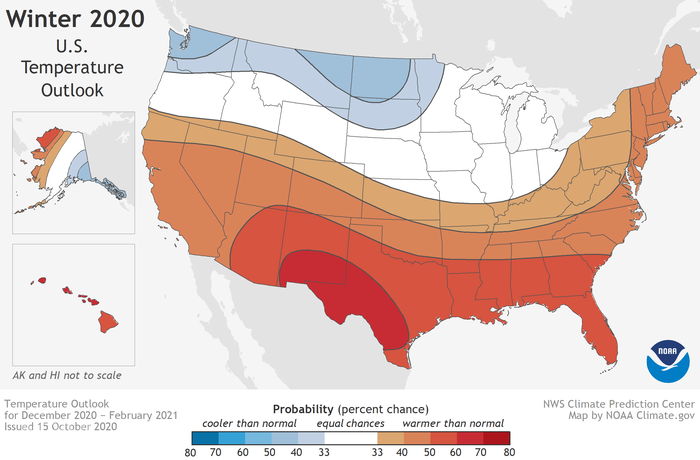
Here’s the one that spooks me a bit:

I don’t want “warmer than normal” I want “cooler than normal”!

Despite our best effort, weather and climate forecasting is still pretty tough. The models are saying the chances are good we will have a warmer, drier winter.

Meteorologists and other scientists have to remind themselves that all models are wrong. They are just models after all, no matter how sophisticated, and a model is not reality.

Models get corrected and updated frequently precisely because they are wrong, and like I said earlier sometimes that’s the only way to get closer to being right.

So I sure hope the models are wrong for this winter. Bring on the cold, rain, and snow!

Rain

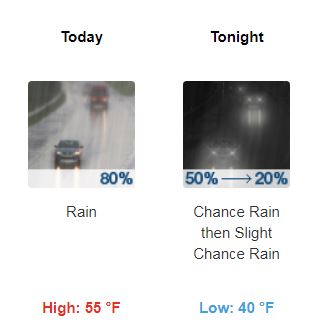
A little, anyway. Not hardly enough, of course.

It’s knocked down the smoke some, perhaps the wind can take care of the rest.

Summer in the Golden State is losing its luster. It was never my favorite time of year, despite being a schoolteacher and a baseball fan! I like the rainy time which is from November to April in most of the state.

There are mountains between me and the Pacific. The Shasta Valley and environs are in the rain shadow of the Klamaths. Suffice to say it is dry here, like much of California.

Like most California cities, Yreka is an oasis sustained by plumbing. We have a water source, Fall Creek, that is a few dozen miles from here so we need a pipeline. Our green lawns and healthy gardens are an illusion. Left to itself, the land here would support juniper, ceanothus, and star-thistle!

Fires have ravaged the West this year. You’ll hear lots of reasons for it, and they are all true. Years of aggressive fire suppression have built up impossible fuel loads in the forests. Logging cutbacks have multiplied that effect. Arguments over policy and bureaucratic inertia have stymied progress. Population growth has put more people on the wild land interface. Climate change has increased the frequency and severity of weather and fire events.

Whenever you are presented with a complex problem, be suspicious when presented with a simple solution. A complex problem is one that can be approached from a variety of perspectives which yield a variety of potential solution paths. At the very least, a complex problem requires a multiplicity of solutions.

Most of the time we solve complex problems by just pushing ahead and seeing what happens, then adjusting on the fly. The problem now is that things are moving too fast. When we just push ahead without forethought, without at least an attempt at planning and problem-solving, we fall back on old habits, old biases, and outmoded ways of doing things.

Engineers often write impossible-to-solve equations for phenomena they study. So they have to make good approximations instead, and that helps guide their work. We need to do the same thing as a society. We don’t know the best way, but we can make models from what we do know, and use those to generate ideas.

And we need the poets on these things, too. They don’t work with differential equations, but they solve equally thorny problems like how to express truth and beauty in the fewest words possible. So they know how to imagine, and see beyond the limits of the language. We will need that to fuel innovation.

The future of life here in the Golden State will likely require an entirely new aesthetic. The California Dream is transforming before our eyes. Let’s get creative and build anew, and stop worrying about what went on before. The most important question is “what shall we do next?”

In the meantime we could use some more goddamn rain!

A truckload

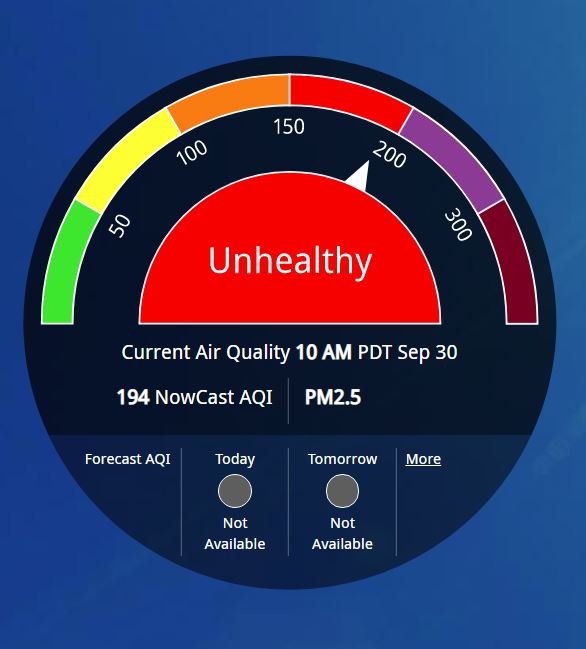
I don’t like to go outside on the really smoky days and today is one of those really smoky days. Here’s the AirNow monitor:

So it got me to thinking, how much air do we breathe every day?

I took a number from HowStuffWorks to get an estimate. They use 11,000 Liters per person per day. The American Lung Association says 2,000 gallons per person per day. That converts to 7571 Liters. I expect there will be a lot of variation in this estimate.

I found I could easily mostly fill a 4-gallon trash bag exhaling normally in one minute. The bag was not at capacity as I had my hand holding a twist in the top few inches, so I estimated the amount with a little geometry. The full part of the bag was a weird, pointy, oblong shape, so I imagined it as a right circular cylinder. I set 12 inches as the average height, 4 inches as the average radius, and used the formula Area = πr2h and got 603 cubic inches. A gallon is 231 cubic inches, so that’s about 2.6 gallons.

If I breathe air at a rate of 2.6 gallons per minute that’s 156 gallons per hour or 3744 gallons per day. That’s over 14,000 Liters. I guess I’m a “heavy breather”!

I don’t think much of my estimate, but I note that it aligns with the other estimates so I will assume their estimates are reasonable. I suspect I would breathe at about half the rate when I sleep, so my 14,000 Liters would then be closer to 10,000 Liters.

So how big is 10,000 Liters? Is 2600 gallons easier to visualize? How about 350 cubic feet?

The cube root of 350 is about seven (7 x 7 x 7 = 343). Imagine a box 7 feet on a side: height, length, and width all about seven feet. That’s how much air you need every day.

Another way to imagine it is in cubic yards, which is about thirteen. Our local garden supply outfit can deliver 10 cubic yards of rock in one load with their ten-wheeler dump truck. Those concrete mixers you see hold about 8 cubic yards.

So if you want to know how much air you need each day, it is at least one truckload!

Tarweed

The smoke has kept me inside. I did go for a walk on Tuesday and regretted it—I should have worn an N95 mask. My throat was scratchy and dry for some time afterwards. Pollution from wildland fires is nasty! And the worst part of it is that the visible stuff, the ash and smoke, are not the main issue. The issue is the very small stuff, the little bits 2.5 microns and smaller. A single cell of E. coli is about 3 microns in size so these particulates are not visible to the human eye. (A micron is a micro-meter or 10-6 meter, about 0.00004 inches.)

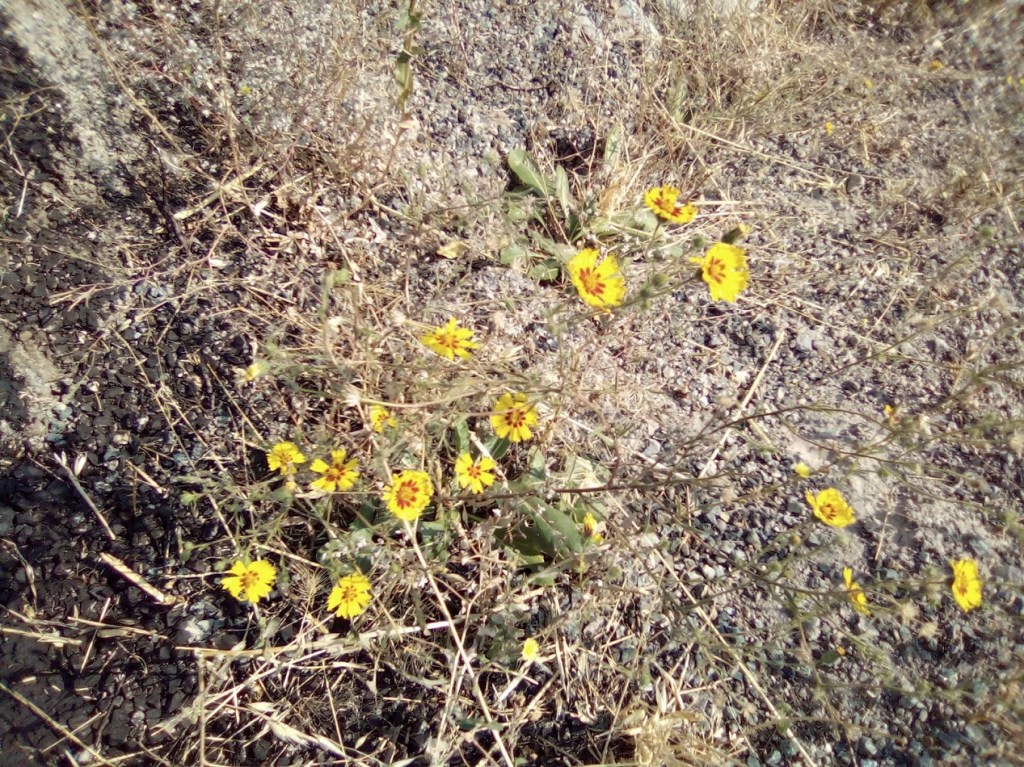
One thing I did see on my walk was Madia elegans, also know as Common Madia, Spring Madia, or Tarweed. Here’s a photo:

Madia is regularly seen along roadsides, in uncultivated fields, and in disturbed areas. It is native to California and the West and a similar alien species Madia sativa, is found on the coasts. The flowers open up in the mornings and face the sun and then curl up in the heat of the afternoon and at night. Around here they bloom for most of the summer and as you can see they linger into autumn.

I’m not much of a photographer but here’s another shot:

Madias are known as tarweeds because of the pungent oils that make the stems and leaves sticky. The seeds were harvested by Native Americans for food.

As you can see it is a sunflower, or composite flower, known botanically as a member of the family Asteraceae.

Cigarette smoke contains “tars” as well as nicotine and these contribute to the health impacts on smokers’ lungs. I guess as I was wheezing around the block I was thinking it was like being in a room full of smokers!

You’ll need a mask

I took this from the EPA site AirNow.

It doesn’t require a sensor to know the air is bad. And it is very bad here in Yreka.

I know we are lucky—so far—as people in nearby communities have lost their homes because of the fires.

We are at the mercy of the winds. In the old days they had Aeolus, the divine keeper of the Anemoi, or Winds. Some Winds were benign, but the Storm-Winds wreaked havoc upon land and sea, so it was up to Aeolus to keep them bottled up. This he did, mostly, but if Zeus ordered them cut loose, so be it.

These days we have windy.com with its entrancing animations. (Warning: serious time sink!) We don’t make sacrifices to the gods the same way, either. Instead of slaughtering a beast and burning offerings on a pyre we build super-computer forecasting ensembles that churn through powerful algorithms. This takes a lot of energy. Not just the human physical and mental energy, but the enormous amount of electrical energy devoted to these tasks.

And important tasks they are!

In geology, aeolian processes are ones involving the erosion, transport, and deposition of sediments by the wind. Winds don’t just affect our weather but also our landscape.

Particulate material from wildland fires can travel across the globe. While we are trying not to breathe in the smoke and ash from our nearby fires, long-traveled micro-debris from fires in other places comes our way as well.

I root for a fresh, cleansing breeze to scour out the valleys and let us breathe again. But I know that firefighters are also at the mercy of the winds, and the best-laid firefighting plans could be scuttled by abrupt changes in wind direction and speed. So, I hope for the best instead.

We all want it to cool down and we all want the rains to come, but it is only September and we have some weeks to go yet.

Stay safe out there!

Aluminum

Here’s a graph. It’s like a lot of other graphs that have to do with natural resources in that it is “going up.” We need a lot of natural resources to live our 21st century lives.

The graphs shows the production and consumption of aluminum, which is expected to reach 65 million tonnes annually. (The graph is in kilo-tonnes, so the 60,000 kilo-tonnes above is the same as 60 million tonnes.) A tonne is a thousand kilograms or about 2200 pounds, so 65 million tonnes is 1.433 x 10¹¹ pounds or 140,330,000,000 (140 billion) pounds. That’s twenty pounds for each person on the planet.

The graph comes from the website of Rusal (Russia Aluminium), the second-largest aluminum producer in the world. (They still call it “aluminium” over there.) It’s the largest company outside of China which dominates the global aluminum market, both producing and consuming more than any other country.

Aluminum is the most abundant metal in the earth’s crust. It is a very reactive metal and is bound up tightly in the rocks. It is hard to separate as a pure metal and the processes require enormous amounts of electricity.

But our lives depend on aluminum. These days we make just about everything out of the stuff.

What’s weird about aluminum is that is has no biological function. Our bodies need lots of metals like iron and calcium. Zinc, copper, cobalt, magnesium—all are found in living systems. Not aluminum. It isn’t particularly toxic to us either as we tend to pass it out readily via our urine and feces. You can cook with aluminum and store food in it, it won’t cause Alzheimer’s or anything like that.

Most of the aluminum in the world is used to build lighter ships, planes, cars, and other transport vehicles. Aluminum is strong for its weight and modern alloys are nearly corrosion-proof. Only steel is used more.

We don’t need aluminum to be alive. But we certainly need it to live.

Caltrop

Perusing Ecodefense: A Field Guide to Monkeywrenching I came across a section about how to make a caltrop. A caltrop is an ancient weapon. The Romans called it a tribulus. It looks like this:

Four metal spikes (or two twisted together) in a tetrahedron shape means no matter how you toss it on the ground at least one spike is sticking upwards. Obviously they are for disabling men, animals, or rubber-tired vehicles. Strewn across a road, trail, or pathway they can make life mighty painful or at least terribly inconvenient.

There’s a common plant called caltrop, better known to locals as “puncture vine.” The botanical name is Tribulus terrestris. The fruits of this persistent, ground-hugging, noxious weed are spiky and harden into bicycle tire-hunting demons. They are often called “goatheads.” Anyone who rides a mountain bike can tell you about goatheads. I upgraded to extra-beefy tires and tubes on my bike after too many flats from those things.

The nuisance impact of puncture vine is so great that weevils have been imported and released in order to help control it. The plant originates in southern Europe and the weevils are imported from France as well as India. They lay eggs on the stems and seed pods and the larvae emerge and eat and weaken or kill the plant.

Here’s a picture:

You’ve seen this plant on every roadside!

Here’s what it looks like when the goatheads have launched their assault on your tires:

A weed is a plant you don’t want. Most folks consider Tribulus terrestris to be a weed. Farmers and ranchers know it to be a serious agricultural pest. But some folks are interested in caltrop for its medicinal value.

Yes, the lowly puncture vine, it seems, is an aphrodisiac. The leaves and roots have many (supposed) health benefits. Do a search using the botanical name and you’ll find plenty of stuff about it. I’ve taken herbal supplements that had “alfalfa” as an ingredient. It’s a crazy world out there in supplement-land, you never know what you are getting! So if the herbal way is your thing check out caltrop. Me, I’ll avoid ’em.

p.s. I’m not an eco-warrior or anything like that, I just like reading weird stuff. (That’s my disclaimer if the FBI is reading my blog.)