How’s the air?

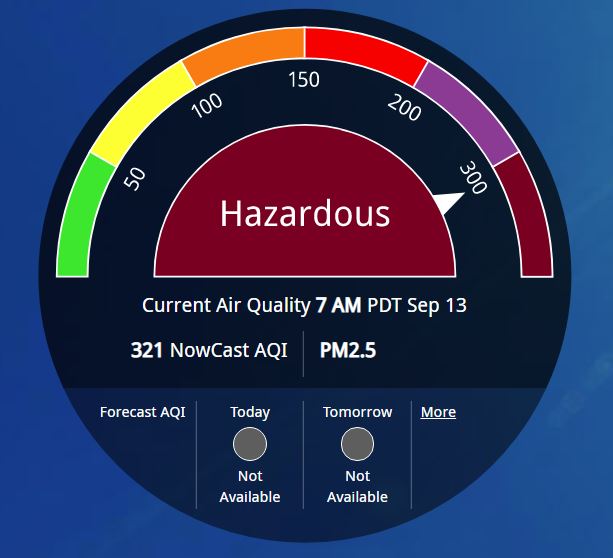
With wildfires raging across the West many of us are experiencing nasty air pollution, the most obvious being the gray-brown smoke that settles in every valley. But much of the issue with polluted air involves the invisible stuff, the tiny particulates that you don’t see and don’t notice you are breathing in.

The EPA measures these particulates when determining the Air Quality Index for an area. One of the standards involves particles that are less that 2.5 microns in diameter. A “micron” is another way to say “micro-meter” which means 10-6 of a meter (0.000001). So 2.5 micrometers (µm) is 0.0025 millimeters (mm) or about one ten-thousandth (0.0001) of an inch. That’s about the size of a bacterium.

The standard involves expressing a particle density as µg/m3, or micrograms per cubic meter. Something on the order of 35 µg/m3 is considered unhealthy for sensitive groups, 55 µg/m3 is considered generally unhealthy, and 150 µg/m3 is very unhealthy.

This is just the PM 2.5 standard. The AQI involves other inputs like carbon monoxide and such. But I want to look at just the fine particulates because of this outfit called PurpleAir.

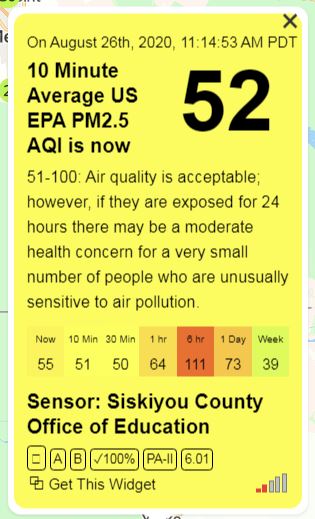
PurpleAir makes sensors that anyone can purchase and begin monitoring their air quality. They also have a network where the data from the sensors can be accessed in real time. I discovered on their map page that my next door neighbors, the Siskiyou County Office of Education, has a sensor installed. In fact, they are installed at schools all over the County!

There’s a circle on the map with a number (PM 2.5 in µg/m3) and if you click on it you get a couple of pop-ups:

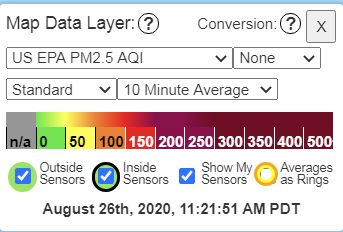
There’s a little + sign in the corner of the map that produces this pop-up:

You can use the pull-downs to change what you see as there are twenty different variables measured such as humidity and temperature as well as different particulate standards.

You can see from the graph that the air here in Yreka has improved quite a bit since midnight last night.

There are a number of health issues associated with breathing particulates so it is good that we can keep track of this and use it to make decisions about our activities. Just because you can’t see or smell smoke doesn’t mean you are immune from its effects!

The EPA also has a site where you can enter your ZIP code and get the AQI and they also have a fire and smoke map.

Copper and Gold

For five bucks you can get a pound of copper and will probably get some change, too.

Not so much with gold. A troy ounce of gold goes for about two grand these days. A “pound” of gold would set you back about twenty-five thousand simoleons! I put pound in quotes because gold is not measured in pounds, at least not the kind of pounds we measure ourselves and everything else with. It’s a small point, but a troy ounce is about 31 grams whereas as an everyday common ounce (1/16 of an everyday common pound) is about 28 grams. The everyday common system we use for most things is called avoirdupois.

Gold has its own system, and there are twelve troy ounces to a troy pound which comes out to about 373 grams. An avoirdupois pound (sixteen ounces) is about 454 grams.

So it is hard to compare a pound of gold—twelve troy ounces—with a pound—sixteen avoirdupois ounces—of anything else. Other precious metals like silver and platinum use the troy system, but more pedestrian materials like copper use the pounds we are familiar with.

Now gold is interesting stuff. It is durable. It doesn’t lose its luster. It doesn’t oxidize or tarnish. It can be beat into most shapes including thin foils and it can be drawn into wire. But its too soft to really work with so it has to be alloyed with something like silver, copper, nickel, or zinc. American Gold Eagles, for example are 22 karat or not quite 92% pure (22/24 = 0.91666…).

Eagles are about 3% silver and about 5% copper.

Copper is the only other colored metal besides gold. Colored other than silvery-grey, that is! Copper is incredibly useful. In fact, our entire modern world could be said to be built on copper since it is required in all electrical devices and all electrical wiring. Think about your complete immersion into the electrical world. Don’t worry, you are not alone. We are all there with you. Our lives are entirely dependent on our electrical system. No copper, no electricity. No electricity, no modern civilization.

Gold has messed with the minds of men for millenia. I live in the Golden State, and that does not just describe the color of our sunsets or of our sun-baked grasslands. Driving the back roads of the county this morning we encountered tailings piles that would take an army of dump trucks to move that were washed off the hillsides 150 years ago. El Dorado infected more than just the conquistadors.

Copper, like gold, is found in its native state, that is as a pure metal and not as a compound. Iron has to be extracted from ore, for example, as does aluminum. Ancient peoples knew all about copper. Copper dulls over time, as do bronze and brass, the well-known alloys. Patinas on bronzes, for example can be part of their charm. Copper kitchenware and things like brew kettles have to be cleaned and buffed to keep their shine. I particularly like the reddish cast of copper and the so-called “pink” or “rose” gold alloy is usually 18-karat and thus 75% gold with 25% copper (18/24 = 0.75).

Gold gets a lot of attention these days. In times of uncertainty people invest in gold. Or hoard it!

But copper is deserving of a place in the pantheon. We can live our whole lives and never need an ounce of gold. The average American, to live at his or her preferred standard of comfort, will require about thirteen pounds of copper per year. Over a lifetime of 85 years, that’s 1105 pounds. Just think, a THOUSAND POUNDS or half a ton of the stuff!

Good thing it’s only five bucks a pound.

Not-so-wild flowers

People go wild for wildflowers. It’s understandable. I’ve waded into meadow streams to get a close-up look at a tiger-lily, for example, or scrambled over boulders for a dermatitis-inducing encounter with a desert bluebell.

But what about those lowly flowers we see on our walks around the neighborhood? I don’t mean the cultivated ones. Those are just “garden-variety” flowers! I mean the weedy ones that grow along the roadsides, or the edges of parking lots, or in the abandoned lots.

We see this one all the time:

That’s chicory, a member of genus Cichorium. The local species is probably C. intybus, but I don’t really know. Locals call almost any showy blue flower a “bachelor’s button” but that common name is usually reserved for a thistle (Centaurea cyanus) with clusters of small flowers making up the head of the plant. The cultivar, the one the home gardener plants, is called blue cornflower

Chicory flowers are sometimes called “blue sailors.” The plant is often known as “coffeeweed” because the roots of some varieties are roasted and used to flavor drinks. An ersatz coffee can be made from them as well.

Chicory is a noxious weed in some places and forage for livestock in others. It’s an alien, originating in Europe, and like our cattle and horses probably came over with the conquistadors. I’m a descendant of aliens (my grandparents were immigrants), so I can appreciate a hardy survivor.

And these plants are hardy. It’s hot and dry, very hot and dry, during their flowering season. And the rest of the year it’s cold. And dry. Did I mention dry? As in arid?

Cichorium intybus is a relative of the dandelion, the daisy, and the sunflower. The family is called Asteraceae by botanists. “Aster” is Greek for “star.” It’s the largest family of plants, worldwide, with over 23,000 known species. When I took botany (in 1980!) the official name was Compositae, which described the bunching of little florets into one flower, much like you see in a sunflower.

Next time you are near a road cut, embankment, verge, weedy field, or other disturbed area, look for chicory. Those blue sailors came a long way to put on a show for us.

Trumpet-creeper

We call it trumpet-vine but according to Jepson the common name is trumpet-creeper. Botanically it is Campsis radicans and is a member of the Bignoniaceae or Bignonia family which includes catalpa and jacaranda.

Here’s a snap from today, on the southwest corner of the house:

You can see the bee on one of the petals. The spectacular flowers always attract bees and of course hummingbirds. They are a little harder to photograph!

You can’t kill these plants and you don’t have to water them. In fact, they seem to thrive on abuse. They are perennial and you have to cut them back as they will quickly take over if there is something to climb on. They stick to walls and can damage the paint.

They have a disheveled appearance and the confusion of shoots and branches makes them hard to prune artfully, but they produce these remarkable flowers in big clusters regardless.

California is mostly desert, and even in the rainier and snowier spots of the state the summer rainfall is next to nothing. Plants that can thrive in drought conditions in the full, harsh glare of the sun are special creatures.

Campsis radicans is native to North America and it was originally confined to New England and the Midwest but has now become established in the West. In the warm, wet South it is a tenacious pest and has to be controlled. We don’t have that problem in our arid corner of the country! The name, by the way, means “flexible root.”

The Border

Don Winslow is the spawn of an unholy alliance between Mickey Spillane and Tom Clancy. He writes thrillers with the astonishing verisimilitude and obsession to detail of the latter, and the lean, macho, karate-chop style of the former.

I highly recommend it.

Winslow’s The Border is the final act in a three-part tragedy that began in 2005 with The Power of the Dog which was followed by The Cartel in 2015.

The subject of the novels is the Mexican drug trade. Or, more properly, the American response to the American drug problem. We import the goddamn stuff, it is entirely our fault that Mexican drug cartels exist, but we like to think it is Mexico’s problem. It is, sadly, Mexico’s problem. Their country is overrun by these ruthless fucking gangsters, but they are only rich and powerful because of America’s insatiable hunger for the drugs they export.

It is also true that the American powers-that-be are perfectly happy to let drugs into the country. Because the drugs make junkies and addicts and users and all of them can be rounded up and placed in some sort of detention. That industry employs thousands of deputies, policeman, border patrol officers, prison guards and whatnot. The pushers and dealers and mid-level brokers get collared as well and they fill our penitentiaries up and keep them in business.

Drugs are big business, and the business of America is business, right? We’ve spent one TRILLION dollars in the last fifty years in this country fighting the War on Drugs. It’s all a joke. It’s just a big make-work program for law enforcement. Drugs are not only cheaper and more available, they are also far more potent.

We’ve lost the war. The defeat is so resounding and complete that we pretend the War never happened. Assholes like Benito Mussolini (I cannot type the name of the current occupant of the White House so I use an historical parallel) continue to spew their Old Testament jive of “get tough and lock ’em up” which never worked, doesn’t work, and won’t work in the future.

Don Winslow is not for the faint of heart. The Border is a grim and savage tale. There’s a thin string of hope, of course, Winslow is too good of a story-teller to leave us defeated. And he raises too many good points about the War on Drugs to ignore. This continued folly—our misguided public policy on drugs—is the central message of the trilogy.

It’s also just damn good crime fiction that’s impossible to put down.

It takes energy to make energy

Chevron Corporation is one of the biggies. The California-based company has over 60,000 employees and revenues around $200 billion. They supply a lot of the gasoline that Californians burn in their automobiles.

Much of the crude oil that Chevron refines into gasoline comes from their holdings in Southern California, in particular the Lost Hills Oil Field in Kern County. Many Californians are not aware of the long oil history in their home state. Vast deposits of petroleum remain underground, as well as offshore, despite decades of extraction.

Pump jacks are a familiar sight in the Central Valley and Los Angeles Basin. Those big bobbing levers run all day and all night, sucking up the oil and sending it to pipelines. They are machines, so they require energy to run.

Chevron has the solution: solar panels!

That’s right, Chevron, the oil major, is using solar electricity to run its pump jacks at Lost Hills!

That’s sort of like the Kentucky Coal Museum installing rooftop solar, right?

Funny, but in a good way. Southern California is a good place for solar. Lots of sunshine and lots of flat ground and open space. So, it is smart of Chevron to do this. Not to mention they’re likely getting carbon credits for doing it! See, that’s how to make pumping oil “carbon-neutral,” just use solar energy.

Economics and politics aside, it’s a good illustration of A Really Important Idea In Physics, namely, it takes energy to make energy. In fact, that may be the most important physics concept for everyone to understand.

It takes energy to make energy. The energy we actually use, from the food we eat to the diesel that powers the delivery trucks to the gas turbines that generate electricity, is refined, in a sense, from another form of energy. And every step in the conversion process is wasteful. Energy is lost in the sense that it can’t do any more useful work. It just becomes waste heat.

We know the solution to the climate crisis is to reduce our carbon dioxide emissions. But we know the only way to do this is to reduce our use of fossil fuels. That’s not going to happen fast enough. Alternative energy sources can’t replace many applications of fossil fuels, unless of course you include nuclear fission. That may be high on the energy density chart but it is low on the public acceptance chart.

So, solar panels pumping oil is not a bad notion. It may seem perverse, or ironic, that Chevron can improve its “green rep” by doing this, but since it takes energy to make energy, I’m all for it.

The signal and the noise

I like “Ask Marilyn.” She usually has an interesting take on a simple question. Last week in Parade magazine she addressed the phenomenon of pareidolia, which is seeing or hearing things that aren’t there.

I will often think I am hearing a song or a radio commercial when there is no source for either. When I track the sound source down it is often something like the hum from fluorescent lights or a ceiling fan. Even the rumbling of a refrigerator’s compressor will do the trick. Somehow my brain is creating a signal out of the noise.

It’s sort of like seeing a giraffe in the clouds or a dragon in an aurora. We do it all the time. Humans like patterns and we like to make meaning out of the sensory barrage we experience. Unfortunately we experience a lot of noise, that is, a lot of random stuff. We don’t like random stuff, we like order and structure, so (apparently) our minds supply the missing pieces and give us a meaningful picture or sound instead of a mess.

In radio telephony the signal-to-noise ratio is a comparison of the strength of the desired information (signal) to the background interference (noise). Think of the signal as what you desire to hear or otherwise interpret and the noise as the rest of the crap that you have to filter out.

We do this in a crowded bar when we focus on our neighbor’s words and tune out the cacophony produced by the rest of the patrons.

But pareidolia is the opposite. In this case we are supplying the signal. It’s not there! All that’s there is noise but we are determined to make sense of it and so we plug in some kind of hallucination.

Gamblers do this. Lousy gamblers, anyway. They see a randomly generated sequence like throws of the dice or fall of the cards and imagine a pattern emerging. Then they bet on an expected outcome based on that pattern. The pattern isn’t there, of course, that’s why Las Vegas casinos make so much money. Assuming the roulette wheel is “fair,” that is, every number has an equal probability of having the ball land in its slot, there is no pattern to the results. No one can guarantee the wheel is perfectly random, but it can be made random enough so that the outcomes are indistinguishable from pure randomness.

Even random number generators are just approximations of randomness. “True” randomness would have to be something natural, or perhaps I should say something physical. These days “natural” is too loaded, making one think of hand-churned butter or turd-fertilized tomatoes.

From RANDOM.ORG:

A really good physical phenomenon to use is a radioactive source. The points in time at which a radioactive source decays are completely unpredictable, and they can quite easily be detected and fed into a computer, avoiding any buffering mechanisms in the operating system. The HotBits service at Fourmilab in Switzerland is an excellent example of a random number generator that uses this technique. Another suitable physical phenomenon is atmospheric noise, which is quite easy to pick up with a normal radio. This is the approach used by RANDOM.ORG.

These folks are looking for the noise! That’s un-natural, man. People are much better at seeing the signals.

I think we all like to believe that there are meaningful patterns in things that are really closer to being random. I like crime fiction and cop shows and a well-worn trope in both is the grizzled vet who always says “there are no coincidences” or something similar. The problem is that in real life there are heaping piles of coincidences. Things that are mostly just luck (random chance can be good or bad) take on significance because of nothing more than coincidence. A quick look at the probabilities of each (independent!) event would make the coincidence just that, something remarkable but not otherwise meaningful.

I like baseball. Baseball fans attach significance to almost everything. A batter is 60-for-300 on the season but gets a start against a pitcher because he went 5-for-11 against him last season. A guy gets six hits in two games and he’s “on a hot streak” and you just know he will get three more hits in today’s game. It turns out that if you make a chart of a guy’s hits, like hash marks on a calendar each day, it will be indistinguishable from one generated by a computer that knows the player’s batting average. You could even simulate it with dice rolls. The “patterns” created by the human player won’t look any different from the “patterns” in the simulations. They will differ in the details, but overall you won’t be able to pick out a chart made by dice or by a real hitter.

So I say beware of the signal and the noise. It is hard enough to sort out what you want from the background of everything else, and now we know that our brains don’t help because they like to make shit up!
1:100

The United States of America has about 340 million people. There are about 3.4 million confirmed cases of COVID-19 infection.

That’s 1 in 100.

For some places, like here in Siskiyou County, the ratio of cases to the population is quite different. We’ve got about 43 thousand folks here and 43 positive tests.

That’s 1 in a 1000.

Obviously there are places where the rate is much higher. LA county has 10 million residents and 140 thousand cases.

That’s 14 in a 1000, or 1.4 per 100.

That’s the problem, of course. Urban areas are more naturally impacted by a pandemic. Viruses don’t move, they need a host to get around. In crowded places (like New Orleans and New York City) it stands to reason that the virus will spread more easily.

So when I say 1:100 Americans have been infected that’s a broad generalization. It doesn’t apply to every region.

That does not make it any less alarming!

Germany has 83 million people and 200 thousand cases or 1:415.

The UK has 67 million people and 300 thousand cases or 1:223.

Sweden has 10 million people and 76 thousand cases or 1:134.

We may be, at this time, relatively safe here in Siskiyou County. After all, 1:1000 is ten times better than 1:100! But people move around. They travel. They visit friends and family. They do business outside of their homes. Not to mention that people in “hot spots” like to get away from there and go someplace safer. Someplace like Siskiyou County!

I like 1:1000 and I hope we can keep it that way. But I’ve got my doubts. I feel the inexorable pull of 1:100.

Tell me I’m wrong. Tell me I need not be concerned.

(Here’s the source of the country numbers. I used the county public health websites for the in-state numbers.)

An apple a day

That’s me. Well, most days. Monday through Friday, when I’m home, I have the same lunch: quesadillas, sweet peppers, and an apple.

We see mostly Fuji and Gala in the organic produce section at the supermarket. They come a dozen to a bag and are usually on the shelf all year. They grow apples all over the world so you can have ones ready to eat regardless of the season. That’s one of the benefits of globalization. The relentless corporate pursuit of cheap labor, which spurs globalization, has some rotten consequences for local economies, no question. But the flip side is the enlarged marketplace and the increased movement of goods which feed our consumer needs.

American consumers need a lot. Not only are our energy requirements per capita high, the United States is the world’s biggest importer.

But I don’t want to talk about economics. I want to talk about apples. Apparently the next big thing in apples is the Cosmic Crisp®. Yes, that’s right, it’s a registered trademark. Apparently you can patent an apple!

This apple variety was invented at Washington State University and is now a licensed product. They have a marketing arm, Proprietary Variety Management, that expects to generate millions from this patented fruit.

This is not new. People have recognized the need to patent cultivars since the 1930 Plant Patent Act. Many varieties of agricultural products have been bred for commercial exploitation. Cosmic Crisp apples are not GMO, they were “classically bred” which should help their marketing.

Biotechnology firms generally patent a particular technique for modifying an organism, a so-called utility patent which has a different scope than a plant patent. Much of the controversy about GMOs involves what can or can not (or should or should not) be patented under existing laws.

But if you are a kick-ass botany nerd and can come up with a new plant the old-fashioned way you can get a patent and make some money. That’s assuming your new plant is commercially viable, that is, somebody wants to take a risk on planting it and trying to sell the harvest.

The Cosmic Crisp took twenty years to make it to market. You can’t just cross-pollinate and graft and all that stuff, you have to test and test and test again to see if your novel variety can handle the rigors of production. And it better taste good as today’s consumers are much fussier, and there are a lot of competing products.

I’ll report back if I ever get a chance to eat a Cosmic Crisp®!

Interdependence Day

I propose that the day following Independence Day should be celebrated as Interdependence Day. July the Fifth shall henceforth be the day we acknowledge our hopeless interdependence on everyone else.

Here’s why:

That’s where we live. We have no other place to go. We are all here sharing the same lifeboat. Outside of Spaceship Earth there is the void of space which is hostile to our kind and the other kinds of life we know about.

Think about what it takes for you to read these words. The infrastructure necessary is vast and complex and requires the efforts of many, many people to keep working. Imagine, at breakfast, how many people, how many machines, how much electricity and fuel, and how many businesses and other entities are required to provide you with toast, eggs, and orange juice.

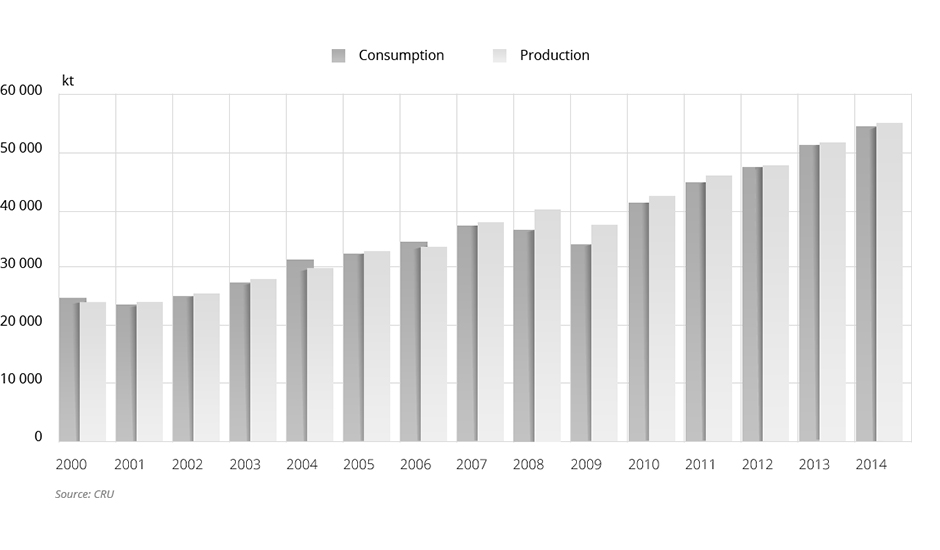
One of the biggest commodities the human race needs to prosper on this planet is iron ore. From iron ore we get steel and steel is needed for way too many things for me to list.

The world needs about two billion tons of iron ore every year. Two billion tons! Most of it comes from Australia, Brazil, and China, but both the US and Canada each produce about 50 millions tons of iron ore annually. That 100 million tons from us and our neighbor is only five percent of the world supply, but every little bit counts.

There’s a mine in Canada in northern Quebec that needs a 261-mile (420-kilometre in Canadian) dedicated railway just to haul the products (ore concentrates) to the port for shipping. And that’s nothing: there’s another rail line in Brazil for iron ore that’s 554 miles long (892 km)!

And those represent a small fraction of the world’s production of just ONE commodity. Look at all the effort and trouble, not to mention expertise, that people put into digging this stuff out of the ground! It’s amazing, if you think about it. That computer case at your feet and that car in your driveway would not exist without the many thousands of people working in the mining sector. Plus all the people who turn the raw materials into products and ship them all over the world.

The human race lives a precarious existence on this third rock from the sun. All the stuff we need to survive is made by all of us, all over the world. And it takes all of us to pass it around and make sure it gets where it needs to go.

We are hopelessly interdependent. Our societies are too complex for any one person, they only survive and thrive because of the sum total of all of us.

July the Fourth celebrates our need for identity and personal liberty. Those are beautiful things.

But those aren’t possible without the human social structures underneath and the web of connections that bind us all together and make us dependent on each other.

Happy Fifth!